Singapore Airlines turbulence: why climate change is making flights rougher
What matters in science |

Is this your brand on Milled? Claim it.
|
|||||
|
|||||
|
Hello Nature readers, |
|||||
|
|||||
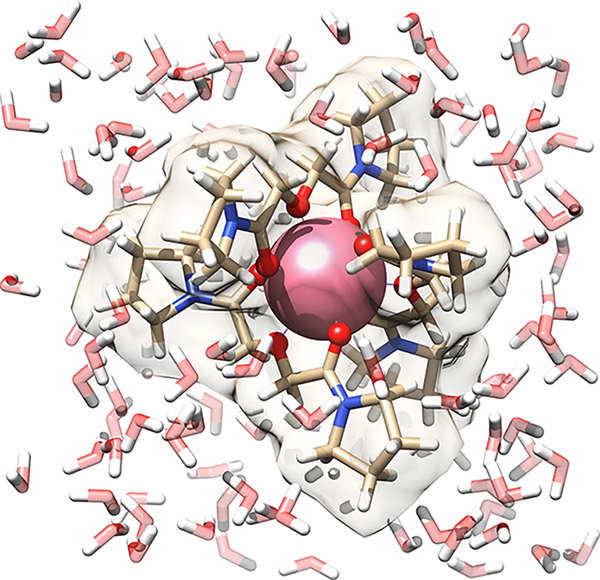
| The first ‘complex’ of promethium (pink, centre) allowed scientists to study how the radioactive element bonds with other atoms in water (shown as pink and white bent tubes). (D. M. Driscoll et al./Nature) | |||||
Elusive element coaxed into compoundPromethium, a rare and mysterious radioactive element from the far reaches of the periodic table, has been made into a ‘complex’ for the first time. In this type of compound, promethium is bound to a few surrounding molecules. “It’s a tour de force,” says chemist Polly Arnold. The feat fills a long-standing gap in our knowledge of chemistry and could lead to better methods for separating promethium from similar elements in nuclear waste, for example. Nature | 5 min readReference: Nature paper |
|||||
Climate change is making flights rougherIn a rare incident, severe turbulence on a Singapore Airlines flight this week left one person dead and injured more than 70 people. “For anyone not wearing a seatbelt it would have been a bit like being on a rollercoaster without any restraint in place — it would have been terrifying,” says atmospheric researcher Paul Williams. Some scientists say that climate change is making clear-air turbulence more frequent and severe. “It is not that we’ll have to stop flying, or planes will start falling out of the sky,” says Williams. “I’m just saying that for every 10 minutes you’ve spent in severe turbulence in the past, it could be 20 or 30 minutes in the future.” A technology called LiDAR could let pilots identify cloudless turbulence that current radar systems miss, although it’s still expensive and bulky. Nature | 5 min read |
|||||
Bizarre bacteria scramble workflow of lifeBacteria have stunned biologists by reversing the usual flow of information. Typically genes written in DNA serve as the template for making RNA molecules, which are then translated into proteins. Some viruses are known to have an enzyme that reverses this flow by scribing RNA into DNA. Now scientists have found bacteria with a similar enzyme that can even make completely new genes — by reading RNA as a template. These genes create protective proteins when a bacterium is infected by a virus. “It should change the way we look at the genome,” says biochemist and study co-author Samuel Sternberg. Nature | 4 min readReference: bioRxiv preprint (not peer reviewed) For more coverage of the most abundant living entities on our planet — microorganisms — and the role they play in health, the environment and food systems, update your preferences to sign up to our free weekly Nature Briefing: Microbiology. |
|||||
A Chinese-language ChatGPTThe Chinese-made chatbot ChatGLM performs as well as ChatGPT on many measures and even outperforms it in Chinese, say its creators. Models that are tailored to different languages avoid “oversimplifying or neglecting the specific characteristics of certain languages and cultures”, says machine-learning specialist Adina Yakefu. Although ChatGPT and many of its rivals can respond in a variety of languages, most of them are built by US companies and mainly use English. By contrast, ChatGLM is designed to work in both Chinese and English. Nature | 7 min read |
|||||
|
|||||
Egypt’s stunning Egyptology mega-museumA sprawling complex with a view of the Pyramids of Giza will be the world’s largest museum and research centre devoted to a single civilization. It will house iconic artefacts such as King Tutankhamun’s armour and the oldest surviving wooden boat — a funeral barge belonging to Pharaoh Khufu. One of the museum’s aims is to take back some control of the study of Egyptology, a field that has long been entangled with historical colonialism. Yet some scholars wonder how the array of influences, including a near US$1-billion construction loan from Japan and the Egyptian army’s oversight of the project, will shape the facility’s future. Nature | 14 min read |
|||||

|
|||||
| The Grand Egyptian Museum exterior, the Grand Staircase, a statue of Ramses II in the lobby and a large vehicle transporting the first Khufu boat to the museum in 2021. (Rehab Eldalil for Nature, Fareed Kotb/Anadolu via Getty, Xinhua/Shutterstock) | |||||
Can maths solve social-justice problems?The rigour of mathematics can help to identify, and sometimes even implement, solutions for problems such as social inequality or racial profiling. “One of the things that makes us mathematicians is our skills in logic and the questioning of assumptions,” says Carrie Diaz Eaton, whose work supports underserved communities in accessing much-needed resources. Mathematicians researching social justice say that helping to create real-world change can be tremendously gratifying. The important thing is to learn the language of new fields and listen to community leaders, activists and people affected by the issues. Nature | 11 min read |
|||||
Video: When heat hardens metalMetals don’t always soften as they get hotter. Researchers discovered that heated metals behave in counterintuitive ways when they are shot with laser-powered micro-bullets. Under these extreme impacts — comparable with those from high-speed meteorites — pieces of copper, titanium and gold heated to higher temperatures were stronger than those not warmed up as much: the bullets created smaller craters and bounced away more. The effect could lead to new strategies for designing devices, for example in aerospace engineering. Nature | 3 min videoReference: Nature paper |
|||||
Quote of the day“Nearly every session evolves into a heated debate about diverting resources to make a new ‘Earth’ instead of fixing the one we have.”Role-playing games, such as one about colonising Mars, can help us think through the complex decisions we will all face as the world warms, says education researcher Sam Illingworth. (Nature | 5 min read) |
|||||
|
|
|||||
|
|||||
|
|
|||||
|
Want more? Update your preferences to sign up to our other free Nature Briefing newsletters:
|
|||||

|
|||||
ACCESS NATURE AND 54 OTHER NATURE JOURNALS
|
|||||
|
|||||
|
You received this newsletter because you subscribed with the email address: - Please add [email protected] to your address book. Enjoying this newsletter? You can use this form to recommend it to a friend or colleague — thank you! Had enough? To unsubscribe from this Briefing, but keep receiving your other Nature Briefing newsletters, please update your subscription preferences. To stop all Nature Briefing emails forever, click here to remove your personal data from our system. Fancy a bit of a read? View our privacy policy. Forwarded by a friend? Get the Briefing straight to your inbox: subscribe for free. Want to master time management, protect your mental health and brush up on your skills? Sign up for our free short e-mail series for working scientists, Back to the lab. Get more from Nature: Register for free on nature.com to sign up for other newsletters specific to your field and email alerts from Nature Portfolio journals. Would you like to read the Briefing in other languages? 关注Nature Portfolio官方微信订阅号,每周二为您推送Nature Briefing精选中文内容——自然每周简报。
Nature Portfolio | The Springer Nature Campus, 4 Crinan Street, London, N1 9XW, United Kingdom Nature Portfolio, part of Springer Nature. |