Skin might have an immune system of its own
What matters in science |

Is this your brand on Milled? Claim it.
|
|||||
|
|||||
|
Hello Nature readers, |
|||||

|
|||||
| In mice, the skin was able to generate an immune response even when lymph nodes — the immune hubs that help to activate immune cells — were disabled. (kazuma seki/Getty) | |||||
Skin has its own immune systemThe skin seems to be able to produce its own antibodies to keep microbes in check. “When the immune system sees a friendly bacterium, you would think that it would just give a friendly wave and walk in the other direction, but that’s not at all what happens,” says microbiologist and study co-author Michael Fischbach. In mice colonized by Staphylococcus epidermidis, a common and harmless bacterium found on human skin, the skin was able to generate antibodies even when other parts of the immune system were disabled. And this surprise power might be harnessed to fight pathogens: when researchers modified S. epidermidis to display part of the tetanus toxin, the skin response protected mice from a lethal dose. Nature | 5 min readReference: Nature paper 1 & paper 2 |
|||||
US and China sign narrower science pactThe United States and China have signed a five-year agreement that dictates how the nations will cooperate on science and technology research. It’s a new version of a pact forged in 1979 and normally renewed every five years — but which expired last year amid rising tensions. The new deal covers collaboration on basic science projects between departments of the two governments and excludes work on technologies that could be important to national security, such as artificial intelligence. Unlike the previous iteration, it doesn’t include any information on collaboration between universities or private companies. Nature | 5 min read |
|||||
Intermittent fasting slows luscious locksIntermittent fasting, a weight-control regime that involves only eating at certain times, triggers a stress response that can slow hair growth. Shaved mice subjected to intermittent fasting regrew less hair in three months than those that ate a similar number of calories with no time restrictions. Researchers traced this effect to the death of hair-follicle stem cells. The regime seemed to have a similar effect on people: hair growth in around two-dozen human intermittent-fasters was 18% slower than in a control group. Nature | 5 min readReference: Cell paper |
|||||
‘Neutrino fog’ reveals and obscuresFor the first time, physicists have observed glimmers of the ‘neutrino fog’, signals from particles called neutrinos that mimic those expected to be produced by dark matter — the mysterious substance thought to make up the bulk of matter in the Universe. That’s exciting for physicists because it means that detectors have become sensitive enough to pick up signals of dark matter. But there’s a catch: the neutrino signals could obscure the dark-matter signals that scientists are so eager to observe. Nature | 5 min readReference: Physical Review Letters paper 1 & paper 2 |
|||||
|
|||||
Encouragement from Kim Stanley RobinsonScience-fiction writer Kim Stanley Robinson, who authored the classic Mars terraforming trilogy, offered a vision of how to keep Earth habitable in his influential 2020 climate-change novel, The Ministry for the Future. “People are hungry for the feeling that everything could work out OK if we do things right. The book serves as a kind of encouragement,” he says. “At the same time, the start of the novel is so awful that it reproduces the feeling of climate dread. Really, I don’t even like to look at those pages again.” His message to undergraduates is to turn climate dread into purpose. “Whatever you’re interested in, whatever your personal interests are, that can become climate work.” Nature | 8 min read |
|||||
CRISPR patents block India’s farmersEarly in his career, biotechnologist Anurag Chaurasia helped lead a project to develop genetically modified, pest-resistant Bt cotton. But the patent on the relevant Bt gene was held by the agrochemical company Monsanto (now owned by Bayer). “Ultimately, Indian farmers could not reap the benefits of state-subsidized seed varieties; those using Bt cotton now rely on expensive proprietary seeds,” writes Chaurasia. “Having witnessed one failed project, I urge scientists in low- and middle-income countries to pay more attention to who owns CRISPR–Cas9 patents and under what terms they are willing to license this innovation.” Nature | 5 min read |
|||||
Walking the greatest journey ever takenPulitzer-prizewinning journalist Paul Salopek is on the walk of a lifetime: covering the 38,000-kilometre route along which ancient humans are thought to have migrated from Africa, through Asia, all the way to the southern tip of South America. Salopek started in 2013 in Herto, Ethiopia; home to some of the oldest known fossils of modern humans. In his latest update, he is in Seoul, South Korea — around the same time that a political crisis came to a head with the declaration of martial law by president Yoon Suk Yeol. National Geographic | 5 min read |
|||||
|
|||||
|
|||||
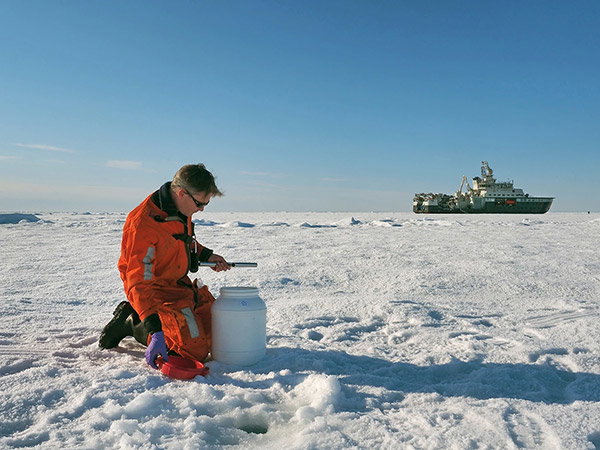
| Physical oceanographer Paul Dodd and his team study the Central Arctic Ocean’s sea ice and salt water in readiness for an influx of people. “Twenty years ago, few people thought there would be much new human activity around the Arctic Ocean, but it could now become an economically productive area as the climate warms,” he says. “We expect people to do more fishing and tourism in the area, and we need to be prepared for that.” (Nature | 3 min read) (Ann Kristin Balto, Norwegian Polar Institute) | |||||
Quote of the day“I find him laughable in many ways — except, of course, that he’s a danger to public health.”Physician-scientist Stanley Plotkin, who developed the rubella vaccine, responds to news that lawyer Aaron Siri, an advisor to health-secretary nominee Robert F. Kennedy Jr., has petitioned the US government to revoke its approval of one of the greatest scientific achievements of all time: the polio vaccine. (The New York Times | 10 min read) |
|||||
|
|
|||||
|
|||||
|
|
|||||
Free newsletters from NatureWant more? Update your preferences to sign up to our other Nature Briefing newsletters:
|
|||||
Access Nature and 54 other Nature journals
Nature+ is our most affordable 30-day subscription, giving you online access to a wide range of specialist Nature Portfolio journals, including Nature. |
|||||
|
|||||
|
You received this newsletter because you subscribed with the email address: - Please add [email protected] to your address book. Enjoying this newsletter? You can use this form to recommend it to a friend or colleague — thank you! Had enough? To unsubscribe from this Briefing, but keep receiving your other Nature Briefing newsletters, please update your subscription preferences. To stop all Nature Briefing emails forever, click here to remove your personal data from our system. Fancy a bit of a read? View our privacy policy. Forwarded by a friend? Get the Briefing straight to your inbox: subscribe for free. Want to master time management, protect your mental health and brush up on your skills? Sign up for our free short e-mail series for working scientists, Back to the lab. Get more from Nature: Register for free on nature.com to sign up for other newsletters specific to your field and email alerts from Nature Portfolio journals. Would you like to read the Briefing in other languages? 关注Nature Portfolio官方微信订阅号,每周二为您推送Nature Briefing精选中文内容——自然每周简报。
Nature Portfolio | The Springer Nature Campus, 4 Crinan Street, London, N1 9XW, United Kingdom Nature Portfolio, part of Springer Nature. |