Sperm whales in the Med have different dialects
What matters in science |

Is this your brand on Milled? Claim it.
|
|||||
|
|||||
|
Hello Nature readers, |
|||||
|
|||||
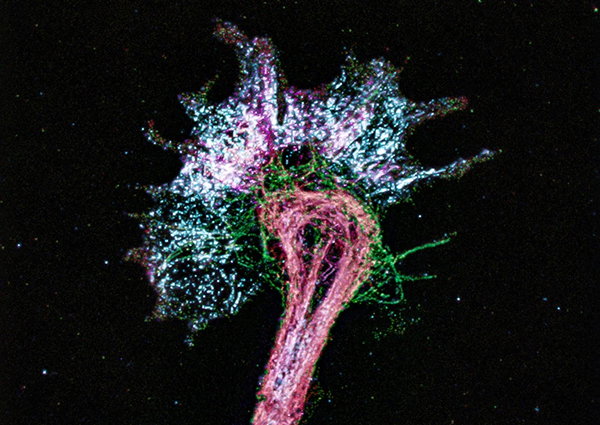
| Using a polymer similar to that used in super-absorbent diapers, scientists have expanded the volume of biological samples — such as this nerve cell — so they are one billion times bigger. (Arthur Chien/SPL) | |||||
How to embiggenate proteins 1,000-foldResearchers have mapped the position of individual amino acids in proteins using a conventional light microscope. The team used an improved version of a technique called expansion microscopy, which enlarges biological samples by carefully pulling them in every direction. The upgrade expands protein samples up to one billion times their original size — 1,000-fold larger in each dimension. The stretch pulls protein molecules apart to a point that they can be visualized without costly and complicated techniques such as cryogenic electron microscopy. “This is the democratization of structural biology,” says neuroscientist and study co-author Silvio Rizzoli. Nature | 6 min readReference: bioRxiv preprint (not peer reviewed) |
|||||
Europe swelters under extreme heatExtreme heat is disrupting lives across Europe, with yesterday the hottest day ever recorded in France. “We know beyond a shadow of a doubt that heat wave events such as this have been made more likely and more severe due to climate change,” said Peter Thorne, the director of the ICARUS Climate Research Centre in Ireland. “But nevertheless many of the records being set, particularly in the UK and France, are mind-bogglingly crazy.” Reference: WHO statement |
|||||
Sperm whales in the Med have accentsIsolated groups of sperm whales (Physeter macrocephalus) in the Mediterranean Sea seem to have developed their own dialects of their species’ primary social vocalization, a pattern of clicks and pauses. Researchers analysed 20 years of audio recordings and found that whales in the Hellenic Trench, near Greece, use a faster version of the pattern than do whales around the Balearic Islands, between Gibraltar and Italy. YaleEnvironment360 | 3 min readReference: Proceedings of the Royal Society B paper |
|||||
|
|||||

|
|||||
| This flying-saucer-shaped research vessel is the Tara Polar Station, which is designed to drift through the Arctic for years, frozen into the pack ice (its oval shape helps it to resist the crushing pressure of the ice). The 26-metre long vessel — shown here during tests in Finland last winter — will launch from its home port in France next month. (Science | 8 min read) (Maéva Bardy - Fondation Tara Ocean) | |||||
|
|||||
Humanities are not just a nice-to-have“As science and technology race ahead, the world needs humanities research to understand the reasons and implications,” writes historian Xin Fan. At undergraduate level, humanities education fosters skills such as creativity and ethical awareness in science students, and teaches them the social context of their work. Universities and governments must ensure that investment in science and technology doesn’t come at the expense of the humanities. Fan’s institution, ShangaiTech, is leading by example. “The aim is not to oppose science, but to enrich it,” he writes. Nature | 8 min read |
|||||
‘How to learn to accept the unthinkable’When journalist Amanda Petrusich’s baby was only 13 months old, her husband had a fatal seizure, sparking a conflagration of grief. But can grief be so ceaseless that it becomes pathological? And how should this most-universal of injuries be healed? Petrusich delves into the research surrounding debilitating long-term grief and takes stock of emerging treatments, including one that helped her, called eye movement desensitization and reprocessing (EMDR). The New Yorker | 35 min readRead more about the enigmatic mechanisms of EMDR in this Nature News & Views article by neuroscientist Andrew Holmes (10 min read, from 2019) |
|||||
Quote of the day“Ideological extremism is easiest to sustain at a distance.”Public policy researcher Mirya Holman looks at a large-scale experiment in Canada which shows that ideological differences soften when issues are framed as questions about one’s own neighborhood. (Nature Cities | 7 min read) |
|||||
|
|
|||||
|
|||||
|
|
|||||
Free newsletters from NatureWant more? Update your preferences to sign up to our other Nature Briefing newsletters:
|
|||||
|
|||||
|
You received this newsletter because you subscribed with the email address: - Please add [email protected] to your address book. Enjoying this newsletter? You can use this form to recommend it to a friend or colleague — thank you! Had enough? To unsubscribe from this Briefing, but keep receiving your other Nature Briefing newsletters, please update your subscription preferences. To stop all Nature Briefing emails forever, click here to remove your personal data from our system. Fancy a bit of a read? View our privacy policy. Forwarded by a friend? Get the Briefing straight to your inbox: subscribe for free. Want to master time management, protect your mental health and brush up on your skills? Sign up for our free short e-mail series for working scientists, Back to the lab. Get more from Nature: Register for free on nature.com to sign up for other newsletters specific to your field and email alerts from Nature Portfolio journals. Would you like to read the Briefing in other languages? 关注Nature Portfolio官方微信订阅号,每周二为您推送Nature Briefing精选中文内容——自然每周简报。
Nature Portfolio | The Springer Nature Campus, 4 Crinan Street, London, N1 9XW, United Kingdom Nature Portfolio, part of Springer Nature. |