Sugar-rationed babies have less risk of Alzheimer’s, depression and some cancers
What matters in science |

Is this your brand on Milled? Claim it.
|
||
|
||
|
Hello Nature readers, |
||
|
||
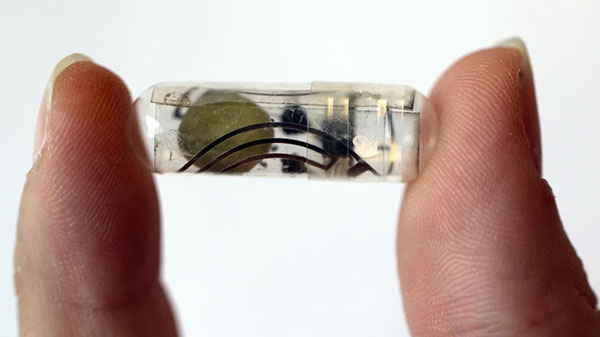
| The cellulose-based coating for this biodegradable battery was partly inspired by the rice-paper wrapping used to protect certain sweets. (Mehmet Say) | ||
Edible battery can power devices in the bodyA battery made with a substance similar to edible rice paper can power ingestible medical devices, and breaks down into materials that can be absorbed by the body after use. The tiny power source uses electrodes made of magnesium and molybdenum trioxide — two micronutrients that the body needs in small amounts — and a biodegradable ionic liquid as an electrolyte. The battery has so far been tested in pigs, with the hope that it could one day be used to provide electricity for ingestible personalized devices in people. Nature | 5 min readReference: Nature Chemical Engineering paper |
||
Epigenetic editing could treat hep BA treatment that adds chemical tags to the genome of the hepatitis B virus (HBV) can shut down the virus’s gene activity and prevent it from producing viral particles. The therapy, which achieved promising results in experiments on human liver cells and in mice, could be used to treat chronic hepatitis B, a lingering liver infection that affects more than 250 million people worldwide. A clinical trial to test the treatment in people is already under way, with the first participant receiving an intravenous infusion in January this year. Nature | 5 min readReference: Nature Biomedical Engineering paper |
||
Dolphin eats fish vomit after fast chaseResearchers have recorded a rare instance of a food-stealing behaviour called kleptoparasitism in a common bottlenose dolphin (Tursiops truncatus). The team filmed the dolphin, known as Bubbles, repeatedly chasing individual bigeye trevally fish (Caranx sexfasciatus) until they threw up — and then eating the vomit. Bubbles might have originally intended to eat the fish, but decided that the vomit was an easier meal, says marine ecologist and study co-author Asia Armstrong. Or, it might have wanted the sick all along, since trevally are large and would be tough for a dolphin to chew. Science | 4 min readReference: Ecology and Evolution paper |
||
|
||
|
||
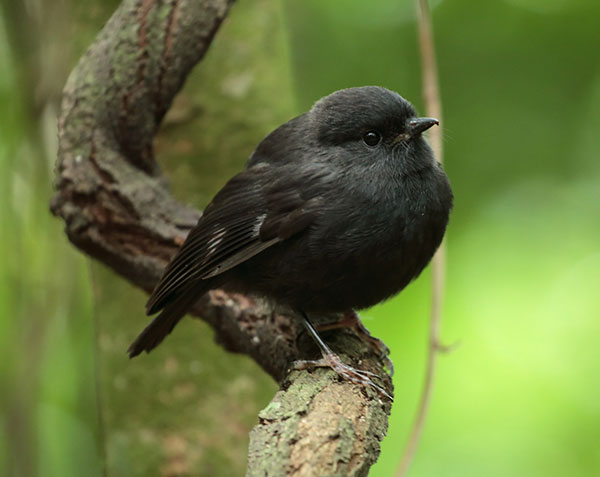
| New Zealand’s Bird of the Year is the karure, or black robin (Petroica traversi), and you can see why: this little creature is small, dark and handsome. This tenacious species has bounced back from just five birds in 1980 — only one of which was a fertile female — to 350 adults living on two islands free of invasive pests. Hats off to Old Blue, mother of her kind. (CNN | 5 min read) (Dave Boyle) | ||
|
||
We must prepare for super El Niño“A serious El Niño caught the world off guard in 1982, when reliable early-warning systems barely existed,” writes climate scientist Zeke Hausfather, who maintains a real-time dashboard that includes data about the weather event. “In 2026, there is no such excuse.” Governments have only a few weeks to act to prepare, for example, for drought in southern Africa. Priorities include distributing drought-tolerant and early-maturing crop varieties in high-risk areas and expanding programmes that provide support when harvests fail. Nature | 7 min read |
||
Sugar-rationed babies saw host of benefitsA study of people who lived their early life during post-war sugar rationing in the United Kingdom found that they had lower risks of all-cause dementia, Alzheimer’s disease, depression and anxiety than people born after rationing ended. A separate study found they were much less likely to develop certain cancers later in life. Even in adulthood, low-sugar babies continued to consume less sugar and had healthier diets overall. “This suggests that the level of sweetness people are exposed to very early in life may shape their taste preferences for a long time,” says economist Weilong Zhang, who co-authored the latter study. People | 4 min read & The Conversation | 6 min readReference: npj Aging paper & PNAS paper |
||
Little red whats?Little red dots (LRDs) sound innocuous, but they present one of the most exciting mysteries in cosmology. Many have been observed, thanks to the unprecedented window into the distant Universe that has been opened by the James Webb Space Telescope. But what are these enigmatic objects from the dawn of time? An initial consensus has coalesced around them involving black holes of some kind — perhaps primitive versions of the active galactic nuclei we see in the more recent Universe. But other, more exotic, theories have also emerged. Nature Astronomy editorial | 6 min read or read the whole LRD collection |
||
Quote of the day“These are not separate emergencies; the planet is telling us, in every region at once, that it is out of balance.”Hindou Oumarou Ibrahim, chair of the Planetary Guardians climate-science advocacy group, responds to the latest Planetary Health Check report. It notes increasing wildfires, floods and other impacts of transgressing seven of the nine ‘planetary boundaries’ — the limits of what Earth can support before human activities make it uninhabitable. (The Guardian | 7 min read) |
||
|
|
||
|
||
|
|
||
|
||
|
If you enjoy this newsletter, please recommend it to a friend or colleague. Click here to forward it by e-mail. Thank you! You received this newsletter because you subscribed with the email address: - To stop all Nature Briefing e-mails forever, click here to remove your personal data from our system. |
||
|
Nature Portfolio | The Springer Nature Campus, 4 Crinan Street, London, N1 9XW, United Kingdom Nature Portfolio, part of Springer Nature. |