Swarm of AI agents find lung-cancer drug candidate
What matters in cancer research |

Is this your brand on Milled? Claim it.
|
||
|
||
|
Hello Nature readers, |
||
|
||
| Artificial intelligence agents can scour data sets and work with large language models to develop drug candidates for cancer. (Eoneren/Getty) | ||
Swarm of AI agents find drug candidateA team of tens of thousands of artificial-intelligence agents has identified a promising lung-cancer drug candidate. The system, called the ‘Virtual Biotech’, comprised up to 37,000 AI agents that worked together as ‘employees’ overseen by an AI ‘chief scientific officer’. The AI agents helped researchers investigate whether a protein called CD276, which dampens immune responses, could be targeted to treat lung cancers. The agents then developed the strategy of tethering a CD276-recognizing antibody to an anticancer drug. But whether the ‘Virtual Biotech’ can emulate real-world know-how, or success in clinical trials, remains to be seen, say some scientists. Nature | 4 min readReference: Science paper (17 September) |
||
Severe mental illness tied to cancer deathsAdults with severe mental illness are more than twice as likely to die from cancer than their peers — and have nearly five times the risk of dying from physical diseases before the age of 75. Severe mental illnesses, such as schizophrenia or bipolar disorder, were also linked with higher rates of poverty, smoking and obesity, and low levels of physical exercise. “Having a severe mental illness shouldn’t be an early death sentence,” says psychiatrist Subodh Dave. “This stark inequality is unacceptable.” The Guardian | 4 min readReference: 'Closing the Mortality Gap' report |
||
In the news
|
||
|
||
Why pancreatic cancer cells construct a webA subset of pancreatic cancer cells protect themselves from attack by creating a sticky extracellular matrix that retains immunosuppressive cells and prevents the entry of immune cells. When the genes that create this extracellular matrix were knocked out in immunocompetent mice, tumour growth was reduced and the number of anticancer T cells increased. Reference: Nature paper (9 September)Go deeper with this Nature Research Briefing written by the study authors (6 min read) |
||
Some adults would conceal loved ones' cancerAround 30% of adults in Thailand reported that if they were informed that a loved one had been diagnosed with cancer, they wouldn’t tell that person. The main reason for withholding the diagnosis was that they believed that receiving such bad news could worsen symptoms and cause fear of pain or death. The study surveyed more than 600 people, of whom around 80% were female. Previous studies have revealed similar trends in China, India and Saudi Arabia. Reference: Scientific Reports paper (20 September) |
||
|
||
Ask the Co-Scientist anythingArtificial-intelligence agents such as Google’s Co-Scientist are helping cancer researchers brainstorm by reviewing and synthesizing vast amounts of information. For example, researchers asked Co-Scientist for practical ways to disable the MYC protein, which is involved in many cancers. Co-Scientist examined more than 700 scientific papers and generated more than 100 strategies — including the idea of gluing MYC-activating proteins together so the DNA could no longer be read. “It’s extremely conceptually compelling,” says bioengineer Kalon Overholt who was involved in the search. “We had certainly never thought about anything like this.” Nature | 13 min read |
||
‘A miracle for him to be here’Twenty-eight-year-old Jya Banks was 14 weeks pregnant when she was diagnosed with advanced Hodgkin's lymphoma. Banks thought she wouldn’t be able to keep the baby and also receive cancer treatment but, with the help of a multidisciplinary care team, she underwent chemotherapy, gave birth to a boy, Harvey, and is now in remission. “A miracle for him to be here,” says Jya's wife, Betha. “We couldn't be happier.” Around one in every thousand pregnant people is diagnosed with cancer. ABC News (Australia) | 5 min read |
||
|
||
|
||
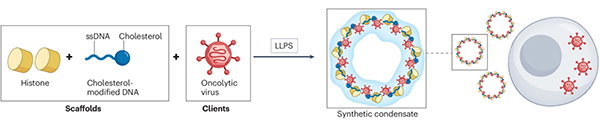
| Researchers are exploring the use of tiny droplets called biomolecular condensates to deliver cancer therapies such as oncolytic viruses to tumours that have historically been considered difficult to drug. View a high resolution version of this image here. (Nature Reviews Bioengineering | 49 min read) (Wang, B. et al./Nat. Rev. Bioeng.) | ||
Quote of the week“Ask any cancer survivor and they will tell you that three things become painfully clear through their diagnosis — their priorities, their purpose and their people.”Being diagnosed with ovarian cancer has given tech worker Pritika Gupta the gift of clarity about her relationships and what matters most in life. (Medium | 7 min read) |
||
|
|
||
|
||
|
|
||
|
||
|
If you enjoy this newsletter, please recommend it to a friend or colleague. You received this newsletter because you subscribed with the email address: - To stop all Nature Briefing e-mails forever, click here to remove your personal data from our system. |
||
|
Nature Portfolio | The Springer Nature Campus, 4 Crinan Street, London, N1 9XW, United Kingdom Nature Portfolio, part of Springer Nature. |