The brain builds a sentence neuron by neuron
What matters in science |

Is this your brand on Milled? Claim it.
|
|||||
|
|||||
|
Hello Nature readers, |
|||||
|
|||||
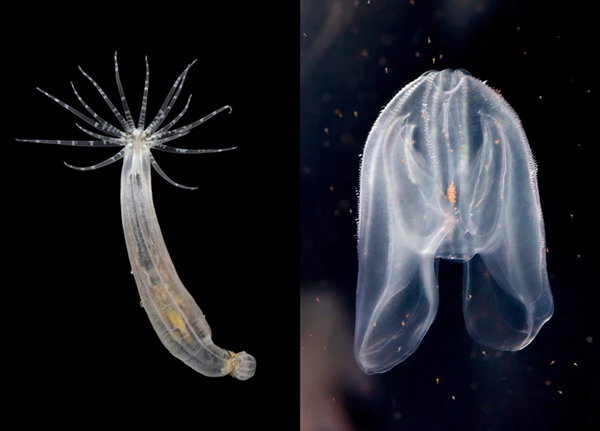
| Researchers transplanted cells between embryos of a warty comb jelly (Mnemiopsis leidyi, right) and a starlet sea anemone (Nematostella vectensis, left) — organisms that belong to entirely different branches of the tree of life. (Paul R. Sterry/Nature Photographers Ltd/Alamy, Phil Degginger/Science Photo Library) | |||||
‘Organizers’ in jellies hint at animal originsResearchers have discovered a new ‘embryonic organizer’ in marine predators called comb jellies (Ctenophora) and successfully transplanted them into sea anemones (Cnidaria). Organizer cells determine an organism’s body axis — a map that plots where various parts of the embryo should develop. After the transplant, the anemones developed a second body axis, complete with extra mouths and pharynxes. The findings support the idea that the emergence of organizing activity was a key step in animal evolution, says evolutionary developmental biologist Ulrich Technau. Nature | 6 min readReference: Nature paper |
|||||
How the brain builds a sentenceResearchers have tracked the electrical activity of individual brain cells during conversation in real time, capturing how sentences are built before a single word is spoken. By observing these neurons in a brain region called the frontotemporal cortex, scientists have discovered that individual neurons act as specialized linguistic building blocks. “We used to think language was this diffuse, whole-network phenomenon,” says neurosurgeon and study co-author Ziv Williams. “But it turns out you have specific neurons that only care if a word is a noun, or only care if a phrase is ending.” Nature | 5 min readReference: Nature paper |
|||||
Post-Brexit research rifts begin to healTen years after the United Kingdom voted to leave the European Union, the UK is set to rejoin Erasmus+, an EU exchange scheme used by PhD students and university staff. And the UK’s share of the EU’s flagship Horizon Europe funding scheme has begun to recover after the country rejoined the programme in 2024. But hurdles remain, such as how much input the UK might have in the next iteration of Horizon Europe, and the country’s increasingly inhospitable visa requirements for researchers and students. Nature | 6 min read |
|||||
Brain freeze lessens stroke damage in miceSharply lowering body temperature with two well-established drugs reduces stroke-related brain damage in mice. Mice given the drugs during a stroke had less dead brain tissue than did those that didn’t receive them, and scored better on a post-stroke neurological assessment. A clinical trial in people showed that the drugs were safe, but ineffective at the doses tested. Researchers are now planning a second trial to administer the drugs to people over a shorter timeframe, which they hope will improve outcomes. Nature | 4 min readReference: Science Translational Medicine paper |
|||||
|
|||||
The great gopher tortoise shuffleTo accommodate the booming population of Florida, housing complexes are popping up left, right and centre. Before construction projects can start, developers are required to relocate any gopher tortoises (Gopherus polyphemus) on the land. More than 97,000 tortoises have been moved around the state since 2009 in an attempt to conserve this vulnerable species. But scientists aren’t sure whether it’s working. The move is stressful for the reptiles, and could introduce them to unfamiliar diseases, both of which can impact their reproduction rates. bioGraphic | 15 min read |
|||||
The first GPS fakersIn her new book Little Blue Dot, energy reporter Katherine Dunn explores how the satellite-based navigation network known as GPS evolved from a military tool to a cornerstone of everyday life. In an excerpt, she tells the tale of engineer Todd Humphreys, who showed that GPS ‘spoofers’ could manipulate the system in dangerous ways, such as to crash a drone or to steal a superyacht. The Walrus | 17 min read |
|||||
Video: 13,000 baby seals killed by bird fluDistressing images recorded on the remote Heard and McDonald Islands in the far south of the Indian Ocean show that more than three-quarters of its young southern elephant seals (Mirounga leonina) have been killed by H5N1 avian influenza. Infections and deaths were also seen among penguin species. The islands make up an uninhabited nature reserve managed by the Australian government. BBC | 6 min read & 30 sec videoReference: bioRxiv preprint (not peer reviewed) |
|||||
Quote of the day“What we’re seeing here is the religion of the stone age made manifest in the ground.”The arrangement of a ‘prototype’ Stonehenge uncovered near the iconic structure aligns with the sunrise and sunset of summer and winter solstices of 5,000 years ago. The finding reinforces the significance of solstice events in the lives of Stone-Age humans, says archaeologist Matt Leivers. (The Guardian | 5 min read) |
|||||
|
|
|||||
|
|||||
|
|
|||||
Free newsletters from NatureWant more? Update your preferences to sign up to our other Nature Briefing newsletters:
|
|||||
|
|||||
|
You received this newsletter because you subscribed with the email address: - Please add [email protected] to your address book. Enjoying this newsletter? You can use this form to recommend it to a friend or colleague — thank you! Had enough? To unsubscribe from this Briefing, but keep receiving your other Nature Briefing newsletters, please update your subscription preferences. To stop all Nature Briefing emails forever, click here to remove your personal data from our system. Fancy a bit of a read? View our privacy policy. Forwarded by a friend? Get the Briefing straight to your inbox: subscribe for free. Want to master time management, protect your mental health and brush up on your skills? Sign up for our free short e-mail series for working scientists, Back to the lab. Get more from Nature: Register for free on nature.com to sign up for other newsletters specific to your field and email alerts from Nature Portfolio journals. Would you like to read the Briefing in other languages? 关注Nature Portfolio官方微信订阅号,每周二为您推送Nature Briefing精选中文内容——自然每周简报。
Nature Portfolio | The Springer Nature Campus, 4 Crinan Street, London, N1 9XW, United Kingdom Nature Portfolio, part of Springer Nature. |