The forensic traces of poachers — the month’s best science images
What matters in science |

Is this your brand on Milled? Claim it.
|
||
|
||
|
Hello Nature readers, |
||
|
||
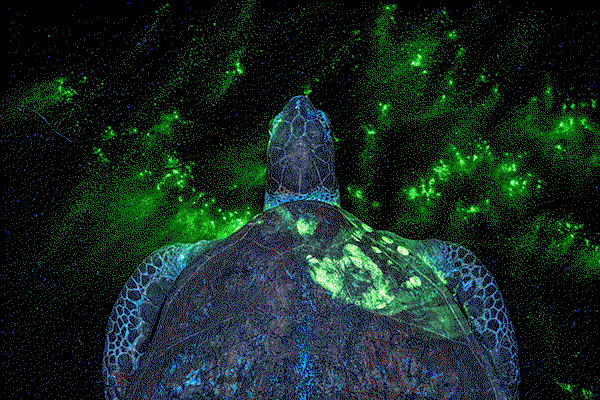
| (Britta Jaschinski, Every Crime Leaves a Trace, 2025, Wildlife Crime Lab, Institute of Zoology (IOZ), London, UK. Earth Photo 2026 Award ) | ||
The month’s best science imagesPhotographer Britta Jaschinski works with border-force operations and wildlife crime units across Europe to document elements of the illegal poaching trade. This striking image of a handprint on the shell of a green sea turtle (Chelonia mydas) confiscated at London Heathrow Airport, UK, was one of Jaschinski’s winning entries in the 2026 Earth Photo Awards. |
||
A greener road to lithium extractionThe demand for lithium has skyrocketed amid a boom in technology that uses rechargeable batteries. The conventional lithium-extraction methods used in Chile and Argentina are inefficient, damage ecosystems and impact local Indigenous communities, say researchers. But a wave of new techniques could make the process greener. The methods use electrochemical processes or heat to extract lithium from naturally occurring brine. These options use less fresh water than existing techniques, and could extract the metal at higher yields, but will require significant investment to scale up. Nature | 5 min read |
||
How smallpox made it to the AmericasViral DNA found in the mummified remains of two people in Chile has confirmed that Orthopoxvirus variola — the virus that causes smallpox — was brought to the Americas by European colonizers. The DNA revealed an unknown smallpox variant, which appeared to have split off from a European variant around the thirteenth century. The variant had fewer genes than did samples found in seventh-century Viking settlements, which suggests that the virus might have shed genes as it adapted to human hosts — a mechanism that related viruses might also be using today. Nature | 4 min readReference: Science paper |
||
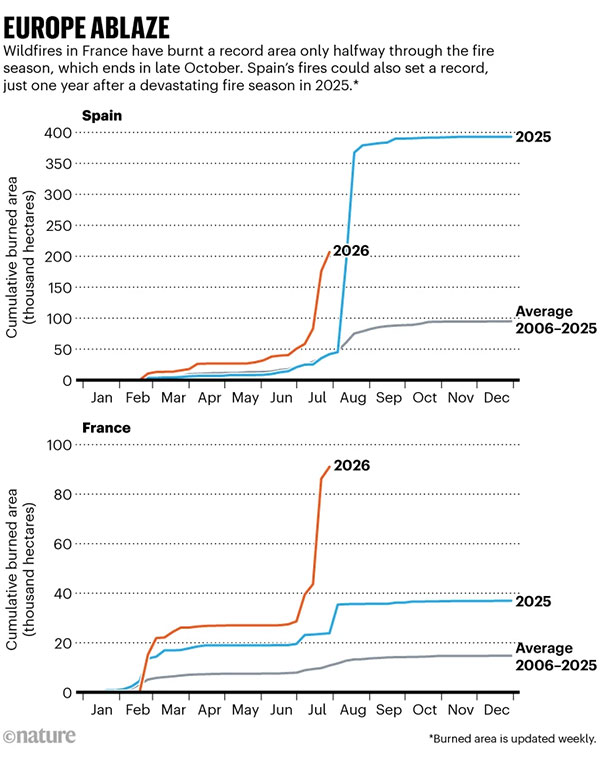
Europe’s wildfire pattern is changingThe wildfires blazing across France and Spain could mark a shift in southern Europe’s fire patterns. As human-induced climate change drives rising temperatures, the region’s fire regime is starting to resemble that of notoriously combustible places such as California, say researchers. The success of fire-suppression efforts has reduced overall wildfire activity in Europe since the 1980s. But the fires in France and Spain this year suggest that hot, dry fire weather is catching up, says meteorologist and study co-author Raúl Cordero. Nature | 5 min readReference: Scientific Reports paper |
||
|
||
|
||
The allergy triggered by tick bitesA tick-induced allergy to meat is on the rise. The condition causes symptoms ranging from mild stomach pain and vomiting to life-threatening anaphylaxis, with no treatment or cure currently available. Researchers say that climate change and rising populations of deer, which often carry ticks, are contributing to the rise in cases, but there is much they still don’t understand. “We’re still casting in the dark, but it is our responsibility to find something that works for people” in need of treatment, says immunologist Benjamin Casterline. Nature | 6 min read |
||
Futures: science fiction from NatureA museum visitor is reminded what climate grief feels like in The past is an open can of worms: a stimulated-memory exhibition. Nature | 6 min read |
||
Five best science books this weekAndrew Robinson’s pick of the top five science books to read this week includes the story of how Los Angeles cleaned up its air and a study of the power of ignorance. Nature | 4 min read |
||
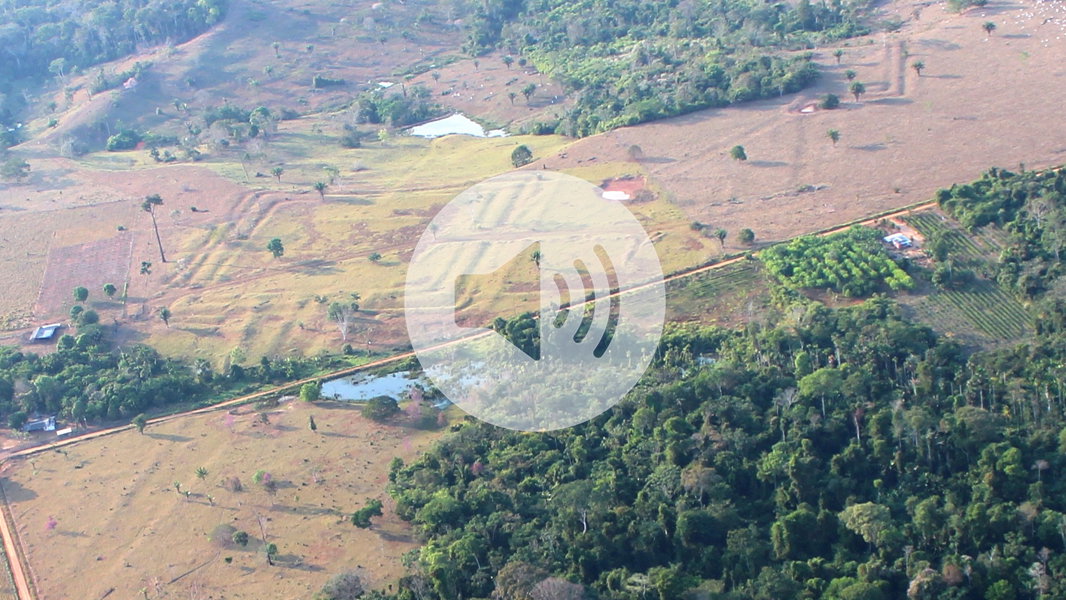
Podcast: hidden ‘earthworks’ in the AmazonThe discovery of hundreds of structures hidden in the Amazon rainforest might redefine the true scale of a civilization that researchers now call the Aquiry. Researchers used a sensing technology called lidar to peek through the rainforest’s dense vegetation, revealing almost 400 ‘earthworks’ that were previously unseen. Taking these structures into account, the team now propose that the total human population of the Aquiry civilization was between 1.25 and 3 million in around 200 AD. Nature Podcast | 20 min listenSubscribe to the Nature Podcast on Apple Podcasts, Spotify or YouTube Music, or use the RSS feed. |
||
|
||
Quote of the day“There is power in remembering that your worth is not determined by a reviewer’s score, a funding panel’s decision or a job market in crisis.”In the current job market, it’s important to remember that rejections aren’t a sign of personal failure, writes health psychologist Daniella Watson. (Nature | 11 min read) |
||
|
|
||
|
||
|
|
||
Free newsletters from NatureWant more? Update your preferences to sign up to our other Nature Briefing newsletters:
|
||
|
||
|
You received this newsletter because you subscribed with the email address: - Please add [email protected] to your address book. Had enough? To unsubscribe from this Briefing, but keep receiving your other Nature Briefing newsletters, please update your subscription preferences. To stop all Nature Briefing e-mails forever, click here to remove your personal data from our system. Fancy a bit of a read? View our privacy policy. Forwarded by a friend? Get the Briefing straight to your inbox: subscribe for free. Get more from Nature: Register for free on nature.com to sign up for other newsletters specific to your field and e-mail alerts from Nature Portfolio journals. Would you like to read the Briefing in other languages? 关注Nature Portfolio官方微信订阅号,每周二为您推送Nature Briefing精选中文内容——自然每周简报。
Nature Portfolio | The Springer Nature Campus, 4 Crinan Street, London, N1 9XW, United Kingdom Nature Portfolio, part of Springer Nature. |