The surprising cause of fasting’s regenerative powers is: eating
What matters in science |

Is this your brand on Milled? Claim it.
|
|||||
|
|||||
|
Hello Nature readers, |
|||||

|
|||||
| (Getty) | |||||
It’s not the fasting, it’s the eatingBreaking a fast seems to carry more health benefits than the fasting itself, a study in mice shows. When mice started eating again after 24 hours of fasting, stem cells in the gut appeared to experience a boost in their ability to repair damage to the intestines. But this activation of stem cells came at a price: mice were more likely to develop precancerous polyps in their intestines if they incurred a cancer-causing genetic change during the post-fasting period than if they hadn’t fasted at all. “Regeneration isn’t cost-free,” says stem-cell biologist Emmanuelle Passegué. Nature | 4 min readReference: Nature paper |
|||||
India mission reveals molten MoonThe first-ever analysis of soil near the Moon’s south pole has found further evidence that the lunar surface melted shortly after it formed. The data come from India’s pioneering Chandrayaan-3 mission, which deployed a rover on the Moon last August that found the soil mainly comprised the mineral ferroan anorthosite. Previous landers have found similar results at other locations, suggesting the composition of the surface is uniform. This supports the theory that the Moon originated from material scattered into space when a large impactor struck the newly formed Earth. Nature | 4 min readReference: Nature paper |
|||||
Video: How to detect gravitational wavesCurrent techniques to spot gravitational waves can only detect them in a narrow band, so researchers are investigating new approached to catch a much wider variety of these ripples in space-time. Nature’s Davide Castelvecci is your guide for a whirlwind three-minute tour of these strategies, which range from watching pulsars to measuring quantum fluctuations. Nature | 3 min video |
|||||
|
|||||
The mpox public health emergencyVirologist and public-health researcher Nicaise Ndembi of the Africa Centres for Disease Control and Prevention (Africa CDC) outlines the body’s decision to issue its first-ever Public Health Emergency of Continental Security (PHECS). “Mpox was declared a PHECS in part to unlock access to emergency resources, including funding, personnel and technical support, but the mpox outbreaks in Africa are a global concern, with the potential for international spread,” writes Ndembi. “Africa CDC asks its global partners to stand with Africa in this critical hour.” Nature Medicine | 4 min read |
|||||
Sustainable ‘climatopias’ are possibleFuturistic flood-resistant villages that float or sit on reclaimed land — ‘climatopias’ — can be viable options for climate adaptation, argue climate scientists Idowu Ajibade and Sameer Shah, but only if they are planned and implemented with care. Ajibade and Shah outline six priorities for designing climatopias, including ensuring equity and justice, introducing regulatory guidelines and safeguarding ecosystems. Nature | 12 min read |
|||||
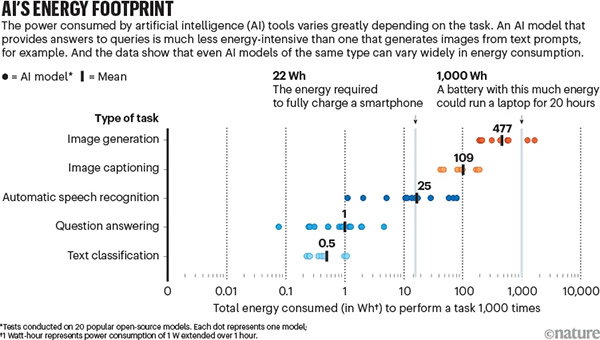
Energy ratings for AIArtificial intelligence (AI) systems are using too much energy, write a group of researchers and leaders from Meta, Hugging Face, Salesforce and others. They suggest an initiative called the AI Energy Star project, inspired by the US Environmental Protection Agency’s Energy Star ratings for products such as light bulbs. “This simple system can help users to choose the most appropriate models for their use case quickly,” argue the authors. And “hopefully, also encourage model developers to consider energy use as an important parameter”. Nature | 9 min read |
|||||
|
|||||
Quote of the day“This is a big dilemma in the aging field — how do you know whether your treatment’s working without waiting for someone to actually die?”Nobel-prizewinning structural biologist Venki Ramakrishnan explores the science of ageing — and, importantly, separates fact from fiction — in his new book, Why we die. Listen to the Nature hits the books podcast with Ramakrishnan (30 min listen) or read the book review by molecular geneticist Jan Hoeijmakers (6 min read) |
|||||
|
|
|||||
|
|||||
|
|
|||||
|
Want more? Update your preferences to sign up to our other free Nature Briefing newsletters:
|
|||||
Access Nature and 54 other Nature journals
Nature+ is our most affordable 30-day subscription, giving you online access to a wide range of specialist Nature Portfolio journals, including Nature. |
|||||
|
|||||
|
You received this newsletter because you subscribed with the email address: - Please add [email protected] to your address book. Enjoying this newsletter? You can use this form to recommend it to a friend or colleague — thank you! Had enough? To unsubscribe from this Briefing, but keep receiving your other Nature Briefing newsletters, please update your subscription preferences. To stop all Nature Briefing emails forever, click here to remove your personal data from our system. Fancy a bit of a read? View our privacy policy. Forwarded by a friend? Get the Briefing straight to your inbox: subscribe for free. Want to master time management, protect your mental health and brush up on your skills? Sign up for our free short e-mail series for working scientists, Back to the lab. Get more from Nature: Register for free on nature.com to sign up for other newsletters specific to your field and email alerts from Nature Portfolio journals. Would you like to read the Briefing in other languages? 关注Nature Portfolio官方微信订阅号,每周二为您推送Nature Briefing精选中文内容——自然每周简报。
Nature Portfolio | The Springer Nature Campus, 4 Crinan Street, London, N1 9XW, United Kingdom Nature Portfolio, part of Springer Nature. |