AI detects risk of Parkinson’s from retinal images
What matters in science |

Is this your brand on Milled? Claim it.
|
|||||
|
|||||
|
Hello Nature readers, |
|||||
|
|||||
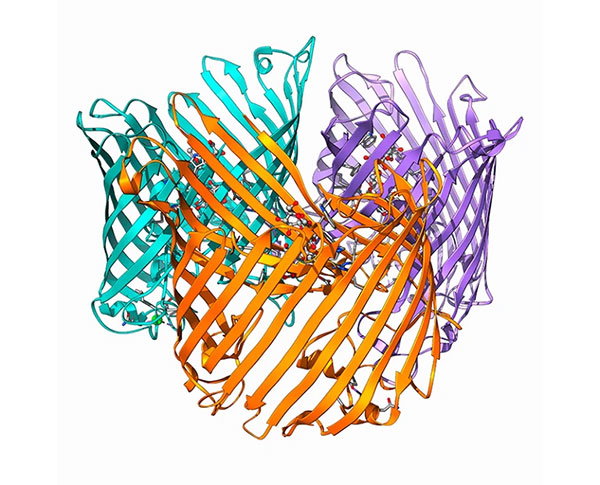
| A protein shape called a beta-barrel. Some of these contain a never-before-seen arrangement of petal-like structures, called the beta-flower. (Laguna Design/Science Photo Library) | |||||
‘Pandora’s box’ of new protein shapesSurprising shapes and unexpected connections have been discovered in the dark corners of the protein universe. Researchers mined a database containing more than 200 million structures of known proteins that Google DeepMind’s revolutionary AlphaFold neural network had predicted. One team identified more than two million clusters of similarly shaped proteins; another discovered a flower-like structure in some distantly related proteins. “This work actually opened up a Pandora’s box of projects,” says computational biologist Joana Pereira. Next: deciding which structures to prioritize for further investigation. Nature | 4 min readReference: Nature paper 1 & paper 2 |
|||||
AI guesses disease risk from retinal imagesScientists have harnessed the power of artificial intelligence (AI) to diagnose and predict the risk of developing a bevy of conditions, from eye disease to Parkinson’s disease and heart failure — all from images of a person’s retinas. Unlike earlier AI tools trained on retinal images, RETFound was developed using self-supervised learning — a method similar to the one used to train large-language models such as ChatGPT. “The model somehow learns what a retina looks like and what all the features of a retina are,” says study co-author Pearse Keane. RETFound performed well at detecting ocular diseases such as diabetic retinopathy. Its ability to predict the risk of heart attack, stroke and Parkinson’s was limited, but still better than other AI models. Nature | 4 min readReference: Nature paper |
|||||
|
|||||
Why breast cancer spreads to the spineA newly discovered type of stem cell that gives rise to the backbone also helps to drive the frequent metastasis of breast tumours to the spine. Unlike stem cells from other bones, vertebral skeletal stem cells produce a protein that makes them likely to interact with cancer cells. In mouse experiments, deleting the gene for the protein cut the chance that cancer cells would spread to the animals’ spines by about two-thirds. Nature | 4 min readReference: Nature paper |
|||||
Japan builds its own version of ChatGPTJapan’s government and big technology firms are sinking hundreds of millions of dollars into creating Japanese-language versions of ChatGPT. The AI chatbot and similar large language models (LLMs) “excel in English, but often fall short in Japanese due to differences in the alphabet system, limited data and other factors”, says machine-learning researcher Keisuke Sakaguchi. One LLM, which uses the Japanese supercomputer Fugaku, is expected to be released next year. Nature | 6 min read |
|||||
|
|||||
How to accelerate progress on the SDGsThe world can’t rely on organic change to achieve any of the 17 United Nations Sustainable Development Goals (SDGs), writes a group of sustainability and policy specialists. Lack of headway is largely a direct result of inaction by governments. But scientists need to play a part in speeding up progress by supporting policymakers, they write. The group highlights three areas in which researchers can make a difference: identifying and removing roadblocks, finding cost-effective ways to achieve all the SDGs simultaneously and developing criteria to assess the impact of different interventions. Nature | 12 min read |
|||||

|
|||||
ACCESS NATURE AND 54 OTHER NATURE JOURNALS
|
|||||
The oil that is eating everythingPalm oil is consumed more than any other fat on the planet, animal or plant. It also emerged from a legacy of enslaved people’s labour and environmental destruction that persists today. Food writer Bee Wilson reviews two new books on the omni-substance, exploring its history, impact and possible future. How can we replace something that “can fry like lard, bake like butter, melt like chocolate and whip like cream — at a fraction of the cost”? The answer, Wilson suggests, is to look at why we need so much in the first place. London Review of Books | 21 min read |
|||||
Quote of the day“This system has so much going on, it is an absolute playground for a fluid dynamicist, and you can set it up in your kitchen for $0.50. Also you can safely eat the experiment when it is done.”Mathematician Saverio Spagnolie set off on a journey of discovery after he and his daughter observed how raisins ‘dance’ in fizzy water. (Twitter thread | Leisurely scroll) |
|||||
|
|
|||||
|
|||||
|
|
|||||
|
|||||
|
You received this newsletter because you subscribed with the email address: - Please add [email protected] to your address book. Enjoying this newsletter? You can use this form to recommend it to a friend or colleague — thank you! Want to switch to the weekly edition? Update your preferences. Had enough? Unsubscribe from the Nature Briefing. Fancy a bit of a read? View our privacy policy. Forwarded by a friend? Get the Briefing straight to your inbox: subscribe for free. Want to master time management, protect your mental health and brush up on your skills? Sign up for our free short e-mail series for working scientists, Back to the lab. Get more from Nature: Register for free on nature.com to sign up for other newsletters specific to your field and email alerts from Nature Research journals. Would you like to read the Briefing in other languages? 关注Nature Portfolio官方微信订阅号,每周二为您推送Nature Briefing精选中文内容——自然每周简报。
Nature | The Springer Nature Campus, 4 Crinan Street, London, N1 9XW, United Kingdom Nature Research, part of Springer Nature. |