‘Almost infinite’ ways cancer can evolve
What matters in cancer |

Is this your brand on Milled? Claim it.
|
|||||
|
|||||
|
Hello Nature readers, |
|||||
|
|||||
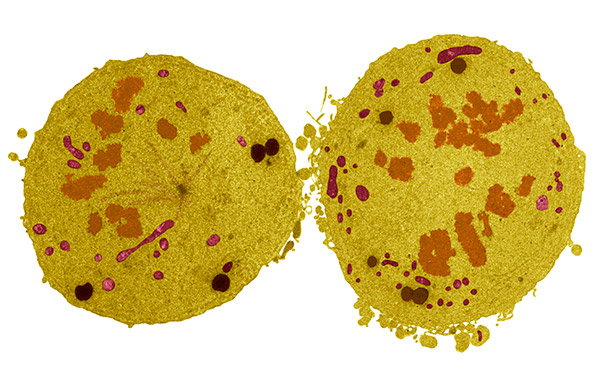
| Late-stage cancers have several billion cells, so there are countless ways the tumour can evolve. (Image depicts cancer cell division.) (Steve Gschmeissner/Science Photo Library) | |||||
Cancer’s evolution is limitlessGiven the “almost infinite” ways that cancer cells can mutate and evolve, “I don’t think we’re going to be able to come up with universal cures,” says cancer researcher Charles Swanton. A series of seven studies, several of which were led by Swanton, offer an unprecedented insight into the genetic diversity in lung cancer. The TracerX studies were based on tumour samples taken from more than 400 people with lung cancer over nine years. “It has surprised me how adaptable tumours can be,” says Swanton. BBC | 3 min readReference: TracerX studies in Nature and Nature Medicine (12 April) |
|||||
B cells spot cancer’s ancient viral DNAImmune cells called B cells swarm to lung tumours when little fragments of ancient viral DNA are expressed, and this increases survival in some patients. Over millions of years, humans have been infected with retroviruses, which insert parts of their DNA into ours. This viral DNA is passed down the generations. Some of these genetic instructions are suppressed, and others are used to our advantage. In cancer cells, the chaotic environment makes it more likely that this ancient DNA will be accidentally expressed, and therefore become a target for roaming immune cells. Future immunotherapies might be able to target these viral DNA fragments, which comprise up to 8% of the human genome. BBC | 3 min readReference: Nature paper (12 April) |
|||||

|
|||||
ACCESS NATURE AND 54 OTHER NATURE JOURNALS
|
|||||
|
|||||
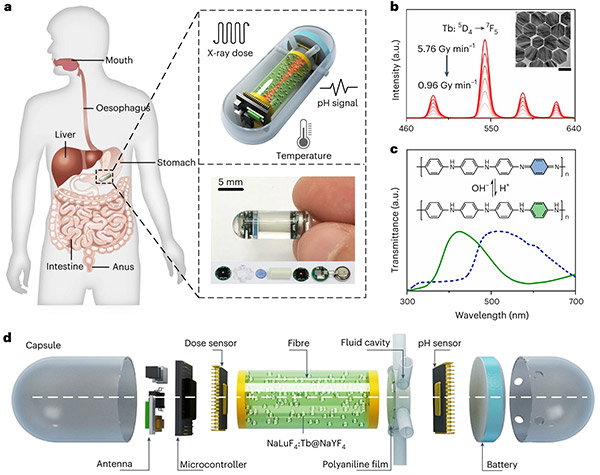
Measuring X-ray exposure with a pillResearchers have designed a prototype swallowable capsule that can measure the cumulative radiotherapy dose delivered to a person with gastrointestinal cancer, and the effect that X-rays are having on the body, in real time. The wireless capsule is around 2 centimetres long and connects to a mobile-phone app. It contains an X-ray dosimeter, a temperature sensor and an acidity or pH sensor. The device could help researchers to understand how radiotherapy affects tumour pH and temperature, the researchers say. Reference: Nature Biomedical Engineering paper (13 April) |
|||||
|
|||||
| The X-ray dosimeter was tested in the gastrointestinal tracts of rabbits. (B. Hou et.al/Nat. Biomed. Eng) | |||||
|
|||||
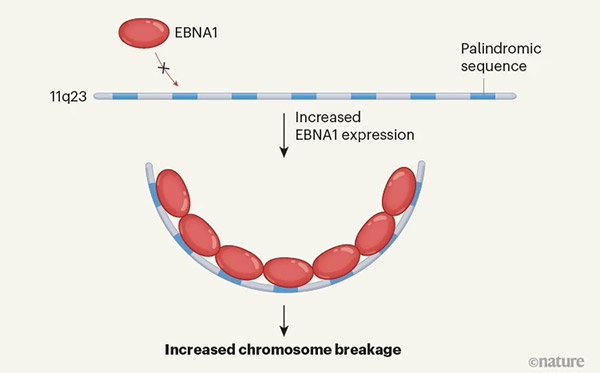
Epstein–Barr snaps chromosomes like twigsThe Epstein–Barr virus predisposes cells to cancer through the action of a protein, called EBNA1, which binds to chromosome 11, breaking it in two. Researchers showed that this protein binds to multiple repeated palindromic DNA sequences. “The question remains as to how binding of EBNA1 to chromosome 11 induces breakage,” writes molecular geneticist Lori Frappier. It could be due to structural changes in DNA or the chromatin, the complex inside which DNA is packaged in the nucleus. “Whatever the mechanism, [the] study supports the contention that EBNA1 contributes directly to the development of cancer,” she writes. Nature News & Views | 6 min readReference: Nature paper (12 April) |
|||||
|
|||||
| The Epstein–Barr virus protein EBNA1 breaks chromosome 11, destabilizing the genome. | |||||
Myocarditis study yields ‘impressive’ resultsAn innovative approach to treating myocarditis — an often-fatal complication of immunotherapy — is “compelling, with impressive survival rates in patients”, write oncologists Douglas Johnson and Alexander Menzies. Myocarditis, or inflammation of the heart muscle, occurs in up to 1% of people given immune checkpoint inhibitors (ICI). In a study of 40 people with ICI-associated myocarditis, only around 3% of patients given the treatment died, compared with 60% of those given guideline-based care. The treatment involved close respiratory monitoring, personalized abatacept dosing, steroids and ruxolitinib. Nature Reviews Clinical Oncology News & Views | 7 min readReference: Cancer Discovery paper (23 February) |
|||||
Quote of the week“They tell you treatment is going to be four to six hours. But most likely you’re going to be there eight or nine if they say six.”‘Time toxicity’ is something that oncologists shouldn’t gloss over when it comes to setting patient expectations about treatment, says JJ Singleton, who has stage-4 colon cancer. (STAT | 8 min read – paywall) |
|||||
|
|
|||||
|
|||||
|
|
|||||
|
|||||
|
You received this newsletter because you subscribed with the email address: - Please add [email protected] to your address book. Enjoying this newsletter? You can use this form to recommend it to a friend or colleague — thank you! Had enough? Unsubscribe from Nature Briefing: Cancer. Fancy a bit of a read? View our privacy policy. Forwarded by a friend? Get the Briefing straight to your inbox: subscribe for free. Get more from Nature: Register for free on nature.com to sign up for other newsletters specific to your field and email alerts from Nature Research journals. Nature | The Springer Nature Campus, 4 Crinan Street, London, N1 9XW, United Kingdom Nature Research, part of Springer Nature. |