‘Disruptive’ science has declined — and no one knows why
What matters in science |

Is this your brand on Milled? Claim it.
|
|||||
|
|||||
|
Hello Nature readers, |
|||||
|
|||||
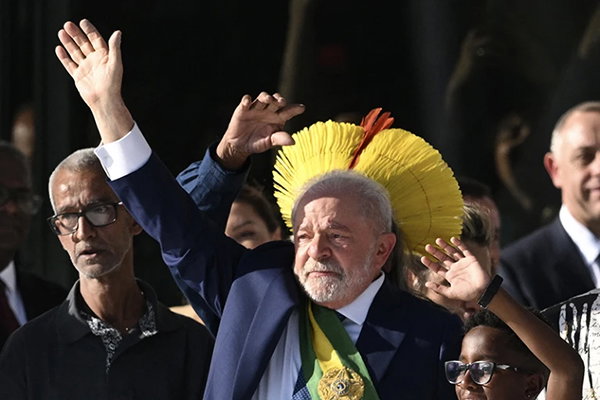
| President Luiz Inácio Lula da Silva took office on 1 January in Brazil. (Evaristo Sa/AFP via Getty) | |||||
Brazil president moves to protect AmazonBrazil’s new president, Luiz Inácio Lula da Silva, has started to make good on his pro-environment promises in his first week on the job — although he faces an uphill battle to get legislation through Congress. Lula has re-established a fund to reduce Amazon deforestation and revoked the 2022 legalization of environmentally damaging small-scale gold mining. He has also indicated that the government will turn towards science-based policy, by establishing an office devoted to the Amazon that will be placed in the Ministry of Science, Technology and Innovation. Scientists are watching to see whether research funding, environment-agency budgets and enforcement against environmental crime will be restored. Nature | 6 min read |
|||||
Why doctors aren’t giving more PaxlovidInsufficient investment and misconceptions about side effects have hampered the roll-out of the lifesaving COVID-19 drug Paxlovid. The antiviral, which reduced the risk of hospitalization and death by nearly 90% in trials, was hailed as a game-changer when it was introduced in late 2021. Because of worries about rebound (when symptoms or detectable virus return after a person starts to feel better) and people increasingly perceiving COVID-19 as less risky, Paxlovid is still prescribed in only about 0.5% of new COVID-19 cases in the United Kingdom, and in about 13% in the United States. Nature | 5 min read |
|||||
New quantum approach targets encryptionScientists have implemented an encryption-cracking algorithm that — theoretically — could break widely used digital privacy systems. The approach could reduce the size of a quantum computer that would be needed to triumph over cryptosystems such as RSA (Rivest–Shamir–Adleman, named after its inventors), which relies on the difficulty of factoring the product of two large prime numbers. The team that came up with the new approach, dubbed the quantum approximate optimization algorithm (QAOA), emphasizes that size isn’t everything — current quantum machines are too error-prone to do such computations successfully. And no one knows whether using QAOA would actually crack codes such as RSA faster than a classical computer, which would take trillions of years. Nature | 5 min readReference: arXiv preprint (not peer reviewed) |
|||||
Controversial Alzheimer’s drug approvedThe US Food and Drug Administration has approved lecanemab, the second-ever treatment for Alzheimer’s disease and the first to slow cognitive decline. During a clinical trial, three people receiving the drug died from complications involving brain bleeding and seizure. Nature | 5 min read |
|||||
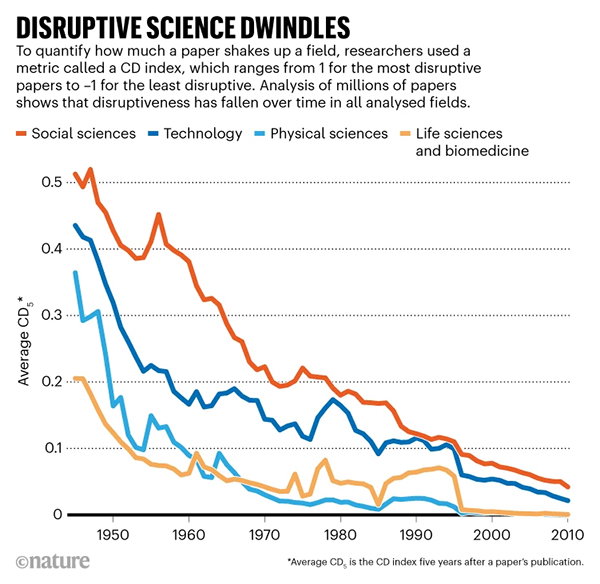
‘Disruptive’ science has declined since 1950sThe proportion of papers that shake up a field has plummeted over the last 50 years. Analysis of citation data from 45 million manuscripts published between 1945 and 2010 showed that, compared with the mid-twentieth century, research done in the 2000s was much more likely to build on previous work than to send the field in a new direction. Reasons for the decline probably include a shift in how science is done — among larger teams and in a more competitive environment — rather than a change in research quality. Nature | 4 min readReference: Nature paper |
|||||
|
|||||
|
|||||
‘Breakthrough’ obesity drugsA new generation of obesity drugs allows scientists to safely alter weight for the first time. One of the gut hormone-mimicking drugs, tirzepatide, has helped people in trials to lose weight at levels typically achievable only through bariatric surgery. It’s unclear exactly how the drugs work or how long people will need to take the pricey medication to maintain their weight. Critics worry that these drugs could play into some societies’ unhealthy obsession with being thin. Nature | 10 min read |
|||||
Access Nature and 54 other Nature journals
Nature+ gives you immediate online access to Nature and 54 other journals. Nature+ is a flexible monthly subscription and is currently available only to personal users in the United States and in the United Kingdom. |
|||||
Method reviews could stop useless science“I’ve lost count of the number of times that a board member has remarked that the way a study has been designed means it won’t yield any informative data,” says experimental psychologist and ethical-review-board chair Daniël Lakens. To counter this trend, his university has introduced a methodological review board that highlights flaws before data collection even begins — such as sample sizes that are too small to test a hypothesis. Nature | 5 min read |
|||||
How war changed life for two Ukrainiane scientists“When people ask me, ‘How did the Russian full-scale invasion change the lives of Ukrainians?”’ I tell them the story of V and his wife N,” writes Ukrainian writer and curator Oleksandr Mykhed. The couple are biologists who study fish, run an ecological management company and dreamed of opening a tourist attraction called “the ‘Museum of Berries’, a place where you could sample every type of berry there is”. Now their home city is occupied by Russian troops, and V is a soldier in the Ukranian army. The Financial Times | 12 min read |
|||||
|
|||||
|
|||||
|
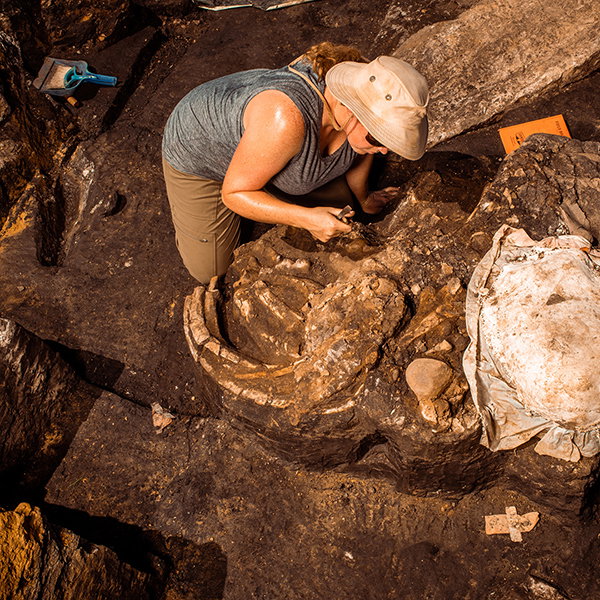
“It’s going to take me three years to unearth this rhinoceros fossil, but that’s okay — he’s been waiting five million years for me to come along,” says field technician Laura Emmert of her painstaking work unearthing ‘Papaw’, a five-million-year-old fossil of a newly described species, Teleoceras aepysoma. Emmert works at the Gray Fossil Site in Tennessee, which was once a watering hole where rhinos, mastodons, red pandas and tapirs gathered. (Nature | 3 min read) (Mike Belleme) |
|||||
Quote of the day“The one time I pinned an error on him he was gracious as anyone could be … but showed no signs of embarrassment — the sure sign of someone who has a long record of being right most of the time, yet accepting his humble place as a mere observer trying to do his best in interpreting something far greater than himself.”Planetary scientist Jeffrey Kargel reminiscences about astronomer Carl Sagan in a collection collated in 1997, the year after Sagan’s death. A printed copy of the Division for Planetary Sciences of the American Astronomical Society document was just rediscovered, and scanned, by atmospheric scientist Andrew Dessler. (21 min read, in PDF format) |
|||||
|
|
|||||
|
|||||
|
|
|||||
|
|||||
|
You received this newsletter because you subscribed with the email address: - Please add [email protected] to your address book. Enjoying this newsletter? You can use this form to recommend it to a friend or colleague — thank you! Want to switch to the weekly edition? Update your preferences. Had enough? Unsubscribe from the Nature Briefing. Fancy a bit of a read? View our privacy policy. Forwarded by a friend? Get the Briefing straight to your inbox: subscribe for free. Want to master time management, protect your mental health and brush up on your skills? Sign up for our free short e-mail series for working scientists, Back to the lab. Get more from Nature: Register for free on nature.com to sign up for other newsletters specific to your field and email alerts from Nature Research journals. Would you like to read the Briefing in other languages? 关注Nature Portfolio官方微信订阅号,每周二为您推送Nature Briefing精选中文内容——自然每周简报。
Nature | The Springer Nature Campus, 4 Crinan Street, London, N1 9XW, United Kingdom Nature Research, part of Springer Nature. |