Drug in high demand gets fast-tracked for pancreatic cancer
What matters in cancer research |

Is this your brand on Milled? Claim it.
|
|||||
|
|||||
|
Hello Nature readers, |
|||||
|
|||||
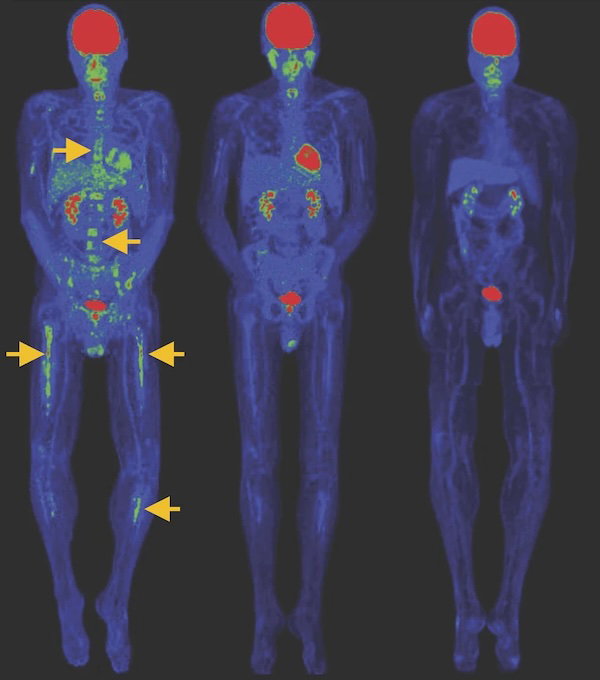
| Over 94 days, bone lesions shrank in one study participant following treatment with the stem-cell-like CAR T cells. (NIH) | |||||
‘Enriched’ CAR T for blood cancerAlmost half of people with hard-to-treat blood cancer given longer-lived CAR T cells with stem-like characteristics went into remission in a small clinical trial. The ‘enriched’ immunotherapy contained an unusually high proportion of immune cells with properties similar to stem cells (such as the ability to generate many types of T cells). Of 11 people given the treatment, five entered remission and another experienced partial remission. By comparison, one of 10 people given the same dose of conventional CAR-T therapy entered full remission. “On a per-dose basis, these cells definitely seemed more potent,” says cancer immunotherapy researcher Christine Brown. “It’s a first step, but an important one.” Nature | 4 min readReference: Cell paper (30 April) |
|||||
Drug in high demand gets fast-trackedThe US Food and Drug Administration will allow the experimental drug daraxonrasib to be used by people with previously treated advanced pancreatic cancer outside of clinical trials as part of an early-access program. People with pancreatic cancer have been clamouring for greater access to the drug. “The demand for daraxonrasib has been very high for several years now, and only getting higher every time we show any data,” says Mark Goldsmith, the chief executive at Revolution Medicines, which developed the drug. The New York Times | 10 min read |
|||||
AI detects early signs of pancreatic cancerComputed tomography scans taken a year or more before a person develops pancreatic cancer carry signatures of precancer that the human eye can’t easily spot but artificial intelligence can. An AI tool detected early signs of pancreatic cancer with 82% accuracy in scans taken a median of 475 days before diagnosis. “We knew, based on the biology of the disease … that the signal was there,” says radiologist Ajit Goenka. “We just needed to find a way to be able to detect it.” The AI tool, called Radiomics-based Early Detection Model (REDMOD), offers “tangible hope for improving outcomes in this challenging disease”, conclude the authors. NBC News | 5 min readReference: Gut paper (28 April) |
|||||
In the news
|
|||||
|
|||||
Aspirin for Lynch SydnromeSome research has hinted at the possibility that aspirin prevents cancer but it’s almost impossible to prove in the general population because a randomized, controlled study would take decades. It’s much easier to test the impact of aspirin on people who are at high risk of developing cancer. In a 10-year study of 861 people with Lynch syndrome, a genetic condition associated with cancer, taking aspirin daily for at least two years halved the risk of colorectal cancer compared with a control group who took a placebo instead of aspirin. As a result of this and subsequent research, clinical guidelines in the United Kingdom now recommend that people with Lynch Syndrome take aspirin. BBC | 11 min readReference: The Lancet paper (2020) |
|||||
|
|||||
Afterglow and exosomesFluorescent tags are useful for detecting cancer cells — but they need a continuous light source to be visible, which can introduce noise into the signal. Biomedical engineer Cheng Xu, who is listed as a ‘rising star’ by Nature Index, set about solving this problem by designing a nanoparticle-based ‘afterglow’ probe that shimmers even after the light is turned off. Another ‘rising star’, cancer researcher Guohua Qi, found that the contents of exosomes — bundles of waste and other biological materials that are released by cells — change when people have cancer, partly because the disease unleashes genetic chaos inside cells. Nature | 12 min readReference: Nature Biomedical Engineering paper (2022) and Analytical Chemistry paper (2025) |
|||||
|
|||||
|
|||||
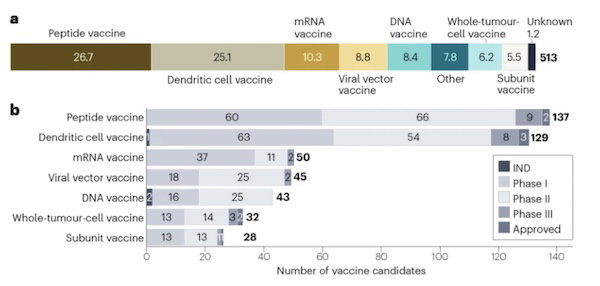
| There are more than 500 cancer vaccine candidates under development globally. Just over a quarter of these are peptide vaccines, which remain popular for their simplicity and ability to effectively target different antigens. (Nature Reviews Drug Discovery | 6 min read) (Congzhou, C. et al./Nat. Rev. Drug Discov.) | |||||
Quote of the week“Every time her ghost pops up on a device, my heart is ripped anew.”Danielle Crittenden’s daughter Miranda died at the age of 32 from complications related to the removal of a brain tumour five years earlier. Memories pop up on social media and on devices without warning constantly but, because of security and legal restrictions, it’s been difficult for the family to access Miranda’s laptop or phone to find mementos they would treasure. (The Wall Street Journal | 7 min read) |
|||||
|
|
|||||
|
|||||
|
|
|||||
Free newsletters from NatureWant more? Update your preferences to sign up to our other Nature Briefing newsletters:
|
|||||
Access Nature and 54 other Nature journals
Nature+ is our most affordable 30-day subscription, giving you online access to a wide range of specialist Nature Portfolio journals, including Nature. |
|||||
|
|||||
|
You received this newsletter because you subscribed with the email address: - Please add [email protected] to your address book. Enjoying this newsletter? You can use this form to recommend it to a friend or colleague — thank you! Had enough? To unsubscribe from this Briefing, but keep receiving your other Nature Briefing newsletters, please update your subscription preferences. To stop all Nature Briefing emails forever, click here to remove your personal data from our system. Fancy a bit of a read? View our privacy policy. Forwarded by a friend? Get the Briefing straight to your inbox: subscribe for free. Get more from Nature: Register for free on nature.com to sign up for other newsletters specific to your field and email alerts from Nature Portfolio journals. Nature Portfolio | The Springer Nature Campus, 4 Crinan Street, London, N1 9XW, United Kingdom Nature Portfolio, part of Springer Nature. |