Exclusive: New evidence for hidden chambers beyond Tutankhamun’s tomb
What matters in science |

Is this your brand on Milled? Claim it.
|
||
|
||
|
Hello Nature readers, |
||
|
||
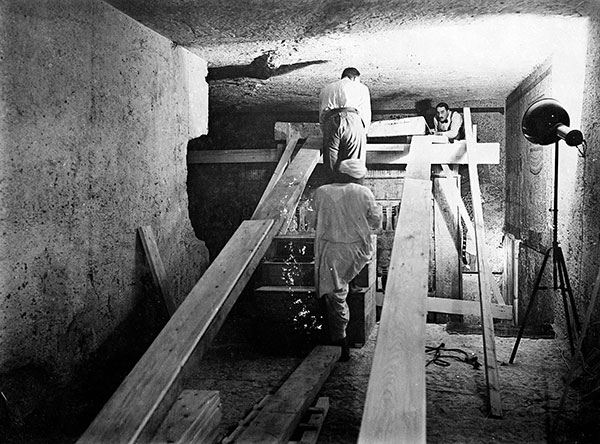
| Howard Carter (right) and his team explored Tutankhamun’s tomb in 1922. If Egypt’s Supreme Council of Antiquities approves, careful drilling to deploy miniature tractors equipped with cameras could start in November, study co-author George Ballard told Nature. (David Cole/Alamy) | ||
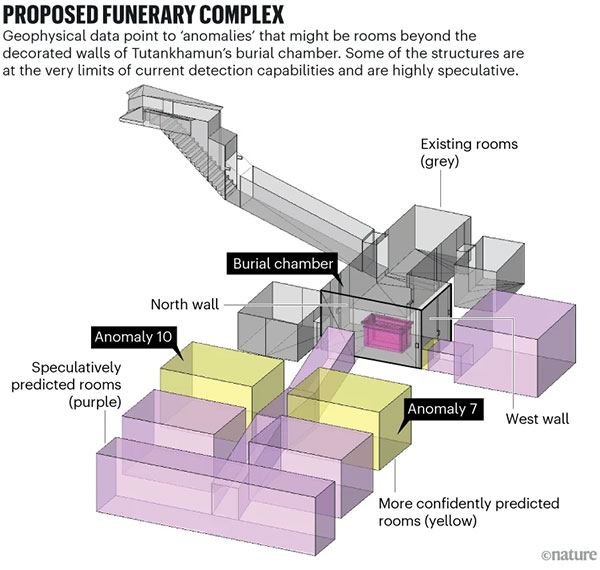
Hidden chambers at Tutankhamun’s tomb?Researchers say they have new found evidence for the tantalizing, but controversial, idea that there are as-yet-unexplored chambers in Tutankhamun’s tomb that might hold the remains of the Egyptian queen Nefertiti. The team conducted a range of geophysical surveys, including the first use of gravitational techniques to probe the density of ground around the site, and say they strongly support the existence of a “hidden complex” of corridors and rooms predating the entombment of Tutankhamun. Nature | 9 min readReference: Occasional Papers of the Amarna Royal Tombs Project paper |
||
|
||
Who gets credit for AI maths bombshell?Controversy around OpenAI’s claim to have solved the Navier–Stokes problem — a major puzzle in fluid dynamics — highlights how researchers could be inadvertently sharing their work through chatbots. Mathematician Tristan Buckmaster raised the concern that the company might have had access to work that he and his collaborator had been chatting about with its AI tools for a year. An OpenAI spokesperson said that “no user inputs past July 3rd could have influenced this system in any way”. “I think academics may have been a little naive,” says Michael Jacobides, who studies digital ecosystems. Nature | 9 min read |
||
Once-in-a-lifetime 222-metre Moon craterNASA’s Lunar Reconnaissance Orbiter has spotted a ‘once-in-a-century’ event — a crater bigger than the Roman Colosseum, which formed when a rock, possibly this size of a three- to six‑story building, crashed into the Moon between 11 April and 22 May, 2024. Such a large-scale event is estimated to occur only once every 132 years. Associated Press | 5 min readReference: Science Advances paper |
||
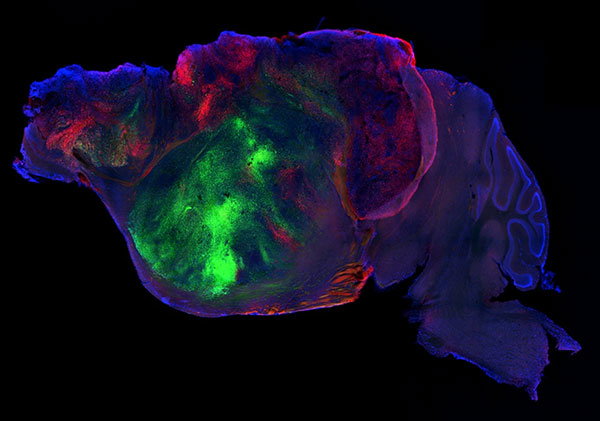
Human brain tissue transplanted into miceIn the most extensive integration of human brain cells into an animal so far, lab-grown organoids have been wired into mice to take the place of a missing part of their brains. The hybrid animals offer an unprecedented way to test drugs and study diseases that involve abnormal brain development such as cerebral palsy, says neuroscientist and study co-author Sergiu Pașca. For those who might be worried, scientists say that human neurons could never function in a mouse as they would in a person, nor did this study present any risk of creating a super-intelligent mouse. Nature | 8 min readReference: Nature paper |
||
|
||
| Transplanted human brain tissue extends nerve fibres (green and red) into a mouse brain (blue) that lacks a cerebral cortex. (S. Pașca lab, Stanford Univ.) | ||
|
||
It’s ctenophore timeCtenophores, also called comb jellies, seem to play a starring role in the evolution of the tree of life. They’re also extremely beautiful, when seen in the right light. Explore our growing understanding of these bizarre creatures, what they tell us about life on Earth and how awesome they look in this lushly illustrated feature. Quanta | 10 min read |
||
‘Increasing inequality demands action’A proposed body called the International Panel on Inequality (IPI) has the backing of the United Nations, the African Union, several national governments and more than 700 economists and other scholars of inequality. Nature is on side too, says the journal in an editorial. “So much is known about the causes and damaging consequences of severe inequality, but that this knowledge has failed to prompt meaningful action from politicians,” it says. “The proposed IPI is the best chance so far for inequality research to inform policy action that can change lives for the better.” Nature | 7 min readRead more on why we need an International Panel on Inequality by authors who include Nobel-prizewinning economist Joseph Stiglitz and Winnie Byanyima, the head of the United Nations’ agency to combat AIDS. (Nature | 14 min read) |
||
Quote of the day“When authors could not answer questions about the technical parts, and sometimes even basic questions about the paper, it is difficult to see how they could have verified the paper’s contents.”Computer scientist Nihar Shah contacted the authors of ten paper submissions to the Transactions on Machine Learning Research in his role as an editor-in-chief. The results were disappointing. (Transactions on Machine Learning Research blog | 8 min read) |
||
|
|
||
|
||
|
|
||
|
||
|
If you enjoy this newsletter, please recommend it to a friend or colleague. Click here to forward it by e-mail. Thank you! You received this newsletter because you subscribed with the email address: - To stop all Nature Briefing e-mails forever, click here to remove your personal data from our system. |
||
|
Nature Portfolio | The Springer Nature Campus, 4 Crinan Street, London, N1 9XW, United Kingdom Nature Portfolio, part of Springer Nature. |