Five ways the brain can age: 50,000 scans reveal possible patterns of damage
What matters in science |

Is this your brand on Milled? Claim it.
|
|||||
|
|||||
|
Hello Nature readers, |
|||||

|
|||||
| Research done from December 2020 to March 2022 found that even just owning a game console increased life satisfaction and reduced psychological distress. (Yong Teck Lim/Getty) | |||||
Gaming helped people during pandemicPlaying video games for a couple of hours a day can improve mental health, according to a study in Japan. The research relied on a natural experiment that arose when the opportunity to buy gaming consoles, which were in short supply, was allocated by a lottery during the COVID pandemic. Of the more than 8,000 people who entered the lottery, those who ended up with a console had increased life satisfaction and reduced psychological distress. But whether these findings apply more broadly remains to be seen. Nature | 4 min readReference: Nature Human Behaviour paper |
|||||
Five ways the brain can ageAn analysis of almost 50,000 brain scans has revealed five distinct patterns of brain atrophy associated with ageing and neurodegenerative disease. The analysis has also linked the patterns to lifestyle factors such as smoking and alcohol consumption, as well as to genetic and blood-based markers associated with health status and disease risk. The work is a “methodological tour de force”, says gerontologist Andrei Irimia. “We knew that brain anatomy changes with ageing and disease. But our ability to grasp this complex interaction was far more modest.” Nature | 4 min readReference: Nature Medicine paper |
|||||
There is a black market in fake citationsResearchers went undercover to confirm what many research-integrity sleuths have long suspected: there is a black market for fake citations used to pad scientists’ Google Scholar profiles. The investigators paid US$300 to a firm that sold them 50 citations from studies in 22 journals — 14 of which are indexed in the scholarly database Scopus. “When a manuscript acquires hundreds of citations within days of publication, or when a scientist has an abrupt and large rise in citations, you know something is wrong,” says computer scientist Yasir Zaki, who took part in the sting operation. Nature | 6 min readReference: arXiv preprint (not peer reviewed) |
|||||
|
|||||
|
|||||
Wood pellets might not be so greenFactories are popping up across the United States to manufacture wood pellets: solid biomass that can be burned to produce electricity in the belief that it is carbon neutral. But an expanding body of research shows that burning wood pellets to generate electricity often emits huge amounts of carbon — even more than burning coal does. There are signs that high-quality wood is being fed into the machines, rather than waste wood, as companies claim. And there are concerns about the effects of wood-pellet facilities on the health of people living nearby. Nature | 11 min read |
|||||
Bias belittles female-dominated fieldsEvidence is building that whole research fields might be prone to gender bias. “People just believe that there are some disciplines that are better than others,” says mathematician Alex James, who led one of the latest studies on the phenomenon. “And it turns out that ones that we think are a bit rubbish are all full of women.” Her study found that the more women there were in a field, the lower the overall grant-application success rate and evaluation of researcher quality. Nature Index | 6 min readReference: eLife paper |
|||||
‘I didn’t feel like shutting up’Last month, UK researchers welcomed the appointment of one of their own as science minister: clinical researcher Patrick Vallance, who gained a high profile for his sober TV appearances as the government’s chief scientific adviser during the COVID pandemic. Five weeks into the job, Nature asked him about the challenges ahead of him — and why, as a non-politician, he took the job in the first place. “It seems like if you’re given an opportunity to do something to make a difference, and you say no, then you should shut up,” he says. “And I didn’t feel like shutting up.” Nature | 5 min read |
|||||
|
|||||
|
|||||
|
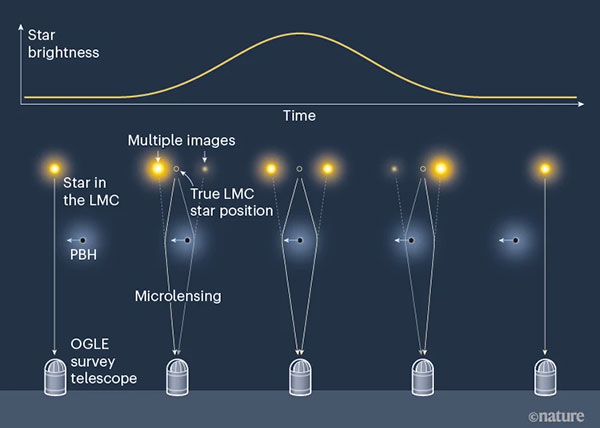
Primordial black holes (PBHs) would have to be at least ten times more abundant to support the theory that they make up a substantial proportion of the dark matter in our Galaxy. Researchers looked for black holes that formed during the early history of the Universe by observing stars in the Large Magellanic Cloud (LMC). A 20-year survey called the Optical Gravitational Lensing Experiment (OGLE) found 13 candidate signals. The detections involved an effect known as microlensing, in which a PBH (or other object) deflects and distorts the light from a star located farther away than the PBH, producing multiple magnified images of the star. The copies cannot be distinguished because they are too close to each other, but their combined brightness shows a characteristic increase as the PBH passes through the line of sight of the star (upper panel). (Nature | 6 min read, Nature paywall) Reference: Nature paper |
|||||
Quote of the day“If you discover violations of research integrity or abuse of patients, it is better to speak out than keep quiet. But for the next 25 years, it will seem that it would have been better to keep quiet.”Physician-scientist Nancy Olivieri has become an icon for scientific integrity after publishing about side effects she discovered during a trial of a thalassaemia treatment, deferiprone, in the 1990s. But life as a whistle-blower is not easy, she says. (Nature | 10 min read) |
|||||
|
|
|||||
|
|||||
|
|
|||||
|
Want more? Update your preferences to sign up to our other free Nature Briefing newsletters:
|
|||||
Access Nature and 54 other Nature journals
Nature+ is our most affordable 30-day subscription, giving you online access to a wide range of specialist Nature Portfolio journals, including Nature. |
|||||
|
|||||
|
You received this newsletter because you subscribed with the email address: - Please add [email protected] to your address book. Enjoying this newsletter? You can use this form to recommend it to a friend or colleague — thank you! Had enough? To unsubscribe from this Briefing, but keep receiving your other Nature Briefing newsletters, please update your subscription preferences. To stop all Nature Briefing emails forever, click here to remove your personal data from our system. Fancy a bit of a read? View our privacy policy. Forwarded by a friend? Get the Briefing straight to your inbox: subscribe for free. Want to master time management, protect your mental health and brush up on your skills? Sign up for our free short e-mail series for working scientists, Back to the lab. Get more from Nature: Register for free on nature.com to sign up for other newsletters specific to your field and email alerts from Nature Portfolio journals. Would you like to read the Briefing in other languages? 关注Nature Portfolio官方微信订阅号,每周二为您推送Nature Briefing精选中文内容——自然每周简报。
Nature Portfolio | The Springer Nature Campus, 4 Crinan Street, London, N1 9XW, United Kingdom Nature Portfolio, part of Springer Nature. |