How AI is decoding the calls of the wild
What matters in science |

Is this your brand on Milled? Claim it.
|
|||||
|
|||||
|
Hello Nature readers, |
|||||

|
|||||
| ResearchHub Journal users are rewarded with ResearchCoin for engaging with content. Authors can also earn the cryptocurrency tokens for using good research practices, such as preregistering studies and sharing data openly. (bizoo_n/Getty) | |||||
Radical journal pays up for peer reviewThe experimental publication ResearchHub Journal is paying peer reviewers the equivalent of US$150 per review in a specially developed cryptocurrency. The journal is hosted on ResearchHub, a platform backed by crypto entrepreneur Brian Armstrong, which aims to make science more open and efficient. “Getting paid to review is justice,” says molecular-biology consultant Pedro Paulo Gattai Gomes. But some other experts are cautious that the journal might struggle to gain a foothold in research publishing because of its unusual approach, and that the use of cryptocurrency could dissuade cautious academics. Nature | 5 min read |
|||||
On the trail of a whale’s tailUsing tail-recognition software, researchers have tracked a humpback whale (Megaptera novaeangliae) over 13,000 kilometres — the longest migration ever seen for the species. The whale’s odyssey, from the Atlantic off Colombia to the coast of Tanzania in the Indian Ocean over the course of almost a decade, is unusual for humpbacks, who normally stick to one section of the ocean. “This could be a simple story of a deeply confused whale,” says marine biologist Alexander Werth. “But it’s more likely that this intrepid explorer is a lonely male desperately seeking mates.” Science | 5 min readReference: Royal Society Open Science paper |
|||||
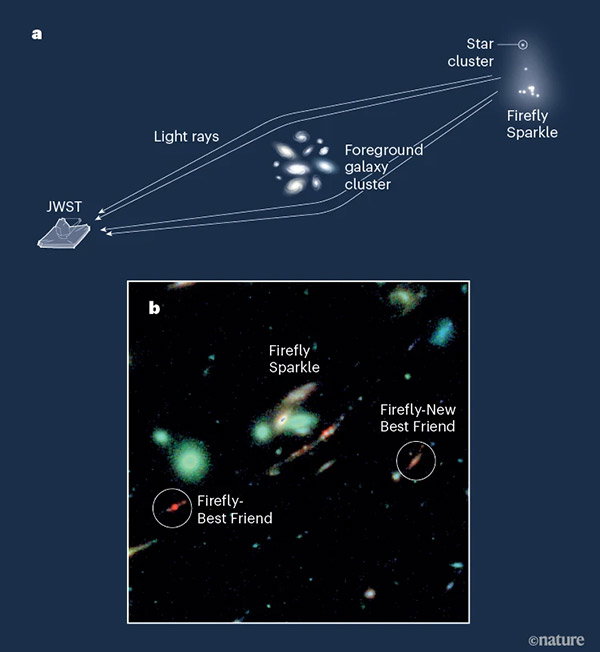
Galaxy could mirror a young Milky WayImages of a young galaxy captured by NASA’s James Webb Space Telescope have given astronomers a glimpse of what the Milky Way might have looked like when it first formed. The images capture the galaxy, dubbed Firefly Sparkle after its resemblance to the bioluminescent insects, in the process of being assembled from groups of stars around 600 million years after the beginning of the universe. Reuters | 5 min readReference: Nature paper |
|||||
|
|||||
| a) Light from Firefly Sparkle and its surrounding stars was bent by the gravitational force of a cluster of other galaxies between it and the telescope, an effect called gravitational lensing. The effect of this distorted path is that the background object seems enlarged, as if it were being viewed through a cosmic magnifying glass. b) Images from the telescope captured Firefly Sparkle and two other young galaxies nearby, appropriately dubbed Firefly-Best Friend and Firefly-New Best Friend. (Nature News & Views | 7 min read, Nature paywall) | |||||
| |||||
|
|||||
|
|||||
AI might decode the calls of the wildArtificial intelligence (AI) is helping scientists to reveal what animals are saying to each other. Researchers have already leveraged the tool to discover that both African savannah elephants (Loxodonta africana) and common marmoset monkeys (Callithrix jacchus) have names. But it’s not as simple as building Google Translate for primate chatter. Such systems need huge amounts of well-defined training data, and it’s still an open question whether animals even have ‘language’ (and what ‘language’ is). Instead, AI can do things such as help researchers comb through recordings, separate sounds and assign them to individual animals. The ultimate goal, for many, is to help protect the creatures they’re studying. “If it were possible for humans to hear from other animals in their own words, ‘Hey, stop fucking killing us’, maybe people would actually do that,” says behavioural ecologist Mickey Pardo. Nature | 15 min readThis article is part of Nature Outlook: Robotics and artificial intelligence, an editorially independent supplement produced with financial support from FII Institute. To discover more on this topic, sign up for the free newsletter Nature Briefing: AI & Robotics. |
|||||
Satellites alone can’t track methaneSatellites can be effective environmental monitoring tools, but they’re no silver bullet, warns satellite expert Lorna Finman. To accurately measure releases of the potent greenhouse gas methane, satellites should be paired with boots on the ground to verify findings and overcome issues such as weather patterns that can distort readings. “Methane monitoring is too important to leave to one tool alone,” says Finman. “Let’s make sure we get this right.” Nature | 5 min read |
|||||
‘Make AI for Africa in Africa’“We cannot expect those who do not understand how we live to build tools for us,” writes artificial-intelligence researcher Nyalleng Moorosi. She argues that making AI systems that are useful for research in Africa is not simply a case of adding more data to Western-built models, which are rarely trained on African languages or culture-specific data. Instead, the research community in Africa deserves opportunities to develop its own AI systems and regulations. Nature | 5 min read |
|||||
Quote of the day“We can chart a course to a future where the sea is not a place where we ignore things today that will threaten us tomorrow.”The seabed is littered with ‘ticking time bombs’ — wrecks of ships, for example those sunk in the two World Wars, says archaeologist Fraser Sturt. Just how many wrecks there are, and whose responsibility it is to clear up the deep sea, isn’t clear, but international action and collaboration can curtail the environmental risk they pose. (The Conversation | 6 min read) |
|||||
|
|
|||||
|
|||||
|
|
|||||
Free newsletters from NatureWant more? Update your preferences to sign up to our other Nature Briefing newsletters:
|
|||||
Access Nature and 54 other Nature journals
Nature+ is our most affordable 30-day subscription, giving you online access to a wide range of specialist Nature Portfolio journals, including Nature. |
|||||
|
|||||
|
You received this newsletter because you subscribed with the email address: - Please add [email protected] to your address book. Enjoying this newsletter? You can use this form to recommend it to a friend or colleague — thank you! Had enough? To unsubscribe from this Briefing, but keep receiving your other Nature Briefing newsletters, please update your subscription preferences. To stop all Nature Briefing emails forever, click here to remove your personal data from our system. Fancy a bit of a read? View our privacy policy. Forwarded by a friend? Get the Briefing straight to your inbox: subscribe for free. Want to master time management, protect your mental health and brush up on your skills? Sign up for our free short e-mail series for working scientists, Back to the lab. Get more from Nature: Register for free on nature.com to sign up for other newsletters specific to your field and email alerts from Nature Portfolio journals. Would you like to read the Briefing in other languages? 关注Nature Portfolio官方微信订阅号,每周二为您推送Nature Briefing精选中文内容——自然每周简报。
Nature Portfolio | The Springer Nature Campus, 4 Crinan Street, London, N1 9XW, United Kingdom Nature Portfolio, part of Springer Nature. |