How antidepressants help bacteria to resist antibiotics
What matters in science |

Is this your brand on Milled? Claim it.
|
|||||
|
|||||
|
Hello Nature readers, |
|||||
|
|||||
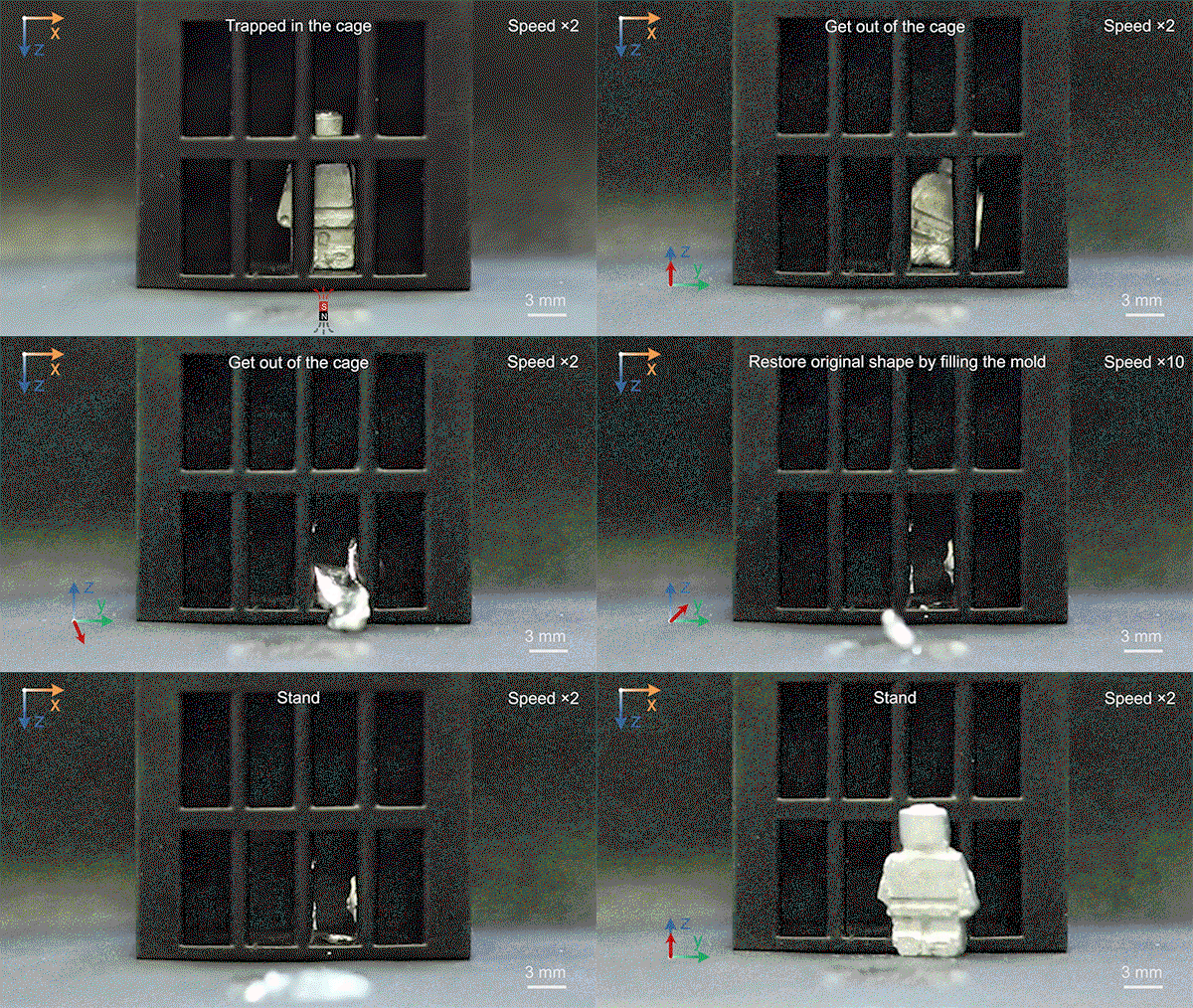
| A blob of ‘magnetoactive phase transitional matter’ shaped like a Lego minifigure softens to escape a cage and then re-forms in a mould to take its former shape. (Quingyuan Wang et al./Matter)) | |||||
Liquid-metal robots can melt and re-formResearchers have created a material that can move, soften and re-harden under the influence of magnetic fields. To demonstrate the material’s promise, researchers showed how it could be manipulated to pass through barriers, extract an object from an artificial stomach, and move a tiny light bulb into place and then melt into the solder required to make it work. New Scientist | 3 min read (free registration required, but worth it for the boggling time-lapse videos)Reference: Matter paper |
|||||
Antidepressants push antibiotics resistanceAntidepressants might contribute to antibiotic resistance, alongside antibiotics overuse. In a laboratory study, five common antidepressants increased the mutation rate of Escherichia coli and triggered cellular defence mechanisms that make the bacteria better able to survive subsequent antibiotic treatment. Researchers now need to assess whether these mechanisms drive resistance in disease-causing bacteria in a real-world scenario. Nature | 5 min readReference: PNAS paper |
|||||
|
|||||
|
|||||
Does it matter if science is less disruptive?A recent finding that the proportion of papers that shake up a field has plummeted over the last 50 years has prompted a lot of soul-searching, says a Nature editorial. Some scientists worry that metrics-driven evaluation, information overload and dividing science into ever-narrower units stops researchers from making disruptive discoveries. Others suggest that the fundamentals in many disciplines are already agreed on, so most further advances are incremental. Nature | 6 min read |
|||||

|
|||||
ACCESS NATURE AND 54 OTHER NATURE JOURNALS
|
|||||
Would ‘mad scientists’ pass ethics review?Discussing research proposals from (in)famous fictional scientists is a fun way to learn about ethics, say three ethics specialists. How, say, would you deal with Emmett Brown’s plan in Back to the Future to secure material from terrorists for his ground-breaking research on time travel? What about ‘dual-use’ research, such as a fictional freeze ray, that could be dangerous in the wrong hands? Luckily, such outrageous projects are rare in the real world, says Amanda Sly. “Occasionally we do see the ones that you’re like, ‘You’re not quite a mad scientist, but there’s some hubris there.’” Science | 6 min read |
|||||
Mormons rally to save the Great Salt LakeEarly Mormon culture revolved around farming and careful stewardship, yet some observe that environmentalism has been widely “scoffed at” in the Church of Jesus Christ of Latter-day Saints. Now, church members are rallying to save the Great Salt Lake, at the heart of their settlement in Utah. The lake is on the brink of collapse because of droughts and water being diverted to grow livestock feed. “If we were to follow that clear guidance in scripture to have a plant-based diet, we wouldn’t be in this situation,” says ecosystem scientist and Mormon Ben Abbott. High Country News | 4 min read |
|||||
Quote of the day“This is one of the closest approaches by a known near-Earth object ever recorded.”Engineer Davide Farnocchia, who developed NASA’s impact hazard assessment system, says that a truck-sized asteroid 2023 BU will whizz very close over the southern tip of South America today — 3,600 kilometers above the surface — but everything will be fine. (Associated Press | 2 min read) |
|||||
|
|
|||||
|
|||||
|
|
|||||
|
|||||
|
You received this newsletter because you subscribed with the email address: - Please add [email protected] to your address book. Enjoying this newsletter? You can use this form to recommend it to a friend or colleague — thank you! Want to switch to the weekly edition? Update your preferences. Had enough? Unsubscribe from the Nature Briefing. Fancy a bit of a read? View our privacy policy. Forwarded by a friend? Get the Briefing straight to your inbox: subscribe for free. Want to master time management, protect your mental health and brush up on your skills? Sign up for our free short e-mail series for working scientists, Back to the lab. Get more from Nature: Register for free on nature.com to sign up for other newsletters specific to your field and email alerts from Nature Research journals. Would you like to read the Briefing in other languages? 关注Nature Portfolio官方微信订阅号,每周二为您推送Nature Briefing精选中文内容——自然每周简报。
Nature | The Springer Nature Campus, 4 Crinan Street, London, N1 9XW, United Kingdom Nature Research, part of Springer Nature. |