How mantis shrimps survive landing the world’s fastest punch
What matters in science |

Is this your brand on Milled? Claim it.
|
|||||||
|
|||||||
|
Hello Nature readers, |
|||||||
|
|||||||
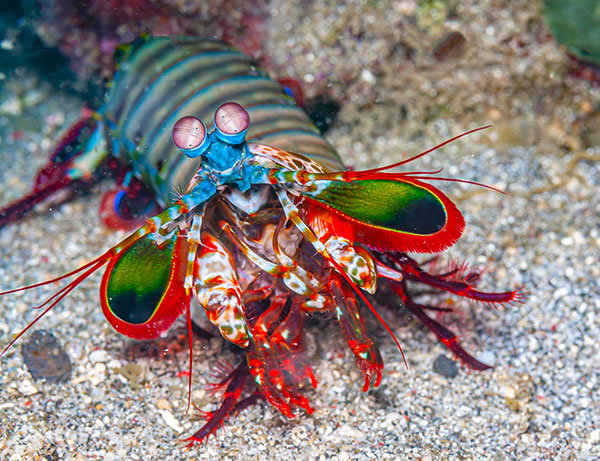
| Mantis shrimp punches can reach peak forces of around 1,500 newtons, more than 1,000 times their body weight. (johnandersonphoto/Getty) | |||||||
Mighty shrimp absorbs its own shockwavesPeacock mantis shrimp (Odontodactylus scyllarus) might be small, but thanks to a specialized limb, they pack a mighty punch. Their jabs are strong enough to crack the shells of other crustaceans, and now researchers have worked out how they can do it without damaging their own body. The punching limb, called the dactyl club, has a multi-layered structure that allows it to absorb the shockwaves generated on impact. The findings could provide inspiration for the design of artificial materials with useful properties, says physicist and study co-author Maroun Abi Ghanem. Nature | 4 min readReference: Science paper |
|||||||
Nose bacteria can sneak drugs into the brainBacteria that colonize the nose have been engineered to ferry drugs to the brains of mice. Researchers examined bacteria in the nasal microbiome and identified the species Lactobacillus plantarum as both safe to use in treatment and able to bind to a molecule found on a nose membrane connected to the brain. They then engineered L. plantarum to produce and secrete three-appetite suppressing hormones. Obese mice that received a dose of the bacteria in their nose each day for eight weeks ate less and lost weight during the treatment period. The bacteria probably don’t enter the brain themselves, but carry the drug to the point where it can diffuse the rest of the way. Nature | 5 min readReference: Cell paper |
|||||||
How useful is OpenAI’s ‘deep research’ toolTech giant OpenAI has unveiled a pay-for-access tool called ‘deep research’, which synthesizes information from dozens or hundreds of websites into a cited report. The tool’s ability to write literature reviews and identify gaps in knowledge has impressed many scientists, but others have noted that its output is not up to the standard you’d expect from a human. Its launch follows that of a similar tool from Google, also called Deep Research, released in December. Artificial-intelligence systems like these could be used to update human-authored reviews more regularly than is feasible for humans, say experts, although OpenAI admits the tool is currently prone to hallucinations and false citations. Nature | 5 min read |
|||||||
| |||||||
|
|||||||
|
|||||||
How to be a good ally in academiaMembers of advantaged groups can lighten the load of efforts to create a diverse, equitable and inclusive academia — a load that is often disproportionately shouldered by members of disadvantaged groups. It’s worth it: a simulation tool suggests that having even a small proportion of people in a network engaging in allyship actions can foster greater inclusion for those at risk of being marginalized. Behavioural scientist Hsuan-Che ‘Brad’ Huang, and social psychologists Lucy De Souza and Toni Schmader, offer six actionable steps for academics who want to step up to the plate for their colleagues. Nature Human Behaviour | 9 min read |
|||||||
Futures: Future legalA cryogenically frozen man wakes up in a future that’s less welcoming than he’d hoped in the latest short story for Nature’s Futures series. Nature | 6 min read |
|||||||
Five best science books this weekAndrew Robinson’s pick of the top five science books to read this week includes a roundup of innovations that changed the course of history and reflections from a poet and a space historian on humanity’s fascination with Mars. Nature | 3 min read |
|||||||
Podcast: street smarts don’t help in classMathematics skills learnt in real-world situations might not translate to the classroom and vice versa. A team surveyed children in India who work in markets and found that, although the kids could quickly solve complex market-based problems in their heads, they struggled with calculations typically used in schools. The reverse was seen for schoolchildren who had no market-selling experience. The researchers hope this finding could help design curricula that bridge the gap between intuitive and formal maths. “What matters is that kids can systematically solve problems, not that they use the right algorithm,” says economist and study co-author Abhijit Banerjee. Nature Podcast | 35 min listenSubscribe to the Nature Podcast on Apple Podcasts, Spotify or YouTube Music, or use the RSS feed. |
|||||||

|
|||||||
Quote of the day“Knowledge of the science behind simple problems can improve even the slightest bits of our daily life, like the simple act of eating an egg.”The perfect boiled egg is a matter of simply placing it alternately in boiling and tepid (30 ℃) water eight times for a total of 32 minutes, say researchers seeking the elusive velvety yolk and soft, solid white. (Associated Press | 3 min read) |
|||||||
|
|
|||||||
|
|||||||
|
|
|||||||
Free newsletters from NatureWant more? Update your preferences to sign up to our other Nature Briefing newsletters:
|
|||||||
Access Nature and 54 other Nature journals
Nature+ is our most affordable 30-day subscription, giving you online access to a wide range of specialist Nature Portfolio journals, including Nature. |
|||||||
|
|||||||
|
You received this newsletter because you subscribed with the email address: - Please add [email protected] to your address book. Enjoying this newsletter? You can use this form to recommend it to a friend or colleague — thank you! Had enough? To unsubscribe from this Briefing, but keep receiving your other Nature Briefing newsletters, please update your subscription preferences. To stop all Nature Briefing emails forever, click here to remove your personal data from our system. Fancy a bit of a read? View our privacy policy. Forwarded by a friend? Get the Briefing straight to your inbox: subscribe for free. Want to master time management, protect your mental health and brush up on your skills? Sign up for our free short e-mail series for working scientists, Back to the lab. Get more from Nature: Register for free on nature.com to sign up for other newsletters specific to your field and email alerts from Nature Portfolio journals. Would you like to read the Briefing in other languages? 关注Nature Portfolio官方微信订阅号,每周二为您推送Nature Briefing精选中文内容——自然每周简报。
Nature Portfolio | The Springer Nature Campus, 4 Crinan Street, London, N1 9XW, United Kingdom Nature Portfolio, part of Springer Nature. |