Loss of the Y chromosome in tumours could be ‘contagious’
What matters in science |

Is this your brand on Milled? Claim it.
|
||||||
|
||||||
|
Hello Nature readers, |
||||||

|
||||||
| A 1,200-year-old Platycladus orientalis (left) at Tiantong Temple in Zhejiang province, China. (ViewStock/Getty) | ||||||
Ancient trees protected in Chinese templesBuddhist and Taoist temples in China are providing a refuge for trees — the oldest of which has been growing for 2,000 years. A study of nearly 50,000 trees, each more than a century old, described nearly 61 threatened species, eight species that were found only on temple grounds and the only existing individual of Carpinus putoensis. Nature | 3 min readReference: Current Biology paper |
||||||
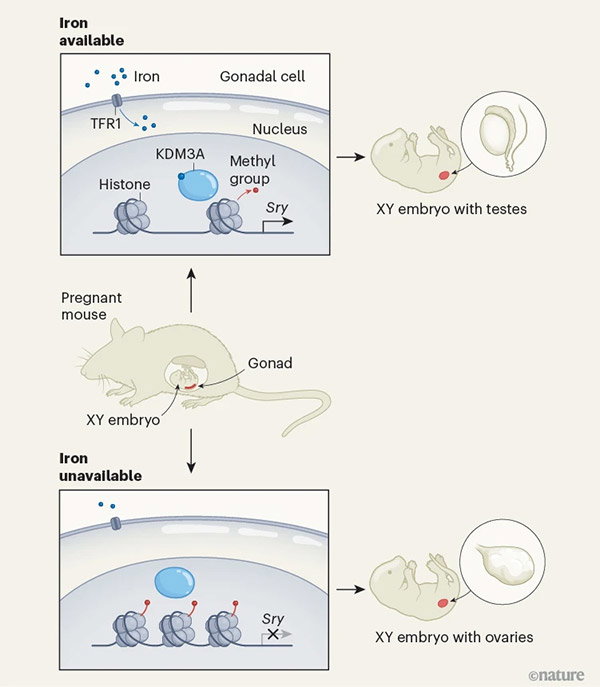
Iron-deficient male mice can grow ovariesMale mouse fetuses can develop female organs in utero if their mother is iron deficient during pregnancy. When pregnant mice were given a molecule that sequesters iron, or their embryos had genetic tweaks that disrupted their iron uptake, a handful of pups with XY chromosomes in their litters grew ovaries. The findings could have implications for medical advice about iron intake during pregnancy, says molecular geneticist Vincent Harley. But as most embryos developed typical sexual characteristics, there must be other key factors that influence sex, he adds. Nature | 4 min readReference: Nature paper |
||||||
|
||||||
| Mice with XY chromosomes usually develop testes if a gene called Sry on the Y-chromosome is activated and ovaries if it is not. Sry is activated by a type of enzyme called a histone demethylase (KDM3A), which needs iron to function. The enzyme removes chemical tags called methyl groups from stretches of DNA near Sry, which lets other cellular machinery access the gene. (Nature News & Views | 7 min read, Nature paywall) | ||||||
| ||||||
|
||||||
|
||||||
A long-sought alternative to opioids for painA young street performer in Pakistan who became famous for not feeling pain. A group of people in Alabama who felt excruciating burning in response to the slightest heat. Both had mutations in the SCN9A gene, which acts on the function of the tiny sodium channel called NaV1.7 that helps to conduct electrical signals in pain-sensing nerves. “We all went crazy, because people without NaV1.7 were pain-free but otherwise normal,” says molecular neurobiologist John Wood. “It was unbelievably exciting.” Eventually, this discovery helped to kick off the development of a promising new painkiller: suzetrigine. In January, the drug (marketed as Journavx), became the first new non-opioid painkiller in more than twenty years to receive approval for acute-pain treatment from the US Food and Drug Administration. The New Yorker | 19 min readFlora |
||||||
Don’t let your default be ‘free’The situation will be familiar to many scientists: behavioural scientist Dritjon Gruda was asked to give a seminar, but when he quoted his fee, he was met with radio silence. Researchers often spend hours doing unpaid work, but there are ways to force you and any prospective partner to treat your labour as professional work, Gruda writes. Keep a tangible list of services and fees handy, bring up payment as soon as possible and seek support from your institution. “We need to break the illusion that all other academics are giving away their work for free,” writes Gruda. Nature | 4 min readFlora (Jeffrey) |
||||||
Quote of the day“It can be tempting to give up when confronted with the scale of humanity’s consumption and the speed with which we are changing the climate and losing the natural world. But nature is our greatest ally. Wherever we have given nature the space to recover, it’s done so.”Protecting the oceans brings swift benefits to ecosystems and the people who depend on them, says naturalist and broadcasting icon David Attenborough, who is about to launch his latest documentary film at the age of 99. (National Geographic | 5 min read) |
||||||
|
|
||||||
|
||||||
|
|
||||||
Free newsletters from NatureWant more? Update your preferences to sign up to our other Nature Briefing newsletters:
|
||||||
Access Nature and 54 other Nature journals
Nature+ is our most affordable 30-day subscription, giving you online access to a wide range of specialist Nature Portfolio journals, including Nature. |
||||||
|
||||||
|
You received this newsletter because you subscribed with the email address: - Please add [email protected] to your address book. Enjoying this newsletter? You can use this form to recommend it to a friend or colleague — thank you! Had enough? To unsubscribe from this Briefing, but keep receiving your other Nature Briefing newsletters, please update your subscription preferences. To stop all Nature Briefing emails forever, click here to remove your personal data from our system. Fancy a bit of a read? View our privacy policy. Forwarded by a friend? Get the Briefing straight to your inbox: subscribe for free. Want to master time management, protect your mental health and brush up on your skills? Sign up for our free short e-mail series for working scientists, Back to the lab. Get more from Nature: Register for free on nature.com to sign up for other newsletters specific to your field and email alerts from Nature Portfolio journals. Would you like to read the Briefing in other languages? 关注Nature Portfolio官方微信订阅号,每周二为您推送Nature Briefing精选中文内容——自然每周简报。
Nature Portfolio | The Springer Nature Campus, 4 Crinan Street, London, N1 9XW, United Kingdom Nature Portfolio, part of Springer Nature. |