NASA to launch rescue mission to save satellite from a fiery death
What matters in science |

Is this your brand on Milled? Claim it.
|
|||||
|
|||||
|
Hello Nature readers, |
|||||
|
|||||
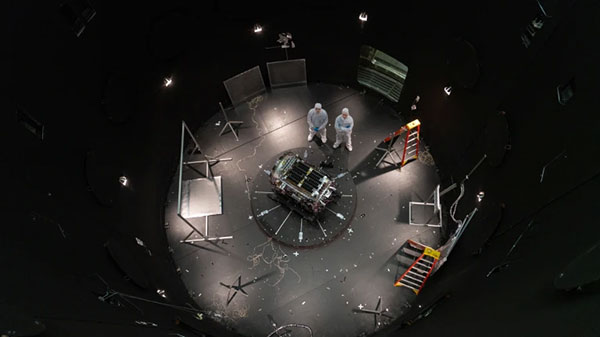
| The LINK spacecraft (centre) could blast off as early as 27 June. If the mission is successful, it could pave the way towards extending the life of other space observatories. (NASA/Sophia Roberts) | |||||
NASA to launch satellite-rescue missionNASA is preparing to launch a first-of-its-kind mission to rescue an ageing satellite from an impending fiery death. The mission aims to raise the orbit of the Neil Gehrels Swift Observatory, which gathers valuable data on cosmic explosions but is slowly falling to Earth. The robotic craft will fly to Swift, grab it with extendable arms and ferry it upwards by around 200 kilometres. That should be high enough to get Swift past the atmospheric drag that would otherwise force it to fall out of the sky by the end of this year. Nature | 5 min read |
|||||
New liquid acts like rechargeable batteryA new type of liquid can harvest and store energy from light to act as a rechargeable power source. The liquid contains a molecule that absorbs electrons from light, which prompts a restructure into a jelly-like substance. This gel remains stable for months at a time and can release the stored electrons upon contact with oxygen to power chemical reactions. The research is still in very early stages, but such a metal-free energy storage system could one day be useful to power small devices such as smartwatches. Science | 4 min readReference: Chem paper |
|||||
Visiting comet formed in Universe’s infancyAn unusual comet that shot through the Solar System last year — and tempted some to dabble in the idea that it was an alien spaceship — could have formed as long as 12 billion years ago. From the chemical composition of the comet, 3I/ATLAS, researchers estimate that it formed relatively early in the history of the Universe, after an intense period of star formation. Gathering data on more interstellar objects — those that aren’t tied to an orbit and can ‘wander’ the galaxy — could “totally revolutionize what we know about the field of interstellar comets, but also star and planet formation in general”, says planetary scientist Darryl Seligman. Science | 5 min readReference: Nature paper |
|||||
|
|||||
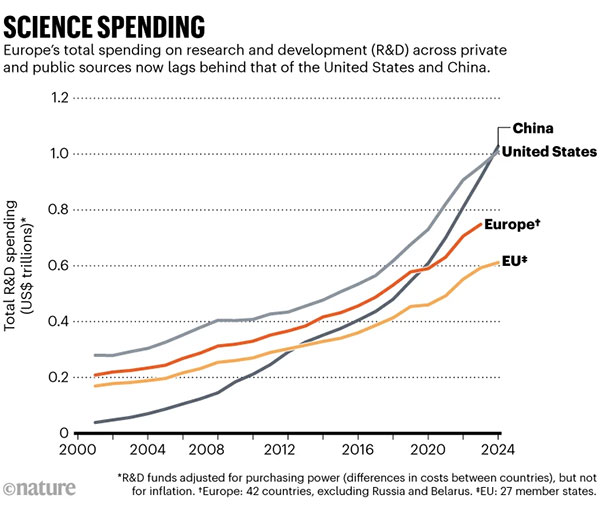
Europe works on its science superpowersAmid chaos in US science and geopolitical turmoil, Europe wants to position itself as a research haven — not least through the European Union’s €900 million (US$1 billion) Choose Europe initiative. And that’s on top of Horizon Europe, the EU’s main pan-national research-funding programme — which could top €175 billion in its next seven-year cycle — and countries’ own programmes. But business research and development funding in Europe still languishes behind that in China and the United States, and the region has found it hard to translate its academic research prowess into innovation and economic benefits. Nature | 12 min read |
|||||
|
|||||
Narcissistic leaders resist remote workLeaders who insist that their employees give up remote work completely tend to have one thing in common, write organizational psychologists Adam Grant, Marissa Shandell and Courtney Elliott — narcissism. “Some leaders say they insist on full-time in-person work because it boosts productivity, despite clear evidence that it does not,” write the researchers. “Our new research reveals that the objection to any work from home is more likely to be driven by something else entirely: ego.” The New York Times | 10 min readReference: Organizational Behavior and Human Decision Processes paper |
|||||
How to respond to race-based exclusionAn early-career researcher of Asian heritage working in an engineering research group in western Europe writes to Nature’s advice column asking how to deal with unequal treatment and unfair comments. They ask, “what options exist when speaking out feels unsafe, even years into a career?” A group of experts offer their advice — including accepting that leaving, if you have to, doesn’t equate to failure. “Nobody will raise statues to us because we thrived in a situation that was hostile,” says pedagogical advisor Joelyn de Lima. Nature | 9 min read |
|||||
Quote of the day“The physics of freezing has always attracted attention. It's good to see thawing finally catching up.”Fisheries expert Francisco Blaha lauds a review of thawing methods — the long-neglected flipside of freezing, the backbone of the global meat and seafood trade. (Personal blog | 10 min read) |
|||||
|
|
|||||
|
|||||
|
|
|||||
Free newsletters from NatureWant more? Update your preferences to sign up to our other Nature Briefing newsletters:
|
|||||
|
|||||
|
You received this newsletter because you subscribed with the email address: - Please add [email protected] to your address book. Enjoying this newsletter? You can use this form to recommend it to a friend or colleague — thank you! Had enough? To unsubscribe from this Briefing, but keep receiving your other Nature Briefing newsletters, please update your subscription preferences. To stop all Nature Briefing emails forever, click here to remove your personal data from our system. Fancy a bit of a read? View our privacy policy. Forwarded by a friend? Get the Briefing straight to your inbox: subscribe for free. Want to master time management, protect your mental health and brush up on your skills? Sign up for our free short e-mail series for working scientists, Back to the lab. Get more from Nature: Register for free on nature.com to sign up for other newsletters specific to your field and email alerts from Nature Portfolio journals. Would you like to read the Briefing in other languages? 关注Nature Portfolio官方微信订阅号,每周二为您推送Nature Briefing精选中文内容——自然每周简报。
Nature Portfolio | The Springer Nature Campus, 4 Crinan Street, London, N1 9XW, United Kingdom Nature Portfolio, part of Springer Nature. |