New hybrid virus seen for first time
What matters in science |

Is this your brand on Milled? Claim it.
|
|||||
|
|||||
|
Hello Nature readers, |
|||||
|
|||||
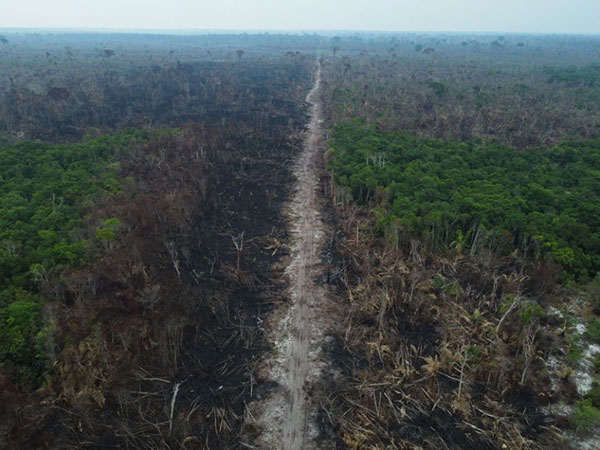
| Deforested areas rim a highway running through the state of Amazonas in Brazil. (Michael Dantas/AFP/Getty) | |||||
Action to save forests is not enoughThe first report card on progress towards a 2030 goal to stop global forest loss is in, and the results aren’t good. Global deforestation slowed by 6.3% in 2021 compared with the baseline average in 2018-20 baseline — short of the 10% cut that is needed. The progress is largely thanks to “exceptional results” in tropical Asian countries such as Indonesia, says Erin Matson, one of the report’s authors. But in other tree-felling hotspots, including Brazil, Bolivia and the Democratic Republic of the Congo, deforestation increased. Nature | 6 min readReference: Forest Declaration Platform |
|||||
New hybrid virus evades immune systemThe flu virus and respiratory syncytial virus (RSV) can fuse together to create a virus that can evade the human immune system. Researchers who were keen to understand co-infections — in which both viruses infect someone at the same time — deliberately infected human lung cells with both viruses. They found that the RSV and the flu virus fused together to form a palm-tree-shaped hybrid, which could infect new cells even in the presence of flu antibodies. “This kind of hybrid virus has never been described before,” says virologist Pablo R. Murcia, who worked on the research. “We are talking about viruses from two completely different families combining together with the genomes and the external proteins of both viruses. It is a new type of virus pathogen.” The Guardian | 4 min readReference: Nature Microbiology paper |
|||||
How long will COVID research remain free?At the beginning of the pandemic, scientific journals rushed to make COVID-19 research free to read — but now reports are circulating that this content will soon disappear behind paywalls. The alarm was sounded in August, following an analysis of the effects of the COVID-19 open-sharing commitment. “Several [publishers] have already started re-introducing paywalls,” said the report, which was posted online in June before peer review. However, some researchers suggested that there was a lack of firm evidence for this statement, and Nature has so far found only one publisher — BMJ — that has paywalled some previously free research papers. Nature | 5 min readReference: Zenodo preprint (not peer reviewed) |
|||||
|
|||||
Cancer drugs close in on deadly mutationsScientists are hoping to save lives with new drugs that target the KRAS protein, which is mutated in many cancers and was previously thought to be ‘undruggable’. Last year, the US Food and Drug Administration approved the first KRAS-targeted cancer therapy — sotorasib (Lumakras) — and a second drug is expected to be approved this year. Although sotorasib’s approval was a landmark, only 28% of the participants treated with the drug responded to it. Even so, the pace of KRAS research and the pursuit of KRAS-targeting drugs has never been so energized, says cancer biologist Channing Der. “I have never seen this level of excitement and buzz in the entire history of the field,” he says. Nature | 11 min read |
|||||
Tiny microscope sees inside animal brainsA thumb-sized two-photon fluorescence ‘miniscope’ called Mini2P can track the activity of hundreds or thousands of neurons deep in a mouse brain while the animal runs, climbs and jumps. Developed by Weijian Zong, an optical engineer, the head-mounted Mini2P achieves “nearly as good” resolution as a bulky bench-top two-photon system. It is also open-source, with parts lists and instructional videos available on GitHub. The Mini2P “opens the door to lines of scientific inquiry that were difficult, if not impossible, to initiate”, says neuroscientist Denise Cai. And it’s a development that has been years in the making. Nature | 13 min read |
|||||
|
|||||
|
|||||
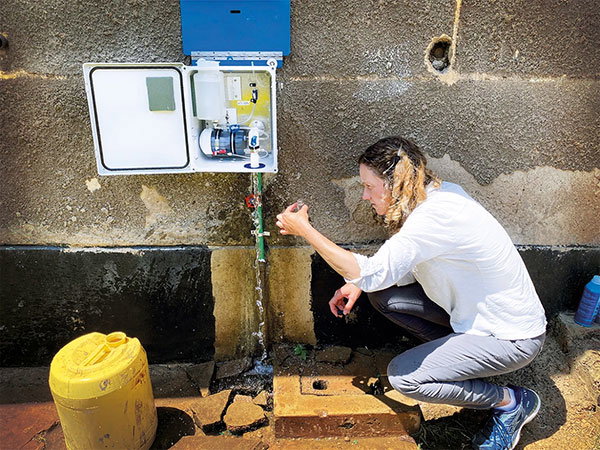
| “As a postdoctoral researcher, I helped to make drinking water safe in Dhaka between 2012 and 2015. I realized that automated disinfection at the tap would be the best way to sterilize water in communities where there are many diseases circulating,” says environmental engineer Amy Pickering. “Since 2013, my team and I have been working to develop a device that purifies water at the tap, or where water enters a building. In this picture, at a hospital in Busia, Kenya, I’m testing the residue of chlorine added to our device, which we have dubbed the Venturi.” (Nature | 3 min read) (Katya Cherukumilli for Nature) | |||||
Quote of the day“We fought with disappointment, darkness, and also with words that could discourage us. But in the end, we witnessed this glorious birth.”Maryam Torki, at the Institute for Research in Fundamental Sciences in Tehran, speaks about the difficult road to launch for the Iranian National Observatory, which just acquired its first images. (Science | 4 min read) |
|||||
|
|
|||||
|
|||||
|
|
|||||
|
|||||
|
You received this newsletter because you subscribed with the email address: - Please add [email protected] to your address book. Enjoying this newsletter? You can use this form to recommend it to a friend or colleague — thank you! Want to switch to the weekly edition or change your email address? Update your preferences. Had enough? Unsubscribe from the Nature Briefing. Fancy a bit of a read? View our privacy policy. Forwarded by a friend? Get the Briefing straight to your inbox: subscribe for free. Want to master time management, protect your mental health and brush up on your skills? Sign up for our free short e-mail series for working scientists, Back to the lab. Get more from Nature: Register for free on nature.com to sign up for other newsletters specific to your field and email alerts from Nature Research journals. Would you like to read the Briefing in other languages? 关注Nature Portfolio官方微信订阅号,每周二为您推送Nature Briefing精选中文内容——自然每周简报。
Nature | The Springer Nature Campus, 4 Crinan Street, London, N1 9XW, United Kingdom Nature Research, part of Springer Nature. |