No, Bunsen burners do not waft bacteria away from workbenches
What matters in science |

Is this your brand on Milled? Claim it.
|
||
|
||
|
Hello Nature readers, |
||
|
||
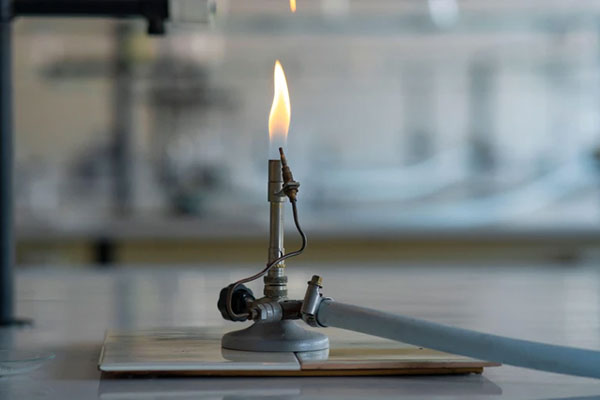
| A new study could fuel debate about whether the Bunsen burner still has a place in the modern laboratory. (Alfonso Fabio Iozzino/Alamy) | ||
Bunsen burners make poor air-cleansersBunsen burners, long used to cleanse airspaces and surfaces in labs of bacteria-laden particles, aren’t actually very effective at doing so, and might even make contamination worse. Researchers seeded the air above lab benches with the bacterium Gordonia rubripertincta and opened two Petri dishes — one near a lit Bunsen burner and one near an unlit one. They found that in several trials of differently sized burners, bacterial levels in dishes beside lit burners were as high as or higher than the other ones. Nature | 5 min readReference: Microbiology Spectrum paper |
||
NIH strikes deal with Dept of DefenseThe US National Institutes of Health (NIH) has signed an agreement with the US Department of Defense to redirect research projects worth hundreds of millions of dollars from its institute for infectious diseases to military biodefence programmes. The 10-year agreement would establish a pathway to move funding out of the NIH “on a project-by-project basis”, said an agency spokesperson in a statement. But some researchers worry that shifting biomedical research to the military threatens the transparency and clinical translation that define NIH-funded work. Nature | 6 min read |
||
Boat-bashing orcas are probably just playingThe Iberian orcas (Orcinus orca) ramming boats off the coasts of Spain and Portugal are more likely to be playing than showing aggression, researchers say. Videos of orcas in the act show that perpetrators were almost always juveniles, and contact with boats was often gentle. Bumpers also occasionally brought ‘gifts’ such as pieces of fish to the boats. The findings could dispel a popular theory that the orcas are seeking revenge for injuries caused by boats. “If you want to avenge yourself, you don’t bring food, you know?” says orca researcher Janek Andre. Science | 5 min readReference: Marine Mammal Science paper |
||
|
||
Newton’s ‘remarkable year’ of geniusIn their new book, The Winding Trail to Newton’s Principia Mathematica, science historians Jed Buchwald and Mordechai Feingold explore how Newton defied the ‘ten-year rule’ of creativity and genius. The rule suggests that artists and scientists must put in a decade of learning before they can make a breakthrough. But Newton’s masterwork, in which he proposed his laws of motion and his universal law of gravitation, followed hardly any study of maths or science, and he worked mostly alone. Nature | 7 min read |
||
Probing the proteome at cellular scaleCells that seem identical can have very different fates, thanks to the proteins they contain. But most analyses of single cells focus on the transcriptome to explore gene expression in the cell. Now a technique that many protein biologists thought was the stuff of science fiction has arrived with a bang: single-cell proteomics, which profiles thousands of proteins in individual cells. For example, in tumour cells, “single-cell proteomics may help us understand why patients have different outcomes due to tumour evolution, immune responses and cell differentiation — all driven by cellular heterogeneity”, says mass spectrometrist Yu-Ju Chen. Nature | 15 min read |
||
A science that sticks up for peopleThe story of one community’s attempt to grapple with air pollution illustrates a way in which science can fail to serve its stakeholders: when people feel studied, but not actually helped. In an essay adapted from her new book, The Science of Repair: How People Who Believe in Facts Can Build a Better Future, environmental justice researcher Gwen Ottinger argues that “reparative science … involves itself in the work expected of reliable members of a moral community: recognizing wrongs, holding wrongdoers accountable, and fostering hope that people who have been wronged won’t be abandoned”. Issues in Science and Technology | 17 min read |
||
Quote of the day“I can compare this journey to climbing Mt. Everest only to discover that a higher Everest stood in front of us.”Structural biologist Ada Yonath tackled the ‘impossible’ mission of using X-ray crystallography to image the large, asymmetric and flexible ribosome. For this work, she won a share of the 2009 Nobel Prize in Chemistry. She has died, aged 87. (Nobel autobiographical essay | 12 min read, from 2009) |
||
|
|
||
|
||
|
|
||
Free newsletters from NatureWant more? Update your preferences to sign up to our other Nature Briefing newsletters:
|
||
|
||
|
You received this newsletter because you subscribed with the email address: - Please add [email protected] to your address book. Had enough? To unsubscribe from this Briefing, but keep receiving your other Nature Briefing newsletters, please update your subscription preferences. To stop all Nature Briefing e-mails forever, click here to remove your personal data from our system. Fancy a bit of a read? View our privacy policy. Forwarded by a friend? Get the Briefing straight to your inbox: subscribe for free. Get more from Nature: Register for free on nature.com to sign up for other newsletters specific to your field and e-mail alerts from Nature Portfolio journals. Would you like to read the Briefing in other languages? 关注Nature Portfolio官方微信订阅号,每周二为您推送Nature Briefing精选中文内容——自然每周简报。
Nature Portfolio | The Springer Nature Campus, 4 Crinan Street, London, N1 9XW, United Kingdom Nature Portfolio, part of Springer Nature. |