OpenAI claims a huge maths breakthrough — but who should get the credit?
What matters in science |

Is this your brand on Milled? Claim it.
|
||
|
||
|
Hello Nature readers, |
||
|
||
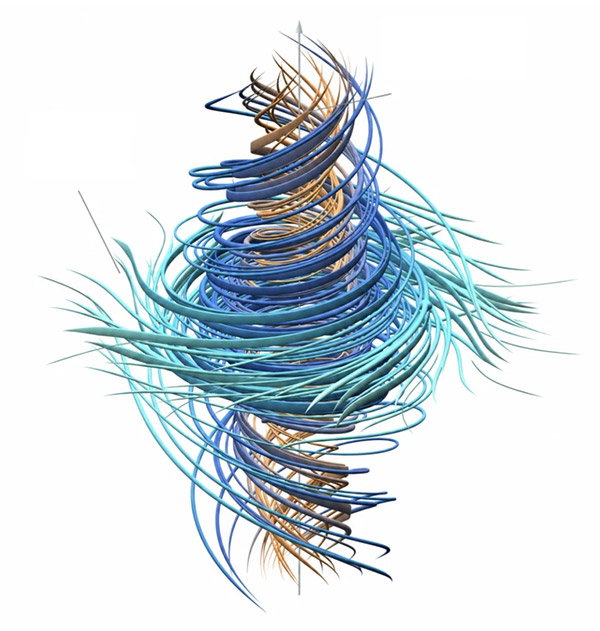
| OpenAI’s solution is a vortex that spirals inward and gets increasingly elongated. In this snapshot, orange marks faster angular rotation, while teal marks slower rotation. (OpenAI) | ||
OpenAI says it has cracked physics of fluidsOpenAI says that it has shown that the Navier-Stokes equations — which describe the motion of fluids — can break down. Whether or not this could happen is considered one of the trickiest problems in mathematics, and it was on a list of ‘Millennium Prize’ challenges. The US artificial-intelligence company published a preprint that describes a spinning fluid system that ramps up to infinite speeds in a finite amount of time — something that would be impossible in real life. Mathematicians have hailed the achievement, but some are getting weary of science-by-press-release. “I would much rather see a professional level preprint appear on a standard server such as the arXiv, or a talk presented by the authors at a conference,” says mathematician Terence Tao. Reference: OpenAI preprint (not peer reviewed) |
||
Moon might have formed in five hoursThey say Rome wasn’t built in a day, but the Moon might have taken just five hours to form from the debris of a collision between Earth and a Mars-sized space rock. Simulations have tended to focus on the size of proto-Earth and ‘Theia’, the body that evidence suggests once struck our home planet. If Earth and Theia were both hot and smooshy, the chunks that eventually formed the Moon would have stayed largely intact — making it form more quickly — than if the two smashees were cool. Live Science | 8 min readReference: The Astrophysical Journal Letters paper |
||
Mapping every single-DNA-letter changeThe AI company Google DeepMind has released an ‘atlas’ of the human genome that aims to guide scientists through our biological code. The AlphaGenome Atlas charts the effects of nine billion single-DNA-letter changes — every possible mutation of this kind — in the human genome using predictions generated by a DeepMind AI model. The atlas could help to diagnose rare, unexplained diseases and uncover the hidden biology of common illnesses and biological traits, say researchers. It could also reveal some of the hidden rules by which DNA sequences control gene activity. Nature | 6 min read |
||
|
||
The Einstein testIf a language model trained on the information Albert Einstein might have had — Western science up to 1911, say — could it reproduce creative breakthroughs such as his general theory of relativity? Demis Hassabis, the co-founder of Google DeepMind, suggested this could be “a good test for AGI”, referring to the nebulous concept of artificial general intelligence that is a goal for many in the AI industry. Scientists are giving this, and similar experiments, a go. But their early attempts reveal more about the limitations of current AI systems — and the data we have to train them — than about their strengths. Nature | 15 min read |
||
Why we don’t have better bacteriaScientists in the United States have bioengineered microorganisms that can eat plastic, detect landmines and extract rare metals, says biotechnology writer Niko McCarty. But the process of getting them out of the lab has been hamstrung by a 1976 US law, the Toxic Substances Control Act (TSCA), that was not written with biotechnology in mind. Some engineered microbes dodge the TSCA by falling under other regulators — as pesticides, or dietary supplements, for example. The rest go into “the black hole of biology” — but it doesn’t have to be that way, McCarty argues. Works in Progress | 15 min read |
||
Document Africa’s geology to protect itAfrica’s geological record is a trove of clues about ancient climates and the origins of humans, but much of it is poorly documented, writes geoscientist Kamaldeen Omosanya. Publications related to Africa are underrepresented in major geological databases. This can both leave sites of possible geological interest vulnerable to mining or construction and alienate African students from Earth sciences in their own countries. “The rocks already hold the stories,” Omosanya writes. “The task is to make sure people can find them, understand them and protect them.” The Conversation | 6 min read |
||
Quote of the day“To do a forecast beyond 24 hours was, in the 1940s, like trying to land a man on the moon.”The upcoming film Pressure depicts meteorologist James Stagg’s work to forecast the weather of 5 June 1944 — the planned date of the D-day landings. Reaching a result, one that delayed the landings by one day, was no mean feat with the equipment available to Stagg at the time, says Stephen Burt, a meteorologist and adviser on the film. (The Guardian | 5 min read) |
||
|
|
||
|
||
|
|
||
Free newsletters from NatureWant more? Update your preferences to sign up to our other Nature Briefing newsletters:
|
||
|
||
|
You received this newsletter because you subscribed with the email address: - Please add [email protected] to your address book. Had enough? To unsubscribe from this Briefing, but keep receiving your other Nature Briefing newsletters, please update your subscription preferences. To stop all Nature Briefing e-mails forever, click here to remove your personal data from our system. Fancy a bit of a read? View our privacy policy. Forwarded by a friend? Get the Briefing straight to your inbox: subscribe for free. Get more from Nature: Register for free on nature.com to sign up for other newsletters specific to your field and e-mail alerts from Nature Portfolio journals. Would you like to read the Briefing in other languages? 关注Nature Portfolio官方微信订阅号,每周二为您推送Nature Briefing精选中文内容——自然每周简报。
Nature Portfolio | The Springer Nature Campus, 4 Crinan Street, London, N1 9XW, United Kingdom Nature Portfolio, part of Springer Nature. |