Text-message tutoring keeps kids learning maths when schools close
What matters in science |

Is this your brand on Milled? Claim it.
|
||
|
||
|
Hello Nature readers, |
||
|
||
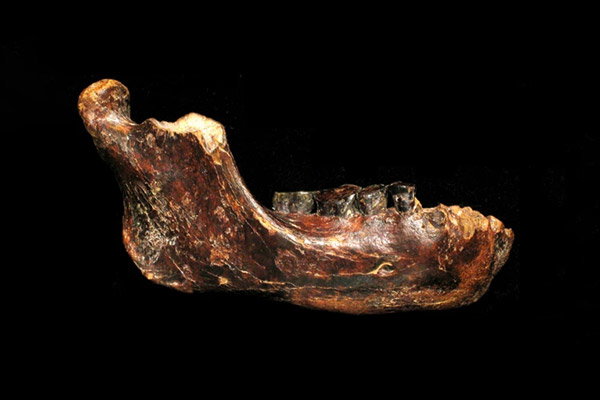
| In 2025, researchers used protein analysis to show that this jawbone belonged to a Denisovan, a species of ancient human. (Yousuke Kaifu) | ||
Fossil trove sheds new light on DenisovansA collection of fossils and artefacts recovered from an abandoned quarry in southwestern China has given researchers an unprecedented glimpse into the lives of ancient humans called Denisovans. The items suggest that Denisovans — who lived at the site for at least 30,000 years — crafted bone tools similar to those of the Neanderthals, and were skilled hunters of animals such as deer. “This site’s the full package,” says archaeologist Ben Marwick. “It’s the first site that we have with a long, rich sequence that’s uniquely associated with Denisovans.” Nature | 5 min readReference: Nature paper 1 & paper 2 |
||
Texts and calls keep learning afloatText messages and weekly 20-minute phone calls from a teacher can improve children’s learning during prolonged school closures. The approach offers a relatively cheap way to support children’s mathematics education when schooling is disrupted by natural disasters, pandemics or other emergencies, say the study authors. In a trial across five countries, kids that received both texts and phone calls improved the most. But text messages alone also improved children's learning compared to a control group. Nature | 5 min readReference: Nature paper |
||
|
||
Virtual cell model predicts best cancer drugA prototype tool called ProteinTalks can predict how the cells in triple-negative breast cancer (TNBC) tumours — which can behave very differently at the molecular level — will respond to various drugs. Researchers trained the computational simulation on millions of protein measurements collected over time from breast cancer cell lines that were treated with dozens of antitumour drugs and drug combinations. The model did a good job of predicting how cells would respond to drugs it hadn’t seen before and real-world clinical outcomes. Nature | 6 min readReference: Nature paper |
||
|
||
|
||
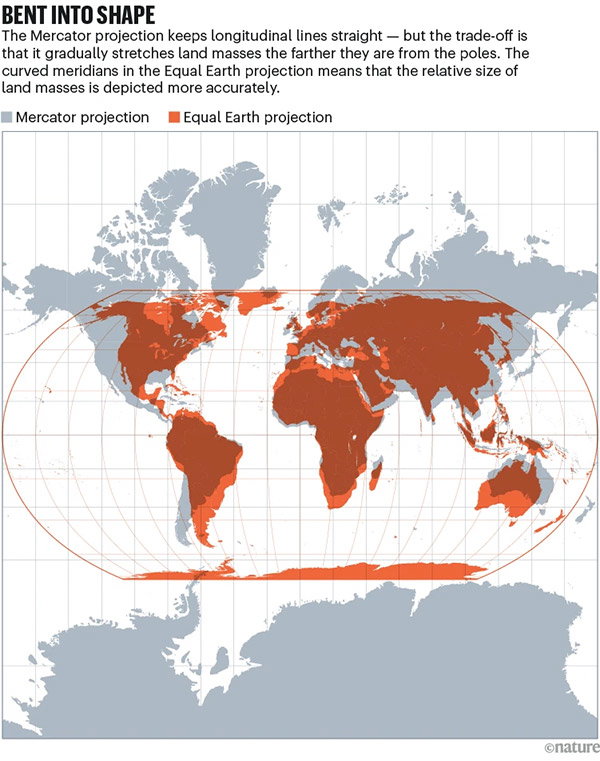
| The United Nations has voted to phase out use of the Mercator map, a widely used sixteenth-century projection that has been criticized for not representing countries’ sizes accurately. The Mercator map depicts land masses closer to the poles — most of which are in the Northern Hemisphere — as disproportionately large. This can be problematic because people are inclined to conflate size and importance, researchers say. The UN resolution instead endorses use of the Equal Earth projection, which more accurately depicts the relative sizes of land masses. (Nature | 5 min read) | ||
|
||
The mathematician’s protégéIn 2019, retired topologist Joan Birman received an email from 15-year-old Vasudha Bharathram asking for help in learning geometry. After a few meetings, Birman realized that Bharathram had a knack for the subject, and often solved well-known problems in an unconventional way. Bharathram inspired Birman to revisit a problem that had eluded her for decades: is the Burau representation — the translation of the structure of braids into algebraic objects called matrices — faithful for four-strand braids? This year, a 99-year-old Birman, Bharathram and collaborator Tara Brendle published their answer: yes. The New York Times | 15 min readReference: arXiv preprint (not peer reviewed) |
||
AI is a debate partner, not an oracleThe concerns that researchers might outsource scientific judgement to generative artificial intelligence are valid, but aimed at the wrong object, argues computer scientist Marc Schmitt. The danger is not AI, but people’s assumption that chatbots are producing final answers. Users should treat AI tools as intellectual sparring partners, with which they can develop and hone their thinking. AI developers should encourage this argument-based dialogue with chatbots, and universities should treat a student’s ability to participate in these arguments as a core skill, Schmitt suggests. Nature | 5 min read |
||
Video: bacteria shuttle drugs to tumoursTo minimize the off-target effects of cancer therapies, researchers need to find ways to deliver drugs to tumours accurately. Some species of bacteria are attracted to the low-oxygen environment in tumours, which makes them ideal candidates to shuttle drugs directly to their target. These bacteria can also be engineered to manufacture the drug inside their cells, and even to sense the conditions of their environment to ensure that they only release their cargo inside a tumour. Nature | 4 min videoThis video is part of Nature Outlook: Drug delivery, an editorially independent supplement produced with financial support from Taiho Oncology, Inc. |
||

|
||
Quote of the day“In hard times, a sense of humour is a survival skill.”The irreverent Ig Nobel prize ceremony feels newly relevant in its fourth decade, argues a Nature editorial. The event punctures pomposity, builds community and offers scientists a chance to have a good laugh. (6 min read) |
||
|
|
||
|
||
|
|
||
Free newsletters from NatureWant more? Update your preferences to sign up to our other Nature Briefing newsletters:
|
||
|
||
|
You received this newsletter because you subscribed with the email address: - Please add [email protected] to your address book. Had enough? To unsubscribe from this Briefing, but keep receiving your other Nature Briefing newsletters, please update your subscription preferences. To stop all Nature Briefing e-mails forever, click here to remove your personal data from our system. Fancy a bit of a read? View our privacy policy. Forwarded by a friend? Get the Briefing straight to your inbox: subscribe for free. Get more from Nature: Register for free on nature.com to sign up for other newsletters specific to your field and e-mail alerts from Nature Portfolio journals. Would you like to read the Briefing in other languages? 关注Nature Portfolio官方微信订阅号,每周二为您推送Nature Briefing精选中文内容——自然每周简报。
Nature Portfolio | The Springer Nature Campus, 4 Crinan Street, London, N1 9XW, United Kingdom Nature Portfolio, part of Springer Nature. |