The month’s best science images: A Mars helicopter and a spectacular flowery frame for the Milky Way
What matters in science |

Is this your brand on Milled? Claim it.
|
|||||
|
|||||
|
Hello Nature readers, |
|||||

|
|||||
| (Alvin Wu) | |||||
The month’s best science imagesPhotographer Alvin Wu used a fisheye perspective to capture this surreal snap of a field of flowers framing the Milky Way over Twizel, New Zealand. The shot was one of 25 selected images in the ninth Milky Way Photographer of the Year competition. |
|||||
Bees can problem-solve on the flyBumble bees (Bombus terrestris) can suss out how to use a tool to complete a set task without explicit training. Bees were shown a ceiling-mounted artificial flower, which contained a tasty sucrose treat, and then separately, a styrofoam ball. Then, the insects were put into an environment with both. The bees worked out that they could roll the ball under the flower for a leg-up to their reward. The insects were never explicitly shown that they could use the ball for this purpose, which suggests they have the cognitive capacity to problem-solve. Science | 5 min readReference: Science paper |
|||||
|
|||||
|
|||||
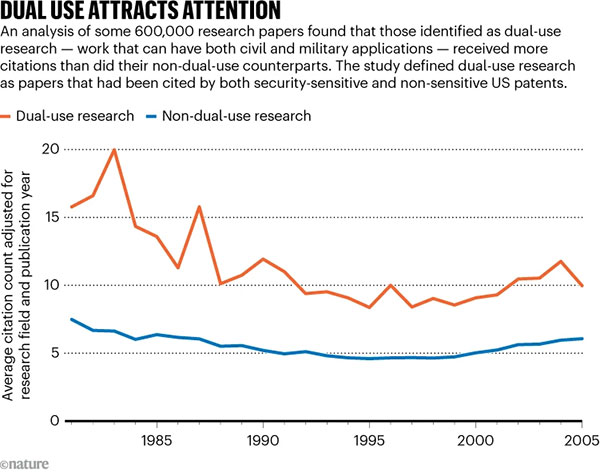
| Research with both civilian and military or security applications — known as ‘dual-use’ research — is cited more than research that has strictly civilian applications, according to an analysis of bibliometric databases and US patent records. The findings could be an overestimate, because the team used a broad definition of dual-use research, says biosecurity policy researcher Michael Imperiale. (Nature | 5 min read) (Reference: Science paper) | |||||
|
|||||
Will AI be the death of astrophysics?“Anyone working in astrophysics is someone who wants to do astrophysics, not someone who wants to learn the answers,” argued David Hogg in a recent preprint. “When we measure the age of the Universe, no-one on the team actually cares what the specific value is, even though each of them might have spent many hard years of their life figuring [it] out.” Hogg was exploring an issue that has been increasingly debated behind closed doors: if AI tools can do much of the data science and mathematics that make up the bread-and-butter of astrophysical discovery, where does that leave one of science’s most fundamental and philosophical fields? Science | 21 min readReference: arXiv preprint (not peer reviewed) |
|||||
Futures: Book of Cron JobA noble machine learns the weight of its power in the latest short story for Nature’s Futures series. Nature | 7 min read |
|||||
Podcast: face-reading phone for heart healthResearchers have developed a system that passively measures your resting heart rate during everyday use of your smartphone, avoiding the need for a visit to a clinic, or an expensive wearable monitor. “Every time your heart beats, it generates this pulse wave that propagates through the blood vessels… including the vessels that are underneath the skin of your face,” study co-author Ming-Zher Poh tells the Nature Podcast. “These are the subtle colour changes that the front-facing smartphone camera is analyzing.” Nature Podcast | 18 min listenSubscribe to the Nature Podcast on Apple Podcasts, Spotify or YouTube Music, or use the RSS feed. |
|||||

|
|||||
Quote of the day“Being conservationists, biologists, ecologists, we can’t just sit and look and wait … We are trying to do at least something.”After the Zalissia National Nature Park near Kyiv, Ukraine, became a battleground in the Russian invasion, its European bison (Bison bonasus) population was reduced to only 14 animals — and no males. Ostap Reshetylo of World Wildlife Fund-Ukraine and others are trying to reintroduce male bison back to the land while the war rages on. (Biographic | 10 min read) |
|||||
|
|
|||||
|
|||||
|
|
|||||
Free newsletters from NatureWant more? Update your preferences to sign up to our other Nature Briefing newsletters:
|
|||||
|
|||||
|
You received this newsletter because you subscribed with the email address: - Please add [email protected] to your address book. Enjoying this newsletter? You can use this form to recommend it to a friend or colleague — thank you! Had enough? To unsubscribe from this Briefing, but keep receiving your other Nature Briefing newsletters, please update your subscription preferences. To stop all Nature Briefing emails forever, click here to remove your personal data from our system. Fancy a bit of a read? View our privacy policy. Forwarded by a friend? Get the Briefing straight to your inbox: subscribe for free. Want to master time management, protect your mental health and brush up on your skills? Sign up for our free short e-mail series for working scientists, Back to the lab. Get more from Nature: Register for free on nature.com to sign up for other newsletters specific to your field and email alerts from Nature Portfolio journals. Would you like to read the Briefing in other languages? 关注Nature Portfolio官方微信订阅号,每周二为您推送Nature Briefing精选中文内容——自然每周简报。
Nature Portfolio | The Springer Nature Campus, 4 Crinan Street, London, N1 9XW, United Kingdom Nature Portfolio, part of Springer Nature. |