What it will take to stop the spiralling Ebola outbreak
What matters in science |

Is this your brand on Milled? Claim it.
|
|||||
|
|||||
|
Hello Nature readers, |
|||||
|
|||||
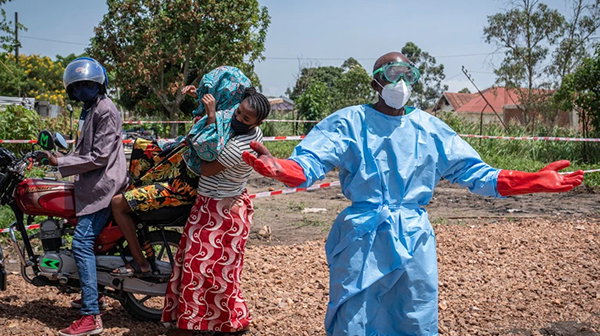
| A health worker at a hospital in Ituri province in the Democratic Republic of the Congo asks for help in receiving a person suspected of having Ebola. (Glody Murhabazi/AFP via Getty) | |||||
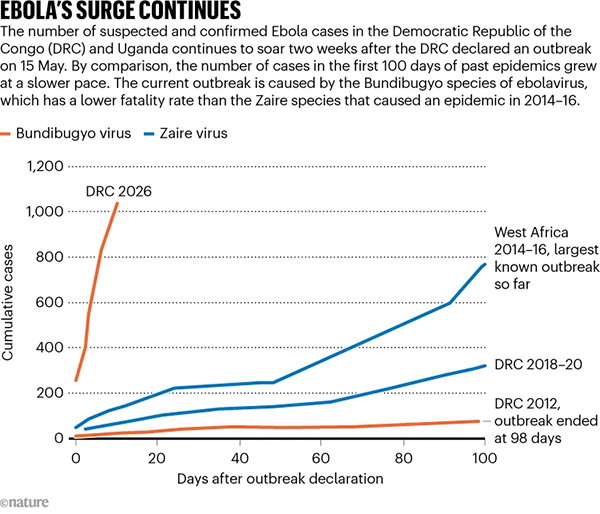
What it will take to stop EbolaThe tally of people with suspected and confirmed cases of Ebola in central Africa is rocketing upwards with shocking speed, but specialists say that we have the tools to control it thanks to hard-won expertise gained during previous Ebola epidemics. They recommend:
|
|||||
|
|||||
Multi-organ pig transplant shows promiseA clinically dead 53-year-old man has become the first person to receive two kidneys and a liver from a genetically modified pig. The man’s organ function was sustained for almost five days with consent from his family, and there were no signs that the organs were being rejected in the first 24 hours. The procedure marks the first time that a whole pig liver has been transplanted into a person, and the first time a pig liver and kidneys have been transplanted into a human at the same time. Nature | 4 min readReference: Med paper |
|||||
Image issues in antibody catalogueCatalogue entries for more than 100 antibodies sold by the research services and supply company Thermo Fisher Scientific contain images that have apparently been manipulated, according to a pair of researchers who specialize in scientific integrity issues. Altered images don’t necessarily mean that the underlying products are defective. But the finding feeds into some researchers’ longstanding worries about the reliability of commercial antibodies, which are a key tool for studying proteins. Nature | 8 min readReference: Database of ‘problematic images’ |
|||||
Rocket failure rattles NASA’s Moon planThe explosion of one of aerospace company Blue Origin’s New Glenn rockets last week leaves NASA at least temporarily without a key partner for its ambitious plans to put people back on the Moon. No one was hurt in the blast, but the company’s rocket design is now being re-assessed and its launch facilities are heavily damaged. A mission to send scientific equipment to the lunar south pole was slated to launch later this year using one of Blue Origin’s rockets, but will be delayed at least until the damage is repaired. Nature | 6 min read |
|||||

|
|||||
| A Blue Origin mission was supposed to launch to the Moon later this year using a rocket of the type that exploded last week. (NASASpaceflight.com via Reuters) | |||||
|
|||||
We don’t know how long humans can liveIn Morbid, longevity researcher Saul Newman argues that all claims and counterclaims about an upper limit to human lifespan rest on shaky foundations. Many cases of extreme longevity — such as the ‘supercentenarians’ who live to an age of 110 or more — arise simply from faulty records, he says, raising broader questions about how ageing is measured and interpreted. “Extraordinary claims about extreme longevity deserve much more scepticism than they receive,” Newman tells Nature. “Claims are loudly platformed when they start and buried in silence when they fail.” Nature | 10 min read |
|||||
Obesity isn’t always a diseaseObesity can be described as a chronic disease, but this label shouldn’t be applied uniformly to a condition that can affect individuals’ health so differently, argues surgeon Francesco Rubino. Instead, there should be two diagnoses: clinical obesity, in which excess fat tissue directly impairs daily activities or causes demonstrable organ dysfunction, and preclinical obesity, in which it doesn’t. The former is “unequivocally disease” while the latter represents elevated health risks, Rubino writes. This distinction can help clinicians know who to prioritize for treatment and avoids labelling people as diseased when they might not consider themselves to be ill. Nature | 16 min read |
|||||
The queer magic of the seaBiophysicist Joseph Osmundson wrote a genre-defying memoir, Spawning Season, that explores the complexities of making a baby as a gay man alongside the odyssey of a spawning salmon. He speaks to three fellow queer authors — Lulu Miller, Lars Horn and Sabrina Imbler — who also used the science and wonder of sea life as routes to self-discovery in their recent books, Why Fish Don't Exist, Voice of the Fish and How Far the Light Reaches respectively. “The magic of the sea,” writes Osmundson, is that “our animal eyes cannot easily see there, and so we are forced to study, to voyage, to imagine”. Orion | 23 min read |
|||||
Quote of the day“No cause, no conflict, no grievance is worth condemning innocent people to death from a preventable disease.”World Health Organization director-general Tedros Adhanom Ghebreyesus calls on warring factions in the Democratic Republic of the Congo to declare a ceasefire so that health workers can access areas affected by Ebola. Protecting public health is a moral obligation and a human right, and crucial for a country’s economic health, says a Nature editorial. (8 min read) |
|||||
|
|
|||||
|
|||||
|
|
|||||
Free newsletters from NatureWant more? Update your preferences to sign up to our other Nature Briefing newsletters:
|
|||||
|
|||||
|
You received this newsletter because you subscribed with the email address: - Please add [email protected] to your address book. Enjoying this newsletter? You can use this form to recommend it to a friend or colleague — thank you! Had enough? To unsubscribe from this Briefing, but keep receiving your other Nature Briefing newsletters, please update your subscription preferences. To stop all Nature Briefing emails forever, click here to remove your personal data from our system. Fancy a bit of a read? View our privacy policy. Forwarded by a friend? Get the Briefing straight to your inbox: subscribe for free. Want to master time management, protect your mental health and brush up on your skills? Sign up for our free short e-mail series for working scientists, Back to the lab. Get more from Nature: Register for free on nature.com to sign up for other newsletters specific to your field and email alerts from Nature Portfolio journals. Would you like to read the Briefing in other languages? 关注Nature Portfolio官方微信订阅号,每周二为您推送Nature Briefing精选中文内容——自然每周简报。
Nature Portfolio | The Springer Nature Campus, 4 Crinan Street, London, N1 9XW, United Kingdom Nature Portfolio, part of Springer Nature. |