Why humans sleep so much less than other apes
What matters in science |

Is this your brand on Milled? Claim it.
|
|||||
|
|||||
|
Hello Nature readers, |
|||||
|
|||||
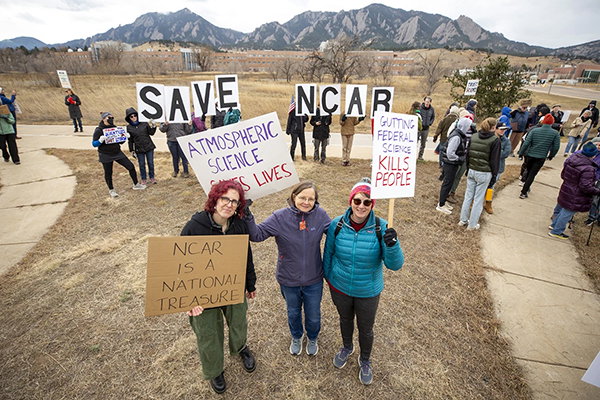
| Protesters gathered late last year in Boulder, Colorado, to oppose the dismantling of the US National Center for Atmospheric Research. (Kevin J. Beaty/Denverite.com) | |||||
Climate ‘mothership’ fights back in courtOne of the leading climate-science institutions in the world — the National Center for Atmospheric Research (NCAR) in Boulder, Colorado — is fighting for its life in a US courtroom. The universities that manage the research centre are suing the administration of President Donald Trump, which has said that it will dismantle NCAR because it is a source of “climate alarmism”. At the heart of the case is whether the US National Science Foundation is moving too quickly and without authority to hand off pieces of NCAR — including a supercomputing centre in Wyoming — to public and private institutions. Whatever the ruling, the broader battle over the future of NCAR — including its aeroplane fleet, space-weather studies and climate-modelling teams — will probably continue to play out. Nature | 8 min read |
|||||
Publishers sue over papers fed to Meta AIMega-publisher Elsevier has joined a class-action lawsuit against technology company Meta and its chief executive Mark Zuckerberg, alleging that its copyrighted works were used to train Meta’s AI models. The lawsuit claims that Meta drew on databases, such as Sci-Hub, that contain unauthorized copies of copyrighted works. Meta has suggested that it will argue that AI training is ‘transformative’ and allowed under the ‘fair use’ exemption. Nature | 6 min read |
|||||
Fact-checking MAHA mental-health claimsAt a Make America Healthy Again (MAHA) wellness summit attended by US health secretary Robert F. Kennedy Jr, speakers raised concerns about the quality of mental-health treatment in the United States, pointing to issues of overdiagnosis, overmedication and withdrawal. But the true problems are “underdiagnosis and undertreatment”, says Timothy Wilens, a clinical psychiatrist and president-elect of the American Academy of Child and Adolescent Psychiatry (AACAP), who notes that at least one-half of US children with mental-health conditions are not getting the care they need. When it comes to withdrawal, clinicians don’t have enough information because researchers have struggled to find funding for large-scale discontinuation trials, says psychiatrist and AACAP president John Walkup. Nature | 9 min read |
|||||
Cyberattack hobbles Canvas platformAn estimated 9,000 educational institutions — including universities across the United States, Canada and Australia — have been affected by a breach of the Canvas software platform. Students and teachers — including some who were in the middle of exams — were greeted with a ransomware message when they attempted to use the system. Instructure, the company that owns Canvas, says the platform is mostly up and running again, but some institutions have suspended its use. BBC | 7 min read |
|||||
|
|||||
Why humans sleep so littleOn the basis of the sleeping habits of closely related animals, biological anthropologist David Samson estimates that humans require roughly 2.5 hours more sleep than we tend to get each day. This “human sleep paradox” is the focus of his book, The Sleepless Ape. Using ethnography, neurobiology and primatology, Samson argues that the amount of sleep our species gets reflects an evolutionary trade-off. Short, high-quality bouts of sleep helped our ground-sleeping ancestors to stay alert to predators, with the bonus of more waking hours for social interaction and learning — something that reshaped the trajectory of our evolution. Nature | 7 min read |
|||||
The true language of the genomeThe regulatory region makes up about 98% of the human genome but is written in a code that researchers have yet to untangle. Now, a suite of tools called massively parallel reporter assays (MPRAs) could give them a cipher key. MPRAs measure how thousands of isolated sequence variants influence the expression of hand-picked reporter genes, letting scientists hone in on the genome’s ‘control knobs’. Decoding this mysterious language could help to clarify the genetic foundations of disease, reveal the changes wrought by evolution and guide the development of next-generation therapeutics. Nature | 16 min read |
|||||
Science dug a hole it couldn’t get out ofWhen the launch of Sputnik put the USSR at the forefront of the Cold-War space race, the event galvanized funding and inertia for US science, argues Lisa Margonelli, the editor-in-chief of Issues in Science and Technology. “But Sputnik moments have an evil twin, what might be called Mohole moments, when some focal point for distrust closes windows, rolls back funding, cuts support, and craters trust.” Margonelli looks back at Project Mohole, a plan to drill to the Earth’s mantle that was cancelled in 1966 amidst huge cost overruns, as an example of how narratives — particularly scandals — can drive science policymaking. Issues in Science and Technology | 13 min read |
|||||
Quote of the day“I realized I was the only person who had ever seen this … For a brief period, that knowledge was just for me.”Traumatic-brain-injury researcher Nicole Ackermans recalls a moment of discovery in an otherwise-empty lab — one example of what a good day in science looks like. (Nature | 17 min read) |
|||||
|
|
|||||
|
|||||
|
|
|||||
Free newsletters from NatureWant more? Update your preferences to sign up to our other Nature Briefing newsletters:
|
|||||
|
|||||
|
You received this newsletter because you subscribed with the email address: - Please add [email protected] to your address book. Enjoying this newsletter? You can use this form to recommend it to a friend or colleague — thank you! Had enough? To unsubscribe from this Briefing, but keep receiving your other Nature Briefing newsletters, please update your subscription preferences. To stop all Nature Briefing emails forever, click here to remove your personal data from our system. Fancy a bit of a read? View our privacy policy. Forwarded by a friend? Get the Briefing straight to your inbox: subscribe for free. Want to master time management, protect your mental health and brush up on your skills? Sign up for our free short e-mail series for working scientists, Back to the lab. Get more from Nature: Register for free on nature.com to sign up for other newsletters specific to your field and email alerts from Nature Portfolio journals. Would you like to read the Briefing in other languages? 关注Nature Portfolio官方微信订阅号,每周二为您推送Nature Briefing精选中文内容——自然每周简报。
Nature Portfolio | The Springer Nature Campus, 4 Crinan Street, London, N1 9XW, United Kingdom Nature Portfolio, part of Springer Nature. |