Why the WHO took two years to say COVID is airborne
What matters in science |

Is this your brand on Milled? Claim it.
|
|||||
|
|||||
|
Hello Nature readers, |
|||||
|
|||||
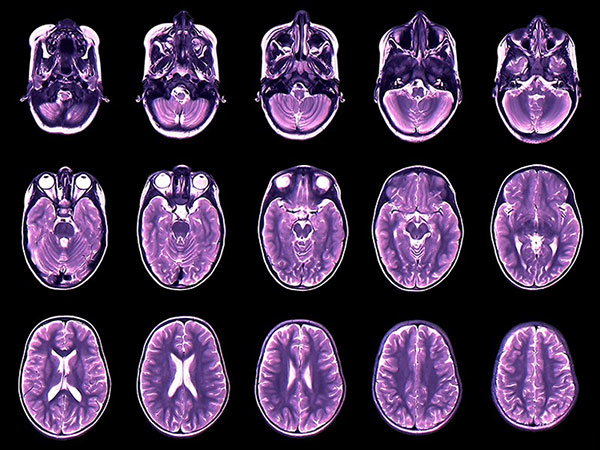
| MRI scans show the healthy brain of a young child. (Zephyr/SPL) | |||||
A growth chart for your brainResearchers have aggregated more than 120,000 scans to create the first comprehensive growth charts for brain development. The charts show how the brain expands and shrinks over time, and could one day be used alongside the height and weight charts that physicians use to track child development. This work has never before been done on such a scale, but the authors call this ‘a first draft’ because their database isn’t completely inclusive — they struggled to gather brain scans from all regions of the globe. If the charts are eventually rolled out to paediatricians, great care will be needed to ensure that they are not misinterpreted, says paediatric neurologist Hannah Tully. “A big brain is not necessarily a well-functioning brain.” Nature | 7 min readReference: Nature paper |
|||||
|
|
|||||
A double-whammy of COVID immunityA trio of studies has shown that even people who have had COVID-19 get long-lasting benefits from being fully vaccinated.
References: The Lancet Infectious Diseases paper 1, The Lancet Infectious Diseases paper 2 & The New England Journal of Medicine paper |
|||||
|
|
|||||
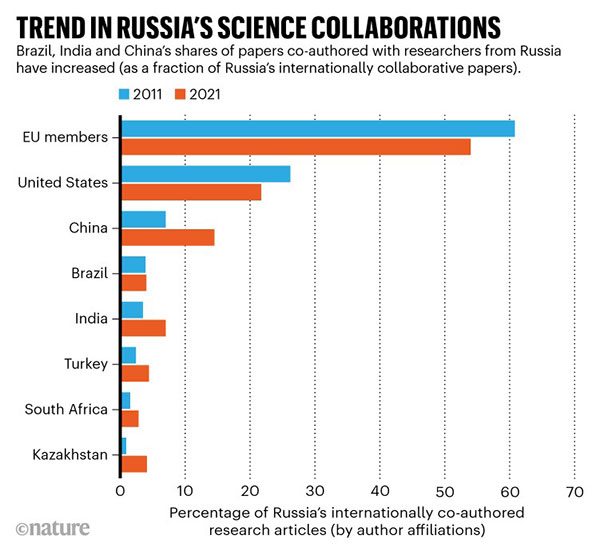
Some nations keep ties to Russian researchMany Western nations are severing scientific links with Russia after the country’s invasion of Ukraine. But it’s a different story in the BRICS, a group of five countries — including Brazil, Russia, India, China and South Africa — that work together to promote trade and economic development and have an active programme of scientific cooperation. For example, last month, all five governments announced a new partnership on vaccines. Many scientists and research institutions in the countries have condemned the invasion. But many agree with Brazilian Physics Society president Débora Peres Menezes that “scientists should not individually pay the price of war”. Nature | 8 min read |
|||||
|
|||||
|
|
|||||
Can mushrooms ‘speak’?Researchers who tapped into the network that connects fungi say that its patterns of electrical signals resemble human speech. Previous studies have suggested that fungi use electrical signals to communicate and process information across tiny connective threads called mycelium. In the new study, researchers inserted tiny electrodes into substrates colonized by four species of fungi. They found that spikes of electrical activity often clustered into groups that resembled vocabularies of up to 50 words and could be similar to human language. But some researchers are sceptical. “The interpretation as language seems somewhat overenthusiastic, and would require far more research and testing of critical hypotheses before we see ‘Fungus’ on Google Translate,” says bioscientist Dan Bebber. The Guardian | 4 min readReference: Royal Society Open Science paper |
|||||
|
|||||
Why the WHO delayed airborne warningThroughout much of 2020, the World Health Organization (WHO) held tight to the idea that SARS-CoV-2, the virus that causes COVID-19, spreads through relatively large ‘respiratory’ droplets that contaminate nearby surfaces. It took many months for the agency to acknowledge that the virus could travel on tiny particles called aerosols that can spread widely and linger in the air. And nearly two years passed before the WHO clearly stated that the virus is airborne. That mistake and the prolonged process of correcting it sowed confusion and raises questions about what will happen in the next pandemic. Nature | 18 min read |
|||||
|
|
|||||
Recognize authorship of open dataThe open data revolution won’t happen unless the research system values the sharing of data as much as authorship on papers, argues a Nature editorial. “Crediting all those who contribute their knowledge to a research output is a cornerstone of science,” says the editorial. “The prevailing convention — whereby those who make their data open for researchers to use make do with acknowledgement and a citation — needs a rethink.” Nature | 4 min read |
|||||
|
|
|||||
Abel winner: ‘I was sort of a bad student’Last month, mathematician Dennis Sullivan won the Abel Prize, the ‘Nobel of mathematics’, for his work on topology. From inauspicious beginnings as a ‘bad student’ in secondary school — “I think it’s because I was actually nearsighted,” he says — Sullivan fell in love with the field as a chemical-engineering undergraduate. “There’s no ambiguity, whereas almost everything else is much woollier and murkier, compared with mathematics,” he says. “There’s some great comfort in that … And it’s very beautiful.” Scientific American | 6 min readRead more: Virtuoso mathematician who re-shaped topology wins Abel Prize (Nature | 4 min read) |
|||||
Quote of the day“This is the first time we've ever had a chapter on demand because this idea about economic growth and demand being linked was just untouchable … But as soon as you start questioning it, you realize that it's a God with clay feet. That you can actually do a lot better with a lot less.”Environmental economist Julia Steinberger is a contributing author on the latest Intergovernmental Panel on Climate Change (IPCC) report, which finds that demand-side strategies to deliver services more efficiently can reduce 50–80% of emissions across all sectors. (Drilled | 8 min read) |
|||||
|
|
|||||
|
|||||
|
|
|||||
|
|||||
|
You received this newsletter because you subscribed with the email address: - Please add [email protected] to your address book. Enjoying this newsletter? You can use this form to recommend it to a friend or colleague — thank you! Want to switch to the weekly edition or change your email address? Update your preferences. Had enough? Unsubscribe from the Nature Briefing. Fancy a bit of a read? View our privacy policy. Forwarded by a friend? Get the Briefing straight to your inbox: subscribe for free. Want to master time management, protect your mental health and brush up on your skills? Sign up for our free short e-mail series for working scientists, Back to the lab. Get more from Nature: Register for free on nature.com to sign up for other newsletters specific to your field and email alerts from Nature Research journals. Would you like to read the Briefing in other languages? 关注Nature Portfolio官方微信订阅号,每周二为您推送Nature Briefing精选中文内容——自然每周简报。
Nature | The Springer Nature Campus, 4 Crinan Street, London, N1 9XW, United Kingdom Nature Research, part of Springer Nature. |