Hi -,
The brilliantly named “cold blob” – a patch of ocean that is the only place on Earth that is cooling – has always been somewhat of a mystery. But now, scientists think it could be a sign that the warm water "conveyor belt" in the Atlantic is slowing down. And we may be getting to the bottom of another mystery: Stonehenge. One hypothesis states that its altar stone was carried southwards from Scotland by a glacier. But it’s actually more likely that humans, who were in no hurry, carried it down.
|
|
|
|
|
Hi -,
The brilliantly named “cold blob” – a patch of ocean that is the only place on Earth that is cooling – has always been somewhat of a mystery. But now, scientists think it could be a sign that the warm water "conveyor belt" in the Atlantic is slowing down. And we may be getting to the bottom of another mystery: Stonehenge. One hypothesis states that its altar stone was carried southwards from Scotland by a glacier. But it’s actually more likely that humans, who were in no hurry, carried it down.
|
|
|
|
Like what you see? Subscribe today to gain unlimited access to all our subscriber only content. |
|
|
|
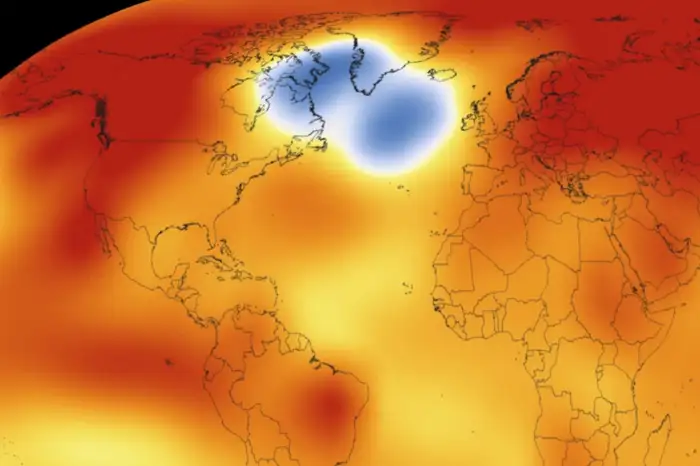
The “cold blob” appears in a data visualisation showing average temperatures in 2015, relative to the 1951-80 average |
NASA Scientific Visualization Studio/Goddard Space Flight Center |
|
|
|
Over the past 150 years, Earth’s entire surface has been warming, except for one patch of the north Atlantic. Located south-east of Greenland, this area has cooled by as much as 1°C and is known as the “warming hole” or the “cold blob”. Scientists have been split over why this cold blob exists, but the latest evidence backs up the idea that it is caused by a weakening of the Atlantic Meridional Overturning Circulation (AMOC), the system of currents that transports warmth from the tropics to Europe. Read more
|
|
|
|
Researchers investigating the origins of Stonehenge’s enigmatic altar stone say it is possible that the 6-tonne rock was carried southwards from Scotland by a glacier – but this hypothesis relies on an unlikely series of events, making it more likely that humans transported it. “These people that erected Stonehenge weren’t in any rush. This could have been much like the pyramids, a multi-year endeavour, so it doesn’t need to happen on our modern timescales of months,” says Anthony Clarke at Curtin University in Perth, Australia. Read more
|
|
|
|
10-12 October, Excel London and online |
Journey to the stars and beyond, exploring the biggest cosmic mysteries, from the hunt for dark matter to unravelling the multiverse and the future of space travel on the Universe Stage. Book now
|
|
|
|
|
Roger Penrose was attending the International Congress of Mathematicians in 1954 when he came across the work of Maurits Cornelis Escher, an artist and print-maker whose work draws heavily on mathematical concepts like infinity and paradox. Penrose was immediately “spellbound” by their mathematical beauty. Now, Escher’s Penrose-inspired prints, together with more than 150 other works, will feature in “M.C. Escher: The Exhibition” at Somerset House in London from 5 June. It is a major retrospective of the artist’s work, including drawings and prints from his entire career. Explore the images
|
|
|
|
A deep dive into our organs |
Giulia Enders made her name with Gut, an exploration of our intestines. Now, in the compelling follow-up Organ Speak, she’s listening to what our other organs are telling us. Read more |
|
|
|
The Change Your Mind podcast |
Can visualising your goals really change your behaviour? Why does the brain focus so heavily on negative outcomes? And could techniques often dismissed as "woo" actually help you achieve what you want? New Scientist journalists Cat de Lange and Helen Thomson investigate the neuroscience of manifestation. Listen here |
|
|
|
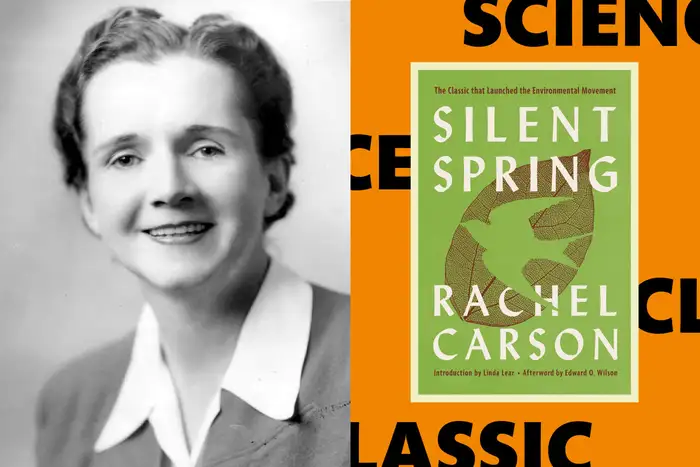
How Rachel Carson's Silent Spring changed the world in 1962 |
|
|
|
Rachel Carson was a marine biologist who wrote three books about life in the ocean, before a letter, published in The Boston Herald, prompted a change of focus. The letter described the deadly impact of the pesticide DDT (dichlorodiphenyltrichloroethane) on a bird population in Massachusetts. Carson set off to research the environmental effects of pesticides: she pencilled in “Silent Spring” as the title for a chapter on birds, but her agent suggested that it worked for the book as a whole. Carson’s look at the dire effects of industrial and agricultural pollution birthed the modern environmental movement when it was first published – and remains as crucial a read today, finds Rowan Hooper. Read more
|
|
|
|
“Simply sitting on a couch to Netflix-and-chill with your partner, or going for a walk, becomes impossible.” |
Becoming a parent may make you love your partner less, and according to Valentina Rauch-Anderegg – an independent psychologist in Zurich, Switzerland – it’s not surprising why. Read more |
|
|
|
|
Free John Lewis gift card |
The extraordinary is everywhere and exploring it starts here. Enjoy a whole year's unlimited digital access and receive a £20 John Lewis gift card. Subscribe now |
|
|
|
|
This email has been sent to -.
Unsubscribe from the Daily newsletter |
Do not reply directly to this email. If you have an enquiry, please contact us using the relevant contact details listed here. |
Copyright © New Scientist Ltd
Registered Office: Northcliffe House, 9 Derry Street, London, W8 5HY
Registered in England. No.10644366
Australian mailing address: PO Box 2315, Strawberry Hills, NSW 2012, Australia
Registered in Australia. ABN 22 621 413 170
Privacy Policy | Terms & Conditions
|
|
|
|
|
|
|