|
The Weekly Eye-Opener
Introducing our New Weekly Series by our Lead Optometrist, Dhruvin Patel
|
|
Who else is reading your screen right now?
|
|
Every day, millions of people sit in open offices, coffee shops, and trains with sensitive information visible to anyone who glances sideways. At the same time, the high-energy light from those same screens is silently disrupting sleep cycles and accelerating eye strain. These are not separate problems, they share a single solution.
Here are four research-backed areas that explain the threat, where it happens, how Micro Louvre technology works, and why combining privacy with blue light filtration is the smarter choice for your long-term eye health and data security.
|
|
Source: Chang, A. M., et al. (2015). Evening use of light-emitting eReaders negatively affects sleep, circadian timing, and next-morning alertness. PNAS, 112(4), 1232–1237.
|
|
💡 This is the core research insight
Visual hacking is a documented, low-tech data breach method. Meanwhile, blue light exposure at night has measurable effects on melatonin, sleep quality, and long-term retinal health. Most workers are unprotected against both threats. Here is what the science actually says.
AREA 01 The threat: "Visual hacking is rare and mostly a concern for executives."
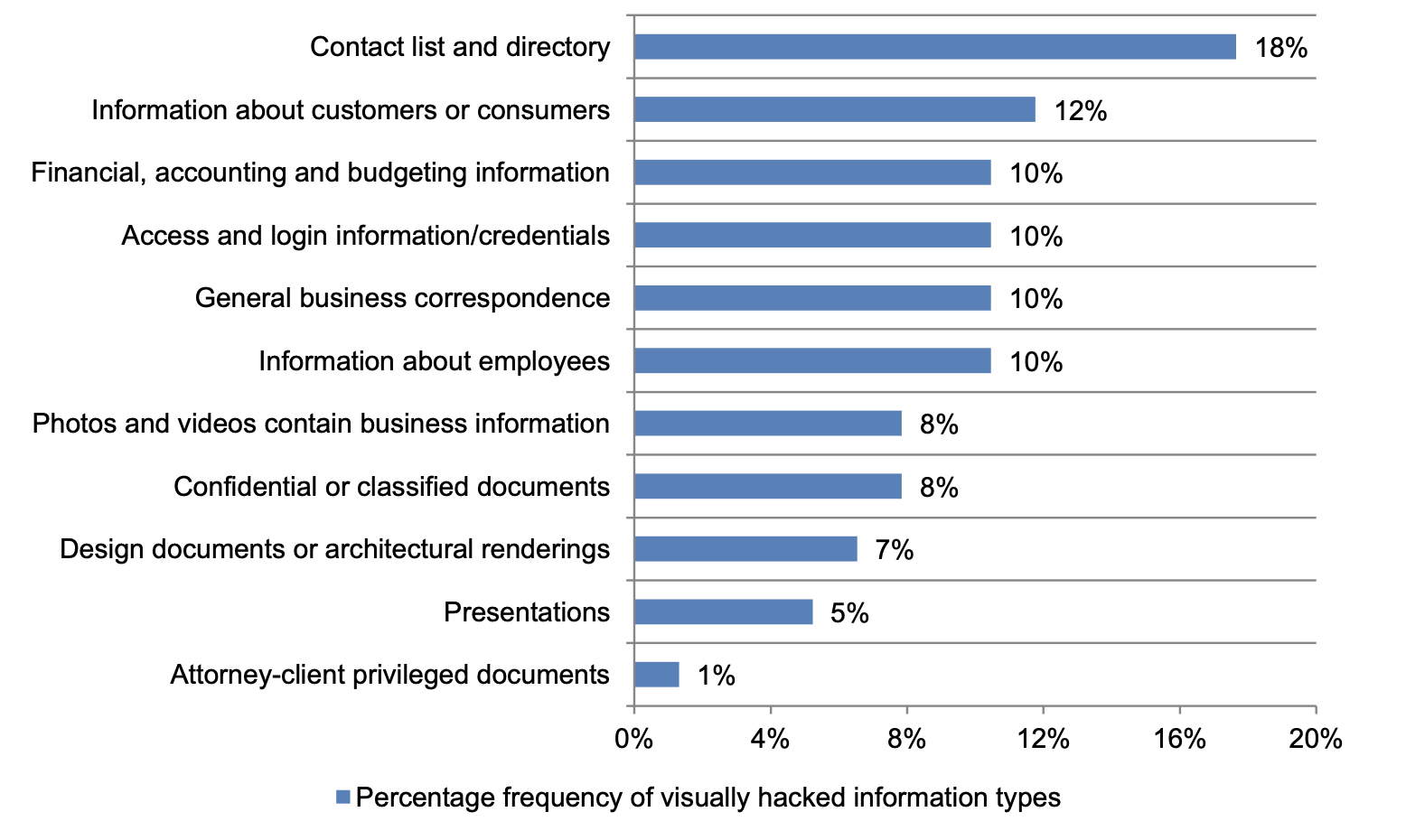
A landmark field study by the Ponemon Institute found that visual hacking attempts succeeded in 91% of trials in open office environments. Sensitive data: passwords, financial figures, patient records, is exposed daily to strangers sitting nearby. Open-plan workspaces, the default in modern offices, create ideal conditions for over-the-shoulder data theft. You do not need a hacker. You just need a curious neighbour.
Stat: 91% — of visual hacking attempts in real office environments succeeded in a controlled field study.
Source: Ponemon Institute / 3M (2015). Visual Hacking Experiment Report — 3M Visual Hacking Report PDF
AREA 02 Where it happens: "Public Wi-Fi is the main risk. My screen is fine."
The IBM X-Force threat intelligence data shows that human error and physical exposure account for a significant share of breaches — with physical observation of screens cited as an underreported vector. Airports, trains, cafés, open-plan offices, and co-working spaces are the highest-risk environments. A person standing 2–3 metres away can clearly read a standard laptop screen. The viewing angle on most panels is 170°, meaning your data is legible across
almost the entire room without you knowing.
Stat: 170° — standard IPS laptop viewing angle, meaning screen content is readable across an entire room without the user's knowledge.
Source: IBM X-Force (2023). Threat Intelligence Index — ibm.com/reports/threat-intelligence
AREA 03 How Micro Louvre works: "Privacy screens just dim the display and hurt image quality."
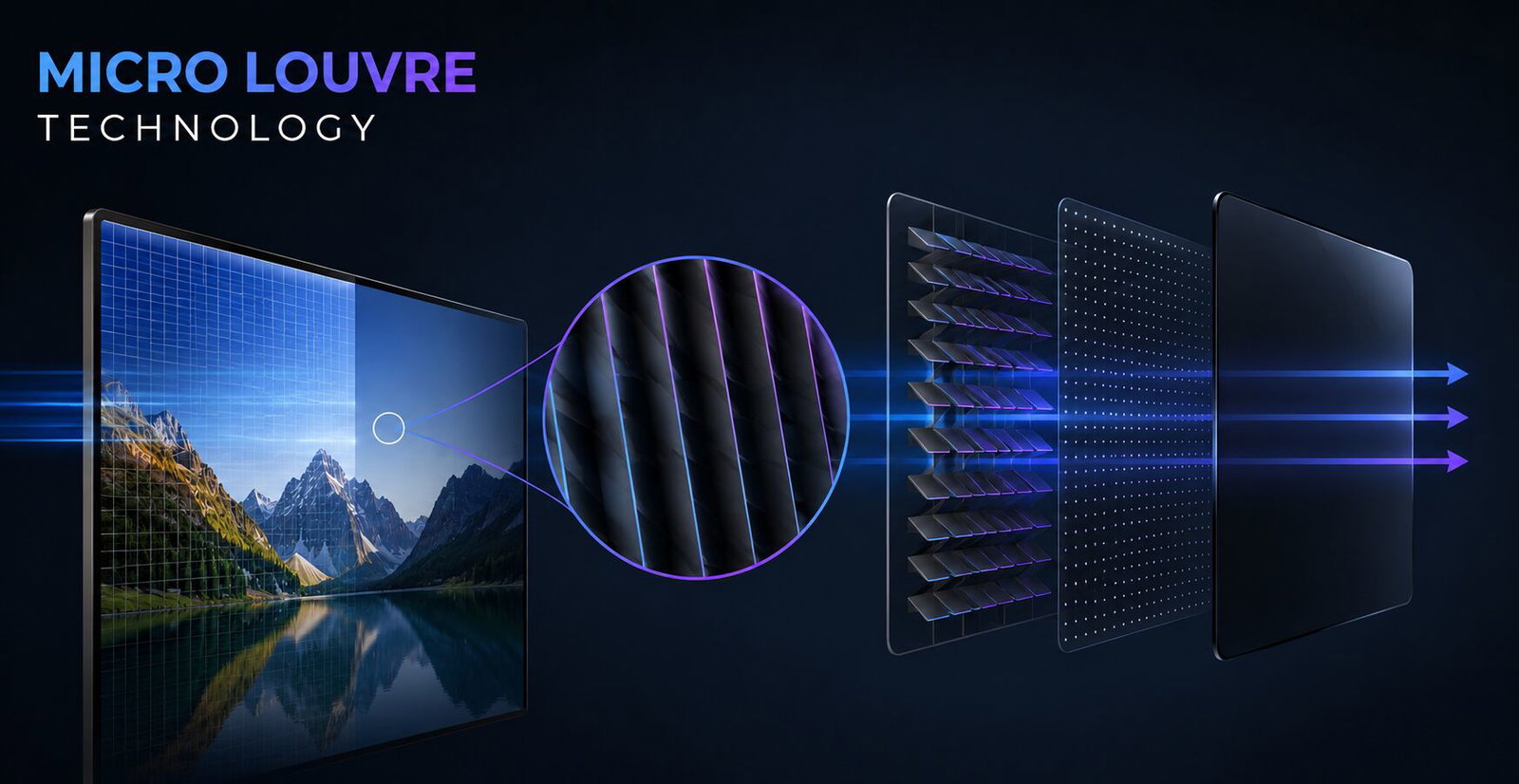
Micro Louvre technology uses a physical microstructure, microscopic vertical blinds embedded in the filter, that restricts the viewing angle of your screen to roughly 60° directly in front. Anyone viewing from the side sees only a dark screen. Unlike basic tinted films, Micro Louvre does not meaningfully reduce central brightness or colour accuracy. It is the same principle used in secure ATM screens and classified government terminals, now scaled for
everyday consumer use.
Stat: 60° — the narrowed safe viewing angle of Micro Louvre screens, compared to the 170° angle of unprotected panels.
Source: Ocushield Technology Overview — ocushield.com/pages/privacy-filter
AREA 04 The double benefit: "Blue light filters and privacy filters are separate products for separate problems."
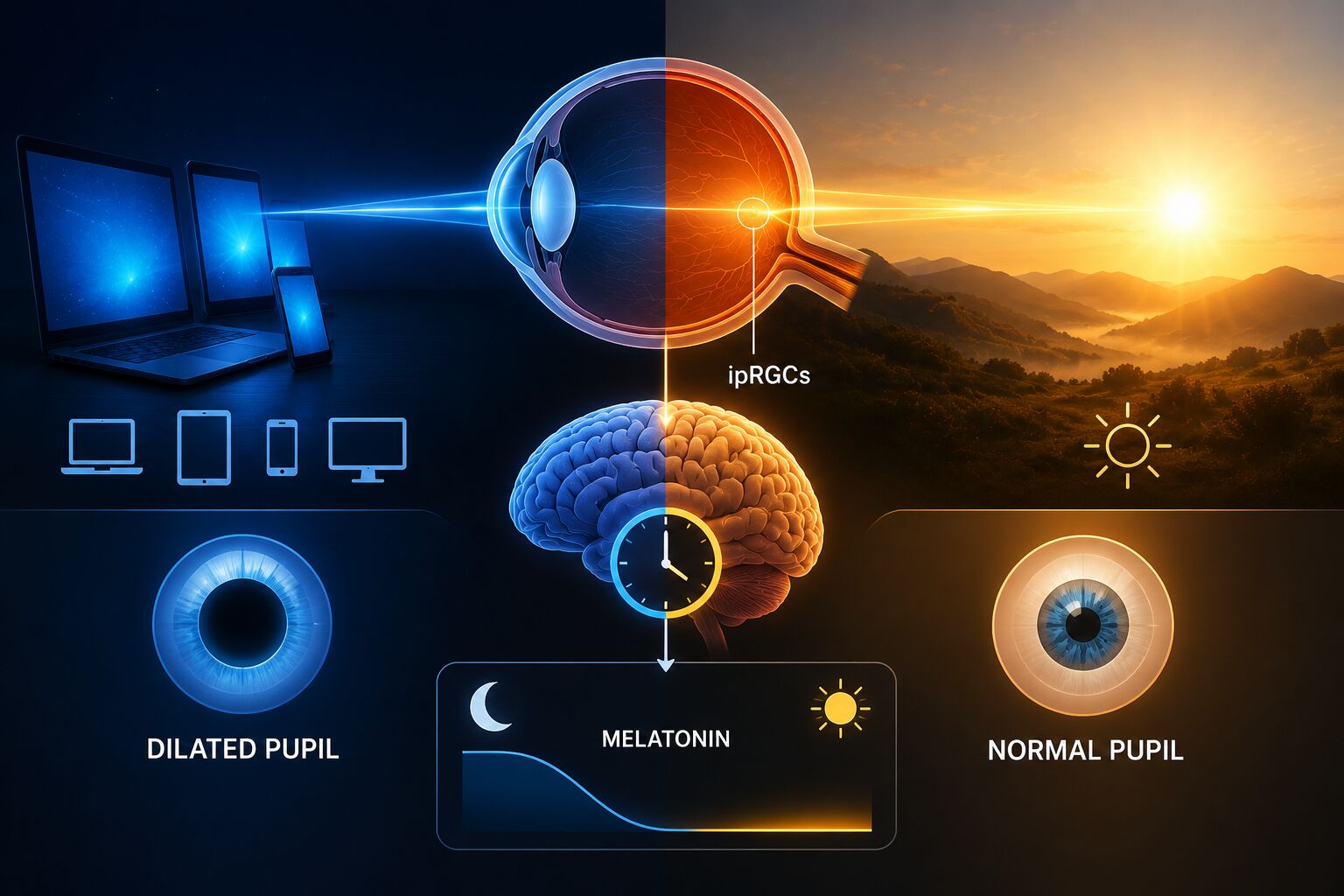
Blue light in the 415–455 nm wavelength range suppresses melatonin by up to 85% when exposure occurs in the two hours before sleep, according to a 2019 Chronobiology International study. Ocushield's filter simultaneously blocks this wavelength range while applying Micro Louvre privacy protection in a single laminated layer. This means one product addresses both digital eye strain during the workday and circadian rhythm disruption in the evening —
without requiring software redshift tools that only reduce red/green balance and do not block physical light energy.
Stat: Up to 85% — melatonin suppression caused by blue light in the 415–455 nm band in the two hours before sleep.
Source: Van der Lely et al. (2015). Blue blocker glasses as a countermeasure for alerting effects of evening light-emitting diode screen exposure. Journal of Adolescent Health — PubMed 25997867
|
|
What standing with the evidence looks like in daily life:
Cover your screen in public, not just your PIN. Every time you type a password, open a payslip, or view a client file in a public space, treat it the same way you cover a cash machine, shield it from lateral view.
Set a screen curfew, not just a sleep alarm. Your brain needs light signal reduction at least 60–90 minutes before sleep. A physical blue light filter on your screen works all evening without requiring you to remember to enable Night Shift or f.lux.
Check your office layout like a security audit. Sit with your back to walls or partitions, not open walkways. Anyone who can walk behind you can see your screen. That includes IT staff, colleagues, and visitors.
👀 The bigger picture
Screen privacy and eye health are usually sold as separate concerns, one for IT security teams, one for optometrists. But at desk level, they converge on the same device, the same person, and the same workday. A filter that does both is not a convenience. For anyone who works with sensitive data in shared or public spaces, it is the evidence-based baseline.
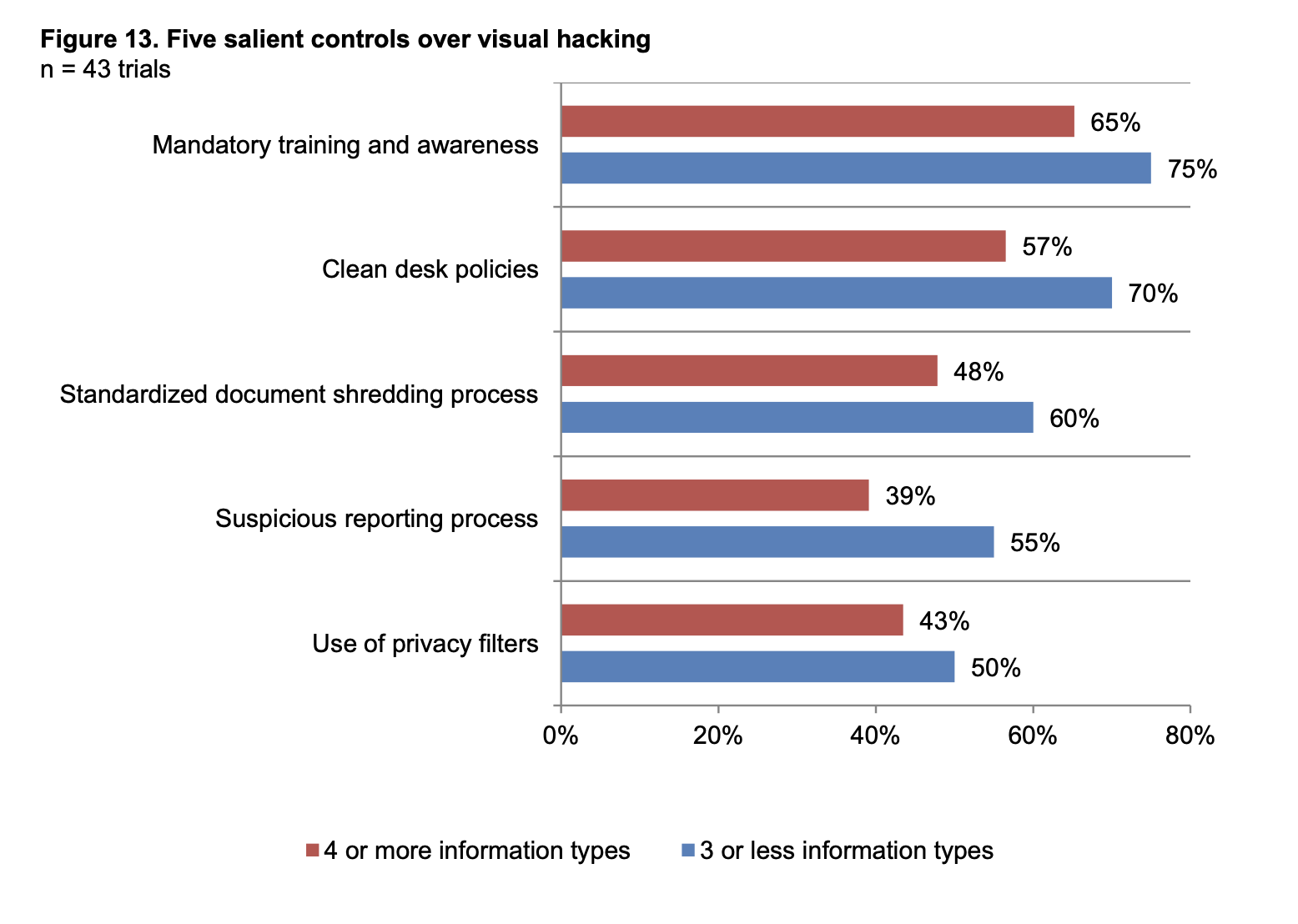
The Ponemon study showed that organisations rarely catch visual hacking when it happens, because there is no log, no alert, and no trace. It is physical. The only reliable countermeasure is a physical one: narrow the viewing angle before the information leaves the screen.
|
|
|
|
|
⚕️ Latest clinical research
The three peer-reviewed studies behind this edition:
|
|
Source: Chang AM, Aeschbach D, Duffy JF, Czeisler CA. Evening use of light-emitting eReaders negatively affects sleep, circadian timing, and next-morning alertness. Proc Natl Acad Sci U S A. 2015;112(4):1232–7. PubMed
|
|
Source: Wang C, Husain K, Zhang A, Centeno BA, Chen DT, Tong Z, Sebti SM, Malafa MP. EGR-1/Bax pathway plays a role in vitamin E δ-tocotrienol-induced apoptosis in pancreatic cancer cells. J Nutr Biochem. 2015;26(8):797–807. PubMed
|
|
Source: Ponemon Institute. Visual Hacking Experimental Study. Ponemon Institute, Traverse City, MI. Sponsored by 3M and the Visual Privacy Advisory Council. February 2015
|
|
|
|
|
Eye tip of the week:
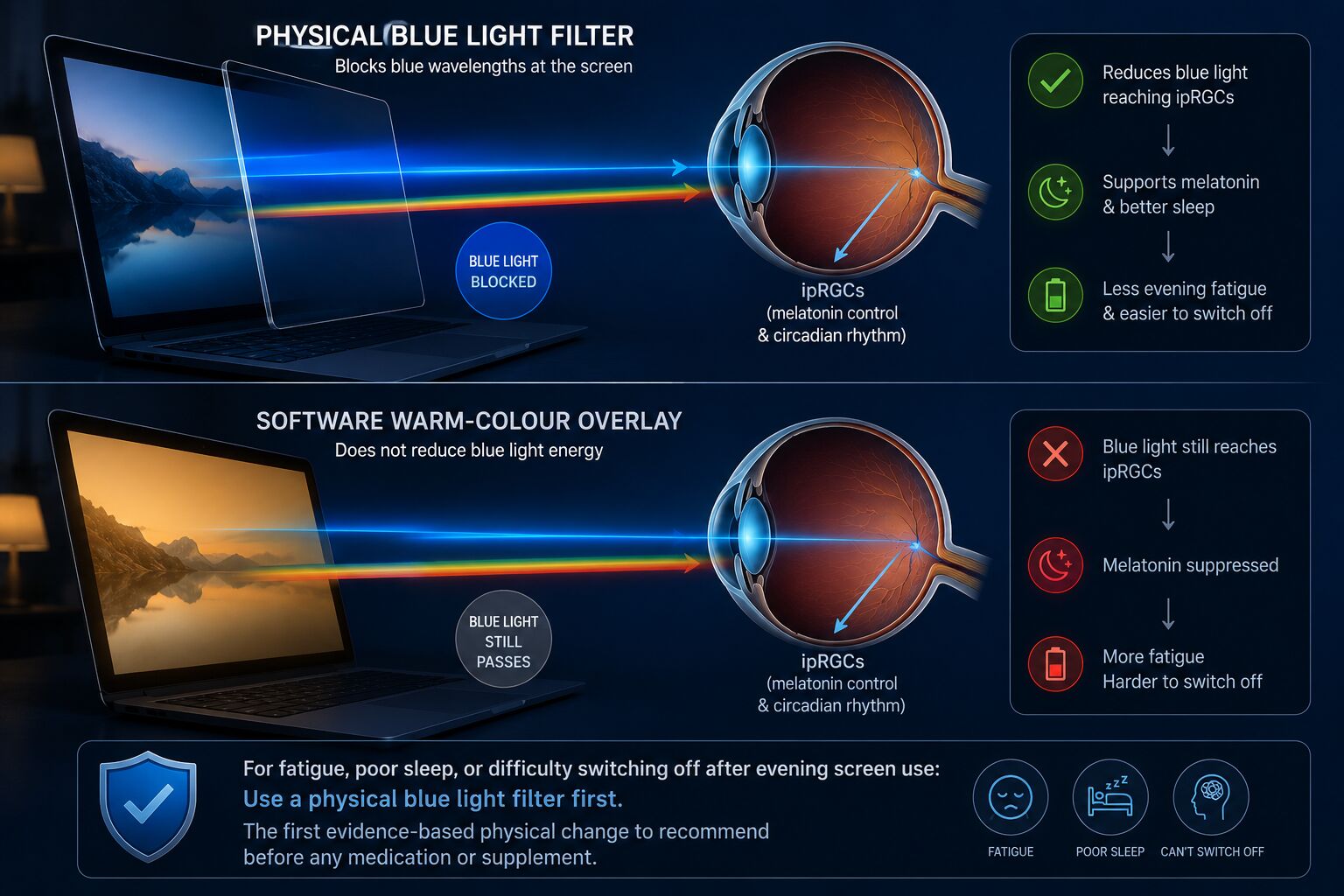
Blue light does not damage the eye in the same way UV light does, but its effect on the pupil dilation cycle and the circadian timing system is real and measurable. Your eyes do not know the difference between a screen and the sun's dawn signal. Both suppress melatonin via the same intrinsically photosensitive retinal ganglion cells (ipRGCs).
|
|
|
|
|
|
Using a physical blue light filter, not a software warm-colour overlay, which does not reduce light energy, is the only screen-level intervention that directly limits the wavelengths reaching those cells. For patients who report fatigue, disrupted sleep, or difficulty switching off after evening screen use, this is the first evidence-based physical change to recommend before any medication or supplement is considered.
|
|
|
|
|
|
Sources:
- Chang, A. M., et al. (2015). Evening use of light-emitting eReaders negatively affects sleep, circadian timing, and next-morning alertness. PNAS, 112(4), 1232–1237. pubmed.ncbi.nlm.nih.gov/25535358
- Van der Lely, S., et al. (2015). Blue blocker glasses as a countermeasure for alerting effects of evening light-emitting diode screen exposure in male teenagers. Journal of Adolescent Health, 56(1), 113–119. pubmed.ncbi.nlm.nih.gov/25997867
- Ponemon Institute / 3M (2015). The Visual Hacking Experiment: An Underreported Threat. 3M Visual Hacking Report https://multimedia.3m.com/mws/media/1027626O/study-visual-hacking-experiment-results.pdf
- Coles-Kemp, L. & Jensen, R. B. (2019). Exploring the Human Side of Data Privacy. IEEE Security & Privacy. pmc.ncbi.nlm.nih.gov/PMC6859618
- IBM X-Force (2023). Threat Intelligence Index. ibm.com/reports/threat-intelligence
- Ocushield. Privacy filter technology overview. ocushield.com/pages/privacy-filter
|
|
|
|
|
UK: Ocushield, 86-90 Paul Street, London, EC2A 4NE, United Kingdom
USA: Ocushield, 2140 South Dupont Highway, Camden, Delaware, 19934, USA
[email protected]
|
|
|
|
|
|
|
|