|
The Weekly Eye-Opener
Introducing our New Weekly Series by our Lead Optometrist, Dhruvin Patel
|
|
Why more children are wearing glasses than at any point in human history, and who is responsible?
|
|
If you have noticed more children around you wearing glasses than when you were young, you are not imagining it. Something has shifted, and the research now tells us clearly what it is, and who helped cause it.
This week we are looking at what prolonged screen exposure is doing to children's developing brains and vision, why the companies behind the apps are not innocent bystanders in this story, and what the science actually recommends for families navigating a world that has made screens unavoidable.
|
|
Source: Ha A, et al. (2025). Digital Screen Time and Myopia: A Systematic Review and Dose-Response Meta-Analysis. JAMA Network Open. PubMed 39808415
|
|
What the research has measured
STAT 1 By 2050, more than half the global population is projected to be nearsighted, compared to just 25% in 1971. Genes do not change that quickly. Behaviour does. (Brighter Outlook Vision, 2025, citing multiple peer-reviewed projections)
STAT 2 335,000 children across 45 studies confirmed a dose-response relationship between screen time and myopia. Risk increased significantly from just one to four hours of screen time per day. (Ha A et al., JAMA Network Open, 2025)
STAT 3 68% of young people aged 13–25 now report difficulty focusing, with many unable to engage with content lasting longer than one minute. (Professor Gemma Calvert, Nanyang Centre for Marketing Technologies, NTU Singapore, 2025)
💡 This is the core research insight
Myopia develops when the eyeball elongates slightly too much during childhood growth, causing distant objects to blur. Near-focus work, especially on bright, backlit screens held close to the face, accelerates this elongation. The more hours per day a child spends focused at close range on a screen, the faster and more severely their myopia tends to develop.
What makes this moment different from any previous generation is not just the amount of screen time, it is that the screen time is being engineered. Platforms are not passively available. They are specifically designed to maximise the time children spend looking at them. The algorithm and the glasses prescription are directly connected.
What the science says across four areas
AREA 01 — The myopia epidemic
More children are wearing glasses than ever before, and the evidence points clearly to screens as the primary driver.
A 2025 meta-analysis published in JAMA Network Open, analysing 45 studies involving more than 335,000 children, confirmed a clear dose-response relationship between daily screen time and myopia risk. Risk increased significantly from just one to four hours per day, a threshold most children now exceed before finishing their homework. A 2025 review in the European Journal of Public Health found that in the 1960s, just 13.9% of European twenty-year-olds
were nearsighted. Today that figure stands at 47.2%. What changed was not genetics. It was how children spend their time.
AREA 02 — The platforms are not passive
Children are spending more time on screens than ever, but this did not happen by accident.
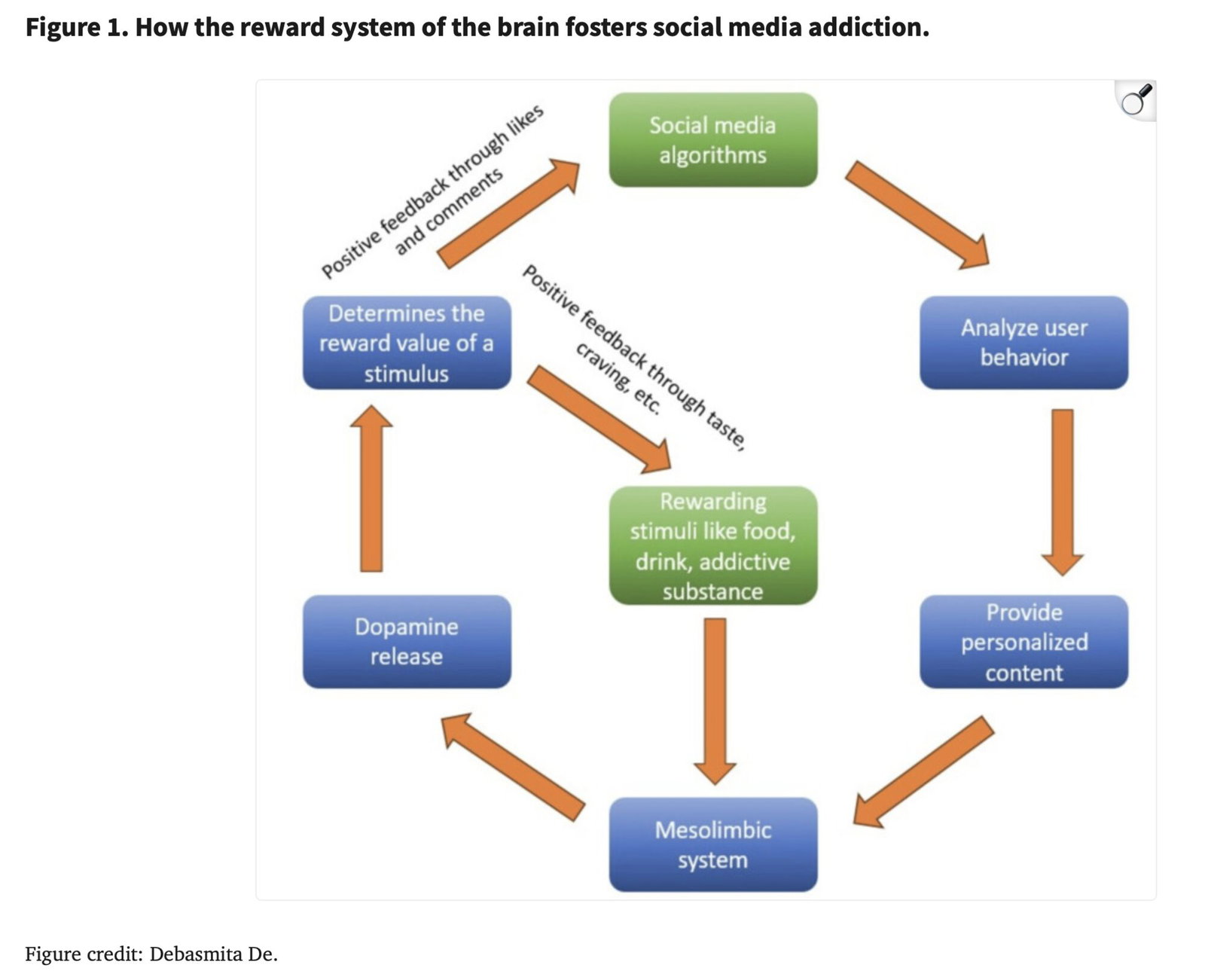
In October 2024, the DC Attorney General and thirteen US state attorneys general filed simultaneous lawsuits against TikTok, specifically citing its dopamine-inducing algorithm as evidence of intentional addictive design targeting young users. The mechanism exploits a known developmental fact: the prefrontal cortex, the part of the brain responsible for impulse control, is still developing in children and adolescents. Platforms know this. The variable
reward system they have built, where sometimes you get a like and sometimes you do not, is the same psychological architecture used in slot machines. It is not placebo. It is deliberate design, and children are its primary target.
|
|
AREA 03 — What this does to the developing brain
The consequences extend well beyond vision.
An international study led by Professor Gemma Calvert at NTU Singapore found that 68% of young people aged 13–25 now report difficulty focusing, with many unable to complete schoolwork or engage with content lasting more than a minute. The brain, her team explained, is being trained to seek constant novelty and instant rewards through dopamine-driven feedback loops. Over time, this reduces the capacity for deep thinking, not temporarily, but structurally. A 2025
meta-analysis published in the Journal of Behavioural Addiction found a linear dose-response relationship between social media use and depression in adolescents: a 13% increase in depression risk for every additional hour spent on social media per day.
AREA 04 — What the science actually recommends
The most effective intervention available costs nothing.
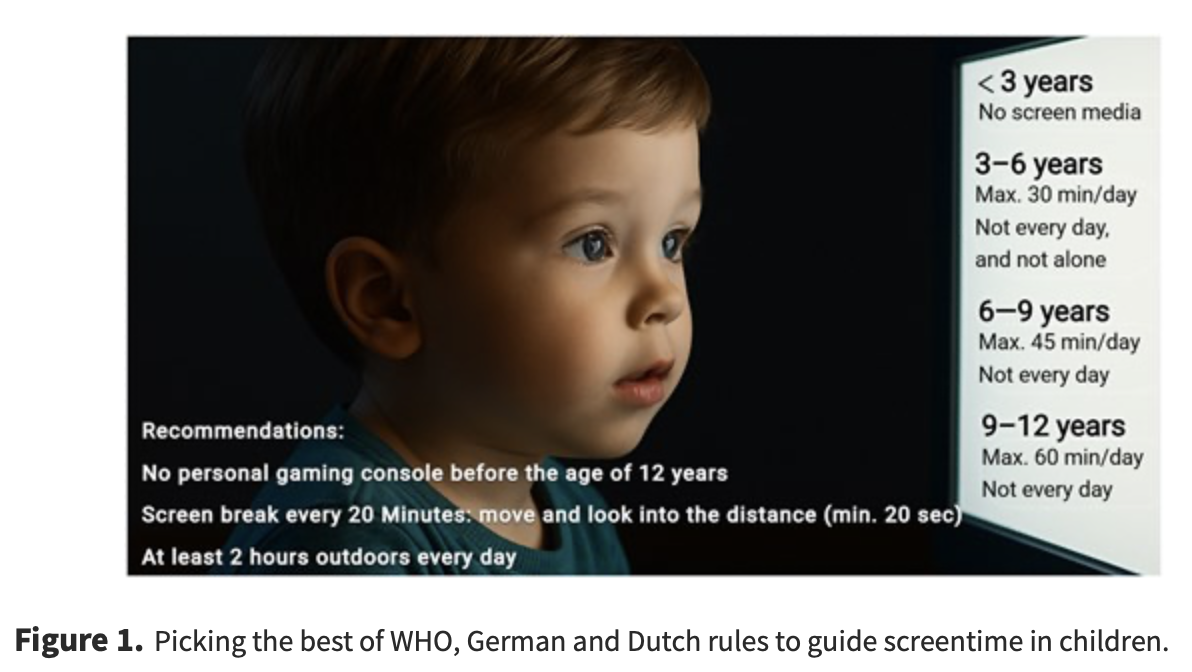
A population-based programme in Taiwan promoting two hours of outdoor activity per weekday for kindergarten children reduced myopia prevalence from 15.5% in 2014 to 8.4% in 2016, a near-halving in just two years, achieved through one behavioural change. Natural daylight stimulates dopamine release in the retina, which regulates healthy eye development. Most studies show a significant protective effect of outdoor exposure when children spend at least two hours outside
daily. For unavoidable screen time, the 20-20-20 rule reduces strain: every 20 minutes, look at something at least 20 feet away for 20 seconds.
What to take from this:
On myopia, the evidence is strong and consistent. Screen time is the most significant modifiable risk factor for childhood myopia, and the relationship is dose-dependent. The earlier myopia develops, the worse it tends to become by adulthood, with increased risk of retinal detachment, glaucoma, and macular degeneration in later life.
On platform design, this is not a parenting failure story. The companies building these products have deliberately engineered features that exploit the neurological vulnerabilities of developing brains. Understanding this changes the conversation from individual responsibility to systemic accountability.
On attention and mental health, the research is building a picture that goes well beyond vision. A 13% increase in depression risk per additional daily hour of social media use is a dose-response relationship strong enough to take seriously. Attention, emotional regulation, and mental health are all implicated.
On prevention, two hours of outdoor time daily is the strongest evidence-backed measure available. It is free, requires no technology, and the research behind it is robust. Prevention matters significantly more than management, myopia that develops early cannot be undone.
👀 The bigger picture
The myopia epidemic will not reverse itself. Screens are now embedded in education, socialisation, and daily life in ways that were unimaginable a generation ago. Telling children to simply use their devices less is not a realistic strategy for most families, and the evidence suggests that even with the best parental intentions, the algorithms are actively working against them.
What the research asks of us is not panic but clarity. Clarity about what is happening to children's vision and brains, clarity about who benefits from the current situation, and clarity about what is actually within our control. Outdoor time works. Screen limits work. Understanding the design of the platforms your child uses is not paranoia, it is informed parenting.
The screen is not going away. How we respond to that fact is the question worth asking.
|
|
|
|
|
⚕️ Latest clinical research
The three peer-reviewed studies behind this edition:
|
|
Source: Ha A, et al. (2025). JAMA Network Open. PubMed 39808415
|
|
|
|
|
Eye tip of the week:
Children's eyes are still developing, which makes consistent habits more important, not less. The 20-20-20 rule gives the focusing muscles a necessary rest during screen use. But the more important habit is time outside. Natural daylight provides light intensity levels that no indoor environment can replicate, and research consistently shows that children who spend at least two hours outdoors daily develop myopia at significantly lower rates. Walking
home from school counts.
You cannot always control the screen. You can control what it does to their eyes. Anti blue light glasses for children are built specifically for developing eyes, because children's eyes are not just smaller versions of adult eyes
|
|
|
|
|
|
UK: Ocushield, 86-90 Paul Street, London, EC2A 4NE, United Kingdom
USA: Ocushield, 2140 South Dupont Highway, Camden, Delaware, 19934, USA
[email protected]
|
|
|
|
|
|
|
|