#17: AI as a Tool for Identifying Threat Vectors |
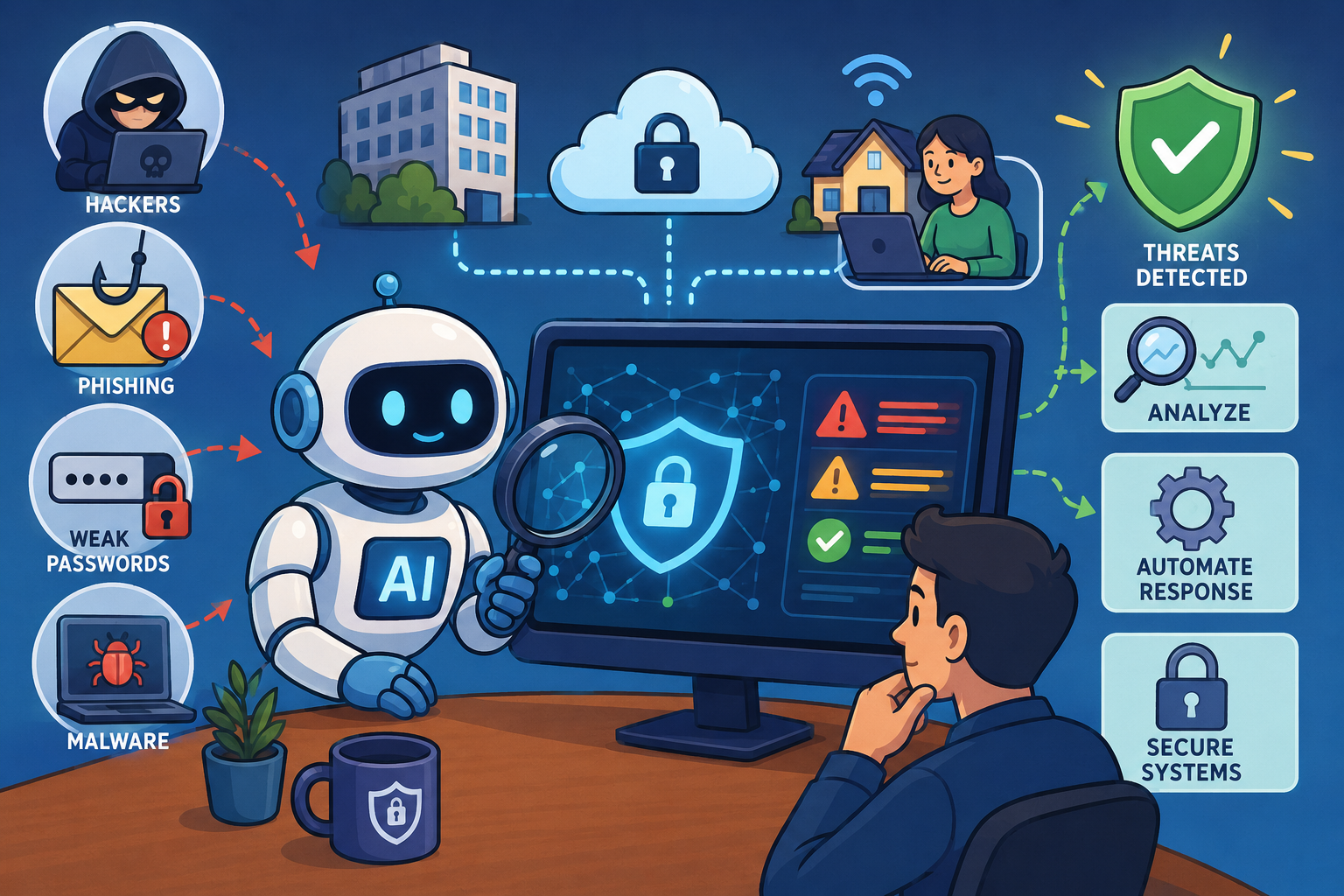
Cybersecurity teams face a difficult challenge in modern workplaces. Every device, account, cloud platform, and employee interaction creates possible entry points for attackers. These entry points are known as threat vectors. A threat vector is any path or method that a cybercriminal can use to gain unauthorised access to a system, steal data, deploy malware, or disrupt operations.
In the past, organisations managed security by building strong network perimeters. Firewalls, antivirus software, and password systems were considered enough to protect company systems. Today, the situation is very different. Businesses now rely on cloud services, remote work, mobile devices, third-party vendors, and artificial intelligence systems. Employees access systems from homes, airports, and personal devices. Attackers also use advanced tools, including AI-powered phishing campaigns and automated malware.
|
As a result, identifying threat vectors has become one of the most important and difficult tasks in cybersecurity. Human analysts alone cannot monitor every log entry, user action, network request, and suspicious email. The amount of data is too large, and attacks move too quickly. Artificial intelligence is increasingly being used to solve this problem. AI systems can analyse large amounts of data, identify patterns, predict risks, and detect unusual behaviour faster than human teams alone.
This article explains the challenge of identifying threat vectors in conventional work environments, shows how AI improves the process, and examines a real-world example of an organisation using AI-driven threat detection successfully.
|
Understanding Threat Vectors in the Modern Workplace |
A threat vector is the route an attacker uses to compromise a system. Some threat vectors are technical, while others depend on human error. In most organisations, attackers do not break through a single weakness. Instead, they combine multiple weaknesses together.
One of the most common threat vectors is phishing. In a phishing attack, a user receives an email, message, or website designed to look legitimate. The goal is to trick the user into revealing credentials, downloading malware, or approving unauthorised access. Phishing is effective because it targets people rather than technology.
Another major threat vector is weak identity management. Employees often reuse passwords across services or choose passwords that are easy to guess. If attackers obtain login credentials from one breach, they may use them against other systems. This is known as credential stuffing.
Cloud services also create new attack surfaces. Businesses use platforms such as cloud storage, collaboration systems, and software-as-a-service applications. If permissions are configured incorrectly, sensitive information may become publicly accessible without the organisation realising it.
Remote work has increased the problem further. Employees may connect through insecure home networks or use unmanaged devices. Attackers often search for outdated software, unpatched vulnerabilities, or poorly secured remote desktop services.
Insider threats are another serious concern. Not every security incident comes from external attackers. Employees or contractors may accidentally expose information or intentionally misuse systems. Detecting insider threats is difficult because insiders already possess legitimate access.
Traditional cybersecurity tools struggle because these threats generate enormous amounts of information. Security teams may receive thousands of alerts each day. Many of these alerts are false positives, meaning the system incorrectly identifies harmless activity as dangerous. Analysts must investigate each alert manually, which consumes time and resources.
This creates a serious operational problem. Important threats may be missed because security teams become overloaded. Attackers understand this issue and often design attacks to blend into normal workplace activity.
|
Conventional Methods of Identifying Threat Vectors |
Before AI became widely used in cybersecurity, organisations depended heavily on rule-based systems. These systems operate using predefined conditions. For example, a firewall may block traffic from known malicious IP addresses, or an email filter may flag messages containing suspicious attachments.
Rule-based systems remain useful, but they have major limitations. They only identify threats that match known patterns. If attackers use a new method, the system may not recognise it. Security Information and Event Management (SIEM) systems were introduced to improve monitoring. SIEM tools collect logs from multiple systems and allow analysts to review activity in one location. These systems can detect suspicious events, such as repeated failed login attempts or unusual network traffic. However, SIEM platforms still depend heavily on human expertise. Analysts must create detection rules, tune alerts, and investigate incidents manually. As organisations grow larger, the volume of data becomes difficult to manage.
Another conventional method is vulnerability scanning. Security teams use scanners to identify outdated software, weak configurations, and exposed services. While important, vulnerability scanning only identifies known weaknesses. It does not always show how attackers may combine weaknesses together during an attack.
Penetration testing is also commonly used. Ethical hackers simulate attacks to identify weaknesses before criminals can exploit them. Penetration testing provides valuable insights, but it is usually performed periodically rather than continuously. Threat environments change rapidly, meaning a secure system today may become vulnerable tomorrow.
Human-centred monitoring creates additional challenges. Security analysts experience alert fatigue when exposed to constant warnings. Fatigue reduces accuracy and increases the likelihood that serious incidents will be overlooked. The rise of sophisticated attacks has made these limitations more serious. Modern attackers often use automation, artificial intelligence, and social engineering techniques that evolve quickly. Conventional systems cannot always adapt at the same speed.
|
How AI Improves Threat Vector Identification |
Artificial intelligence changes cybersecurity by allowing systems to analyse data dynamically rather than relying entirely on fixed rules. AI systems can identify patterns, recognise anomalies, and learn from new information over time.
Machine learning is one of the most important AI technologies used in cybersecurity. Machine learning systems analyse large datasets and identify relationships between activities. Instead of simply following predefined instructions, the system improves as it processes more information. Obviously, for anyone who has been paying attention, the use of machine learning and AI isn’t exactly new in cybersecurity—however, it has certainly improved many times over in recent years to such an extent that we might consider it a completely different way of doing things. To that extent, the following should be considered the benefits of AI in this new brave world.
One major advantage of AI is speed. Human analysts cannot review millions of events in real time, but AI systems can process data continuously. This allows organisations to identify suspicious activity much earlier. Behavioural analysis is another key capability. AI systems learn what normal activity looks like within an organisation. For example, the system may recognise that an employee usually logs in during business hours from a specific country. If the same account suddenly accesses sensitive files at midnight from another region, the AI system may flag the activity as suspicious.
This approach is valuable because many attacks involve legitimate credentials. Traditional systems may not detect these attacks because the login appears technically valid. AI focuses on behaviour rather than only technical rules.
AI also improves phishing detection. Traditional email filters search for known malicious indicators, such as suspicious domains or harmful attachments. AI-powered systems examine writing style, sender behaviour, message structure, and communication patterns. This helps identify phishing emails that do not match previous attack signatures.
Threat intelligence integration is another major improvement. AI systems can process global threat data from many sources simultaneously. If attackers begin using a new technique in one region, AI systems can rapidly incorporate that information into detection models elsewhere.
Automation further strengthens security operations. AI systems can automatically isolate infected devices, disable compromised accounts, or block suspicious network traffic. This reduces response time significantly. Predictive analytics is one of the most advanced uses of AI in cybersecurity. By analysing historical attack data, AI systems can estimate which vulnerabilities are most likely to be exploited. Security teams can then prioritise the most serious risks instead of attempting to fix every issue equally.
AI also supports zero-trust security models. Zero-trust architecture assumes that no user or device should automatically be trusted, even if they are inside the organisation’s network. AI continuously evaluates user behaviour, device health, and access patterns to determine whether activity appears legitimate. This is particularly important in remote and hybrid work environments. AI helps organisations monitor access across multiple devices and cloud platforms without relying entirely on perimeter-based defences.
|
Threat hunting is the process of actively searching for hidden threats inside an environment. Traditional cybersecurity often reacts after an alert occurs. Threat hunting is proactive instead. AI significantly improves threat hunting operations. Advanced systems can identify weak signals that humans may miss. For example, a single failed login attempt may not appear dangerous on its own. However, AI may detect that the same pattern is occurring across hundreds of accounts simultaneously.
Natural language processing, another branch of AI, is also useful in cybersecurity. NLP systems can analyse written text from emails, reports, and threat intelligence feeds. This helps organisations identify emerging attack trends more quickly.
AI can also correlate information across systems. An attacker may compromise one endpoint, move laterally through the network, and eventually access cloud services. Individually, these events may appear unrelated. AI systems connect these activities together into a single attack narrative. This reduces investigation time and helps analysts focus on the highest-priority incidents.
|
Challenges and Risks of AI in Cybersecurity |
Although AI provides major advantages, it is not perfect. Organisations must understand their limitations:
• One concern is false positives. AI systems may incorrectly identify normal activity as malicious. Excessive false positives can still overwhelm analysts if the system is not configured properly.
• Bias in training data is another issue. AI systems learn from historical information. If training data is incomplete or inaccurate, detection quality may suffer.
• Attackers are also using AI themselves. Cybercriminals now create AI-generated phishing messages that are more convincing than traditional scams. Some attackers use AI to automate reconnaissance, vulnerability discovery, and malware development.
• There is also a risk of overreliance on automation. AI should support human analysts, not completely replace them. Human judgment remains essential for understanding context, making strategic decisions, and handling complex incidents.
• Privacy concerns must also be considered. AI systems often monitor employee behaviour closely. Organisations must ensure monitoring practices comply with legal and ethical standards.
Despite these challenges, most cybersecurity experts agree that AI is becoming necessary because modern threat environments are too large and fast-moving for manual analysis alone.
|
Darktrace and AI-Driven Threat Detection |
One well-known example of AI being used to identify threat vectors is the cybersecurity company Darktrace. Darktrace developed an AI platform designed to monitor organisational behaviour continuously and identify unusual activity. Darktrace uses machine learning to establish what it calls a “pattern of life” for users and systems inside a network. Instead of relying only on known malware signatures or fixed rules, the platform studies normal activity patterns and searches for deviations.
A widely discussed case involved a financial services organisation using Darktrace technology to detect insider-related suspicious activity. The AI system identified unusual data transfers from an employee account. While the credentials appeared legitimate, the behaviour differed significantly from the employee’s normal activity profile. The employee had begun accessing large volumes of sensitive information outside standard working hours and transferring files to external locations. Conventional systems did not initially classify the activity as dangerous because the employee possessed valid access permissions.
However, the AI platform recognised the behavioural anomaly. Security teams investigated the activity quickly and prevented a potential data breach before sensitive information was lost.
Another notable example occurred during the rise of remote work following the COVID-19 pandemic. Many organisations rapidly expanded remote access systems, creating new attack surfaces. Darktrace reported detecting increases in credential misuse, unauthorised cloud access, and phishing-related compromises during this period.
AI systems proved valuable because attackers adapted quickly to changing work environments. Traditional rule-based systems struggled to keep pace with new attack methods, while behavioural AI models adapted more effectively. Darktrace’s approach demonstrates one of the most important advantages of AI-driven cybersecurity: the ability to detect previously unknown threats. Many attacks today do not match existing malware databases or predefined signatures. AI focuses on abnormal behaviour rather than only known attack indicators.
The success of these systems does not mean AI alone solves cybersecurity problems. Organisations using AI-driven security still require skilled analysts, clear policies, employee training, and strong governance. However, AI provides visibility and speed that conventional approaches often cannot achieve independently.
|
Building Better, Building Faster |
Identifying threat vectors has become one of the most difficult responsibilities in cybersecurity. Modern workplaces rely on cloud computing, remote access, mobile devices, and interconnected systems that create complex attack surfaces. Conventional security methods remain important, but they struggle against the scale and speed of modern threats.
Artificial intelligence improves threat vector identification by processing large volumes of data, recognising behavioural anomalies, correlating events across systems, and automating responses. AI-driven cybersecurity systems help organisations detect threats earlier and reduce the burden on human analysts.
The technology is particularly effective against modern attacks that use legitimate credentials, social engineering, and evolving malware techniques. AI allows organisations to move from reactive security toward proactive threat detection and continuous monitoring.
The example of Darktrace shows how AI can successfully identify suspicious activity that conventional systems may overlook. By analysing behaviour rather than depending entirely on predefined rules, AI systems can uncover hidden risks before they become major breaches.
As cyber threats continue to evolve, AI will likely become a standard component of organisational security strategies. However, AI is most effective when combined with skilled cybersecurity professionals, employee awareness, and strong security policies. Organisations that successfully integrate AI into their cybersecurity operations will be better prepared to identify and respond to future threat vectors.
|
|
|
|
Copyright (C) 2025 Packt Publishing. All rights reserved.
Our mailing address is:
Packt Publishing, Grosvenor House,
11 St Paul's Square, Birmingham,
West Midlands, B3 1RB, United Kingdom
Want to change how you receive these emails?
You can update your preferences or unsubscribe.
|
|
|
|
|