OpenAI Daybreak, NVIDIA Sparse LLMs, BASF Evolutionary AI, and AWS Exa Agents
Agentic AI, LLMOps, and AI-native workflows — the skills shaping 2026, plus key insights ahead of tomorrow’s AI Skills Conf featuring leaders from Google DeepMind, AWS, Meta, Spotify, SAP, and more.

Is this your brand on Milled? Claim it.

OpenAI Daybreak, NVIDIA Sparse LLMs, BASF Evolutionary AI, and AWS Exa AgentsAgentic AI, LLMOps, and AI-native workflows — the skills shaping 2026, plus key insights ahead of tomorrow’s AI Skills Conf featuring leaders from Google DeepMind, AWS, Meta, Spotify, SAP, and more.
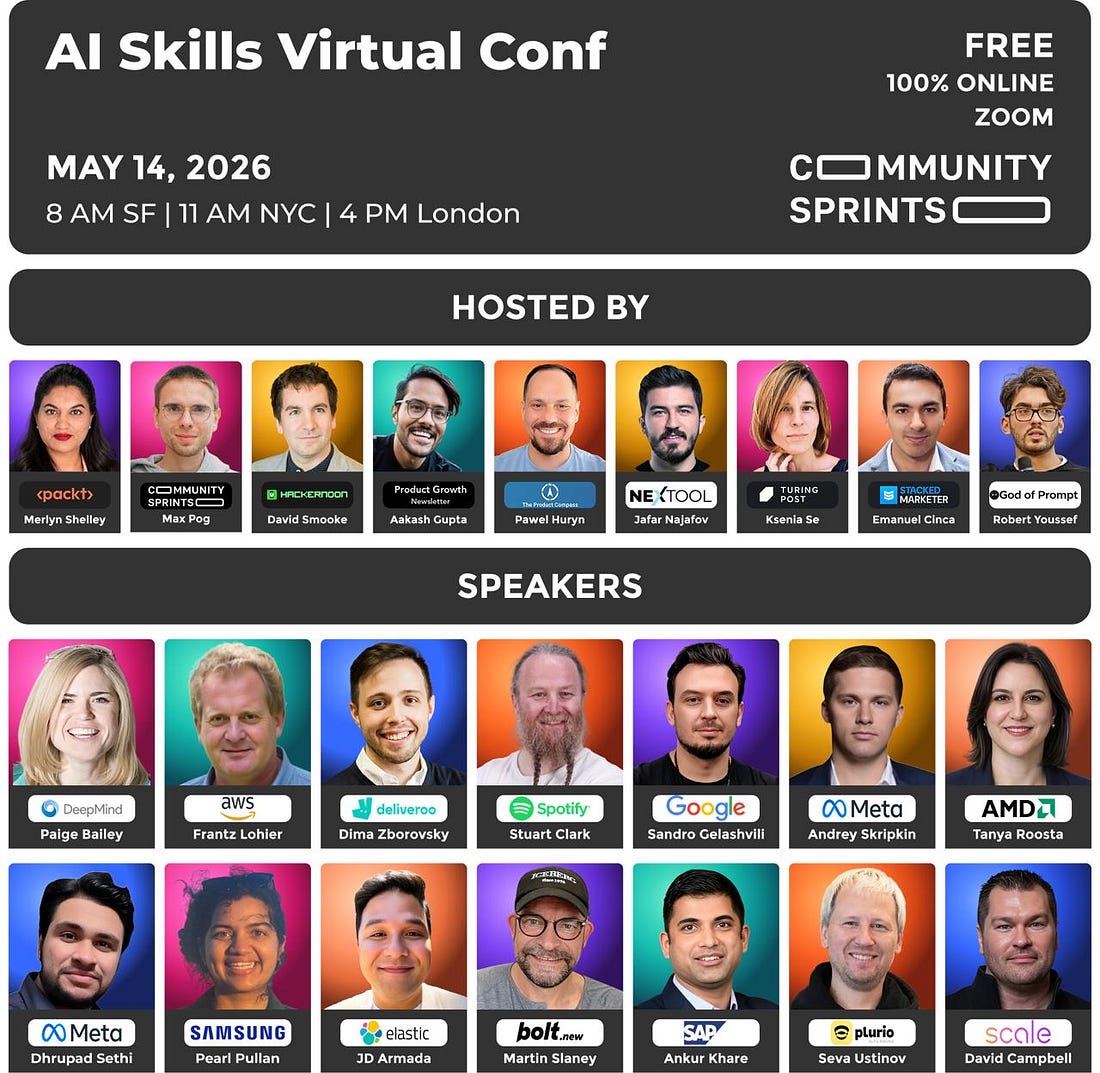
👋Hello there! Welcome to DataPro #172 — this week, we explore the AI skills, agents, and production systems shaping 2026, alongside insights from the upcoming free AI Skills Conf happening tomorrow. As AI rapidly moves beyond prompting into agentic workflows, context engineering, multimodal systems, and operational AI infrastructure, the real advantage now belongs to professionals who can build and deploy AI systems, not just use them. That’s why this edition features an expert-led deep dive from AI engineer Hari Prasad Renganathan on the 10 essential AI skills professionals need in 2026, covering RAG, LLMOps, AI evaluation, autonomous agents, and more. The same shift is driving massive interest in the AI Skills Conf, where 6,000+ AI professionals are already registered to hear leaders from Google DeepMind, AWS, Meta, Spotify, SAP, DoorDash, and Scale AI discuss topics like “How to Become Irreplaceable with AI,” “Building Your AI Chief of Staff,” “Vibe Coding,” and “The Context Engineering and Agentic Memory.” This is part of Packt DataPro’s Knowledge Partner initiative with global AI communities, complementing the hands-on workshops and technical deep dives delivered by the Packt Virtual Conference team. I’ll also be joining the “AI ROI Reality Check” panel alongside leaders from Spotify and SAP to discuss where enterprises are seeing measurable business value from AI today. 🚀 Registration is free, and even if you miss the live sessions, all recordings, AI workflows, templates, guides, and bonus resources will be delivered directly to your inbox afterward.
In this week’s highlights: • OpenAI launched Daybreak for AI-driven cyber defense workflows The AI era is no longer just about using tools. It is about understanding the systems behind them. Cheers, Merlyn Shelley, Growth Lead, Packt.
“Most Developers Are Learning AI the Wrong Way”: Hari Prasad Renganathan’s 10 Essential AI Skills for 2026From prompt engineering and AI agents to LLMOps and multimodal systems, here’s the practical roadmap developers and AI professionals need to stay ahead in 2026.Artificial Intelligence is no longer a futuristic concept reserved for research labs or billion-dollar tech companies. It is now woven into the everyday workflows of developers, startups, enterprises, product teams, and even non-technical professionals. In 2026, the biggest challenge is not whether AI will transform industries. It already has. The real question is this:
The pace of AI innovation is moving faster than most people can keep up with. New frameworks emerge every month. AI models become more capable every quarter. Entire workflows are being automated in ways that seemed impossible just a few years ago. Yet amid all the noise, there are a handful of foundational topics that truly matter. In a recent webinar hosted by Packt Talks, AI engineer and founder Hari Prasad Renganathan shared a practical roadmap for developers looking to thrive in the AI era. With experience spanning Columbia University, AI leadership roles at YC-backed startups, and building real-world AI products, Hari distilled the overwhelming AI landscape into ten critical topics every professional should understand. Hosted by our Growth Lead, Abhishek Kaushik, the session focused not on hype, but on practical, production-ready AI skills that companies are already adopting today. This article expands on those ideas into a complete guide for developers, engineers, and AI professionals preparing for the next wave of intelligent systems. 1. Advanced Prompt EngineeringEvery AI workflow starts with prompts. While basic prompting is now common knowledge, advanced prompt engineering has become a serious professional skill. Developers who understand how to structure prompts effectively can dramatically improve the quality, reliability, and relevance of AI outputs. Hari emphasized an important point during the session:
That single idea captures the essence of modern prompt engineering. Today’s professionals must go beyond simple instructions and learn how to provide context, examples, reasoning patterns, and clear output expectations. Techniques such as few-shot prompting, chain-of-thought prompting, and structured outputs have become critical in enterprise AI systems. Structured outputs are especially important because they allow AI systems to return clean JSON, XML, or CSV responses that integrate directly into applications and workflows. Prompt engineering may look simple on the surface, but in production systems, it directly impacts performance, cost, and user trust. 2. Retrieval-Augmented Generation (RAG)Large Language Models are powerful, but they have limitations. One major limitation is that they cannot naturally access an organization’s private knowledge base. That is where Retrieval-Augmented Generation, or RAG, becomes essential. RAG allows AI systems to retrieve relevant information from documents, databases, PDFs, internal systems, or even web sources before generating a response. Instead of relying purely on pretrained knowledge, the model becomes context-aware and personalized. Hari described RAG as one of the most practical skills AI engineers should learn because it bridges the gap between generic AI and real-world enterprise applications. At its core, RAG works by converting information into vector embeddings, storing them in databases, retrieving the most relevant chunks during a query, and feeding those results back into the model. This creates AI systems that feel dramatically smarter and more useful. Most enterprise AI tools today rely heavily on some form of retrieval system because businesses care less about generic intelligence and more about contextual accuracy. 3. Agentic AI SystemsIf prompt engineering is the first level of AI maturity, agentic AI is the next major leap. Traditional AI systems behave like assistants that answer questions. Agentic systems behave more like autonomous workers capable of completing tasks on behalf of users. Hari described this transformation perfectly during the webinar:
That is the essence of AI agents. Instead of simply generating text, agents can send emails, interact with APIs, manage workflows, run code, query databases, and use external tools. Developers can now create systems where AI decides what steps should happen next rather than following rigid workflows. Modern frameworks such as LangGraph, CrewAI, and AutoGen are enabling developers to build increasingly sophisticated agentic systems. Hari specifically highlighted LangGraph as his preferred framework for production-grade AI workflows. However, he also offered a realistic perspective. Despite the hype surrounding AI agents, most businesses are still primarily using prompt engineering and RAG because those systems are easier to deploy and maintain. Agentic AI is powerful, but the industry is still discovering its most commercially viable use cases.
4. Fine-Tuning Large Language ModelsA few years ago, fine-tuning was considered one of the most important areas in AI development. Today, it has become more specialized. Modern foundation models are already extremely capable. Many business problems can now be solved using better prompts, retrieval systems, and workflow orchestration without retraining models. Still, fine-tuning remains valuable for highly customized applications. Fine-tuning involves taking an existing model and retraining it on domain-specific data so it behaves in a more tailored way. Industries such as finance, healthcare, and legal services often benefit from fine-tuned systems because they require strict consistency and domain-specific behavior. Hari pointed out that fine-tuning introduces operational complexity. Beyond training costs, organizations must also handle hosting, scaling, monitoring, and infrastructure management. That is why many companies prefer retrieval-based systems before committing to full fine-tuning pipelines. Even so, developers should still understand fine-tuning because it remains an important tool for advanced AI applications. Platforms like Hugging Face have made experimentation with open-source models significantly more accessible. 5. LLMOps and AI Production SystemsBuilding an AI demo is easy. Deploying AI reliably at scale is the real challenge. That challenge is where LLMOps comes in. LLMOps focuses on operationalizing AI systems in production environments. Developers must think beyond experimentation and address real-world engineering concerns such as scalability, latency, reliability, monitoring, and governance. Hari highlighted a key difference between traditional software and AI systems. Traditional systems are deterministic, meaning the same input produces the same output every time. AI systems behave differently. Even the same prompt can produce slightly different responses at different times. This creates entirely new operational challenges. Production-grade AI systems therefore require observability tools, prompt versioning systems, human review workflows, and robust monitoring pipelines. Tools like LangSmith and LangFuse are increasingly becoming essential for debugging and tracking AI behavior in production. Without proper LLMOps practices, even impressive AI products quickly become unstable, expensive, and difficult to maintain. 6. AI Evaluation FrameworksOne of the hardest problems in AI engineering is evaluation. How do you determine whether an AI system is actually performing well? Traditional software testing relies on predictable outputs, but AI systems are probabilistic by nature. This makes evaluation significantly more difficult. Hari explained that a major portion of his professional work involved building evaluation frameworks for AI systems. These frameworks help teams measure output quality, detect hallucinations, monitor performance degradation, and maintain alignment with business goals. One popular approach is “LLM-as-a-Judge,” where another model evaluates the responses generated by the primary system. Developers also use benchmark testing, human review loops, and ranking systems to assess quality. Evaluation remains one of the least solved yet most critical areas in AI engineering. As companies deploy more AI systems into production, professionals who understand evaluation methodologies will become increasingly valuable. 7. Multimodal AIAI is no longer limited to text. Modern AI systems can now process images, videos, documents, screenshots, diagrams, and audio inputs alongside traditional text interactions. This shift toward multimodal AI is reshaping how humans interact with machines. Today’s models can analyze visual data, extract information from documents, interpret diagrams, and even generate media content. Industries such as healthcare, education, design, and autonomous systems are already benefiting from these capabilities. Hari noted that while most current commercial applications remain text-focused, multimodal systems represent the next major evolution in AI interfaces. Continue reading on the Packt Medium page.
Data Science & ML Research Roundup◾How Amazon Finance streamlines regulatory inquiries by using generative AI on AWS: Amazon FinTech teams built a scalable AI-powered regulatory response system using Amazon Bedrock, Claude Sonnet 4.5, OpenSearch, and AWS Lambda. The platform automates document retrieval, multi-turn conversations, and compliance workflows across thousands of regulatory inquiries. With RAG pipelines, vector search, and observability through Langfuse and OpenTelemetry, the system improves accuracy, scalability, security, and response speed for complex compliance operations. ◾Build a Hybrid-Memory Autonomous Agent with Modular Architecture and Tool Dispatch Using OpenAI: This tutorial walks through building a hybrid-memory autonomous AI agent using OpenAI, BM25, vector search, and modular tool orchestration. The architecture combines long-term memory, semantic retrieval, tool calling, and autonomous reasoning into a production-ready framework. With runtime tool swapping, multi-turn memory, and RAG workflows, the system demonstrates how AI agents can reason, remember, and act with scalable autonomy. ◾Automate schema generation for intelligent document processing: AWS has introduced multi-document discovery for the IDP Accelerator, helping teams classify unknown document collections and generate extraction schemas automatically. Using Amazon Bedrock, Cohere Embed v4, k-means clustering, and Strands Agents, the feature groups documents by visual structure, creates JSON schemas, and flags overlaps through quality reports, reducing manual setup for large-scale intelligent document processing. ◾MedAIBase/AntAngelMed: AntAngelMed is a 100B open-source medical LLM built on a highly efficient MoE architecture, activating just 6.1B parameters while matching ~40B dense model performance. Developed by MedAIBase and healthcare partners, it leads benchmarks like HealthBench and MedBench, offering advanced diagnostic reasoning, safety-focused medical intelligence, 128K context support, and high-speed inference exceeding 200 tokens per second. ◾Daybreak | OpenAI for cybersecurity: OpenAI Daybreak is a cybersecurity initiative designed to embed AI-driven defense directly into software development workflows. Combining frontier OpenAI models with Codex Security, the platform helps teams identify vulnerabilities, validate patches, automate remediation, and improve threat modeling at scale. With tiered cyber-focused GPT-5.5 access levels and partnerships across major security firms, Daybreak aims to make software resilient by design through continuous AI-assisted defense. ◾Sparser, Faster, Lighter Transformer Language Models: Sakana AI and NVIDIA introduced TwELL, a sparse data format and custom CUDA kernels that make transformer LLMs faster, lighter, and more energy efficient. By leveraging activation sparsity in feedforward layers, the system delivers over 20% speedups in inference and training while reducing memory usage and power consumption. The research highlights how sparse architectures could become a key path for scaling future LLM performance efficiently. ◾How BASF manages thousands of supply chain decisions with AlphaEvolve: BASF Agricultural Solutions is using Google Cloud’s AlphaEvolve to build a digital twin of its global supply chain, helping planners manage over 5,000 value chains and complex production dependencies. By evolving algorithms from historical operational data, the system improved planning accuracy by over 80%, enabling smarter inventory management, dynamic safety stocks, and network-wide optimization across BASF’s global manufacturing operations. ◾Cloud Storage Rapid turbocharges object storage for AI, analytics: Google Cloud introduced Cloud Storage Rapid, a high-performance object storage family built for AI and analytics workloads. Featuring Rapid Bucket and Rapid Cache, the platform delivers ultra-low latency, multi-terabyte throughput, faster checkpointing, and improved GPU utilization for large-scale AI training and inference. Designed for data-intensive workloads, it helps organizations reduce bottlenecks, lower infrastructure costs, and scale AI systems more efficiently. ◾Building web search-enabled agents with Strands and Exa: AWS and Exa demonstrated how to build web search-enabled AI agents using the Strands Agents SDK and Exa’s AI-native search tools. The integration enables agents to perform semantic web search, retrieve structured page content, and autonomously conduct multi-step research workflows. By combining Exa’s search capabilities with Strands’ model-driven orchestration, developers can build research, fact-checking, and competitive intelligence agents grounded in real-time web data. See you next time! You're currently a free subscriber to Packt DataPro. For the full experience, upgrade your subscription.
|