The Enterprise AI Playbook
AI agents, Bedrock AgentCore, OKF v0.2, conversational analytics, and beyond-RAG architectures.

Is this your brand on Milled? Claim it.

The Enterprise AI PlaybookAI agents, Bedrock AgentCore, OKF v0.2, conversational analytics, and beyond-RAG architectures.
👋Hi there, welcome to DataPro #180. Beyond the AI Hype: Building Systems People Can Actually TrustEveryone is talking about AI agents. But the real challenge isn’t building them—it’s building systems your business can actually trust. As organizations race to deploy enterprise AI, many are discovering that the biggest obstacles aren’t model performance or prompt engineering. They’re fragmented data, weak governance, poor infrastructure, and a lack of accountability. Leading this edition is an insightful conversation between Marijn Markus, AI Leader at Capgemini, and Packt’s Relationship Lead Sanjana Gupta, exploring why AI doesn’t have an ethics problem—companies do. From data quality and enterprise readiness to the limits of LLMs and the future of responsible AI, it’s a timely reality check on what separates successful AI adoption from expensive experiments. Also in this week’s highlights:
Let’s dive in. Cheers, Merlyn Shelley, Growth Lead, Packt.
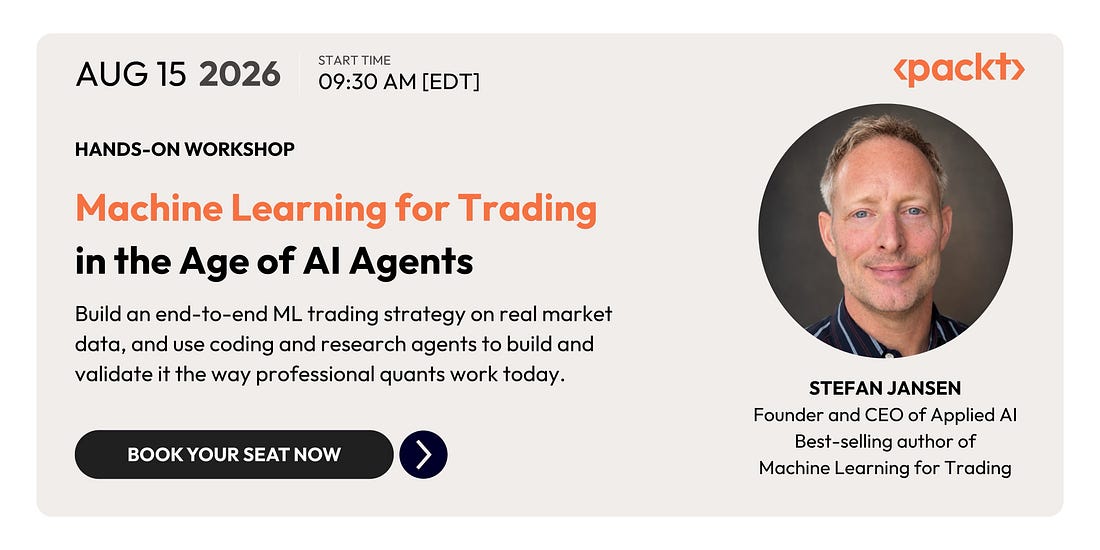
Join Stefan Jansen, best-selling author of Machine Learning for Trading, for a hands-on workshop where you’ll build a complete ML trading strategy using real market data and AI agents. Learn the end-to-end workflow used by professional quantitative teams—from feature engineering to backtesting. Marijn Markus: AI Doesn’t Have an Ethics Problem. Companies Do.The Capgemini AI Leader joins Packt’s Sanjana Gupta to explain why accountability, data quality, and human decision-making — not algorithms — will determine the future of enterprise AI. Everyone wants to talk about Artificial Intelligence. Very few want to talk about accountability. Over the last two years, boardrooms have rushed to launch AI initiatives, governments have drafted AI regulations, and organizations have published glossy frameworks promising “Responsible AI.” But according to Marijn Markus, AI Leader at Capgemini, we’re obsessing over the wrong problem. In a compelling conversation with Sanjana Gupta, Relationship Lead at Packt, Markus challenges some of the biggest assumptions surrounding AI — from ethics and hallucinations to enterprise transformation and the future of work. His central message is both uncomfortable and refreshing:
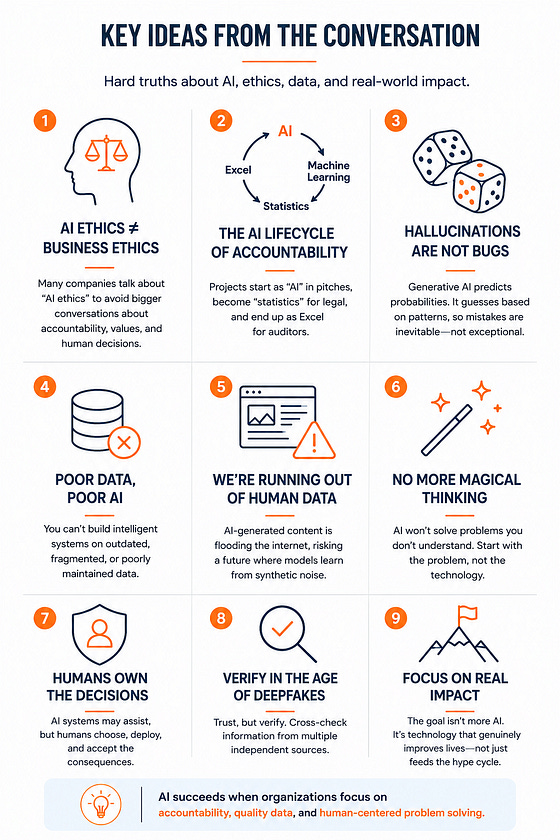
Rather than another conversation about prompt engineering or the latest foundation models, this discussion dives into something far more important: why successful AI adoption depends on organizational maturity, high-quality data, and a willingness to confront uncomfortable truths. AI Ethics Has Become a Convenient DistractionAsk any enterprise about responsible AI and you’ll hear familiar phrases. Bias. Fairness. Transparency. Explainability. Governance. These are important topics. But Markus believes they’re only part of a much bigger conversation. Businesses are increasingly comfortable discussing AI ethics, while avoiding discussions about business ethics. That’s a crucial distinction. When organizations automate jobs, optimize for profit, or deploy systems that affect people’s lives, those decisions are rarely made by algorithms. They’re made by people. Yet when something goes wrong, blame quickly shifts to the technology. As Markus points out, AI has become a convenient lightning rod — allowing organizations to distance themselves from decisions that were always fundamentally human. The real ethical question isn’t whether an algorithm made a poor recommendation. It’s who chose to deploy it, accepted its risks, and benefited from its outcomes.
The Curious Lifecycle of Enterprise AIOne of the interview’s most memorable observations comes from Markus’ experience leading AI projects across industries. He jokes that every AI project follows the same lifecycle. It starts as Artificial Intelligence during the sales pitch. During implementation it becomes Machine Learning. When lawyers become involved, it turns into Statistics. By the time auditors inspect the system… “It’s just an Excel sheet.” The room laughs. But the point is serious. Technology doesn’t change. The language does. And with every change in terminology, accountability quietly shifts. Organizations often use labels strategically, but changing the vocabulary doesn’t change the impact those systems have on people’s lives. That’s why Markus insists these conversations shouldn’t be framed as AI dilemmas. They’re simply ethical dilemmas. Hallucinations Aren’t Bugs. They’re Probability.Few topics dominate AI conversations more than hallucinations. Markus strips away the mystery with a surprisingly simple analogy. Large language models are sophisticated prediction engines. Every response is, in essence, a probability calculation — a highly informed guess based on patterns learned from enormous amounts of data. “They’re rolling dice,” he explains. Not random dice. Extremely well-trained dice. That distinction matters. Because it means hallucinations cannot be completely eliminated. Only reduced. Guardrails. Evaluation pipelines. Human review. Retrieval systems. These all lower the probability of failure, but they cannot remove uncertainty entirely. Ironically, Markus argues, humans operate in much the same way. People make mistakes. Forecasts fail. Judgment isn’t perfect. The goal isn’t perfection. It’s understanding acceptable levels of risk and designing systems accordingly.
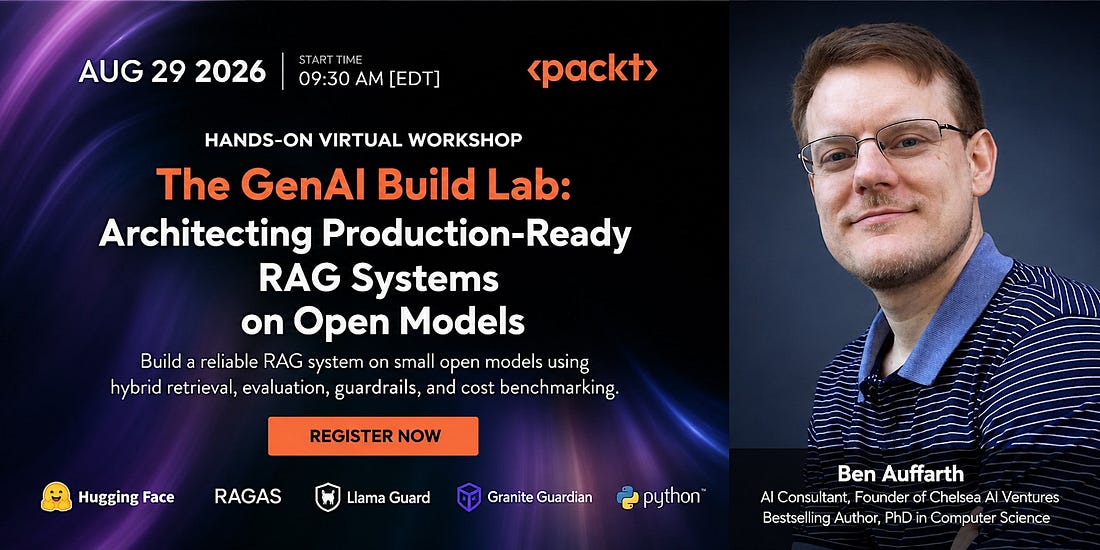
Join Ben Auffarth to build a production-ready RAG application using open-source models. Learn how to improve retrieval, benchmark performance with RAGAS, add guardrails, and deploy reliable AI systems without expensive APIs. The Biggest AI Problem Isn’t AIAs the conversation shifts toward enterprise transformation, Markus introduces what may be his most important observation. Companies don’t have AI problems. They have infrastructure problems. Many organizations proudly announce ambitious AI roadmaps while relying on fragmented databases, disconnected systems, poorly maintained SharePoint repositories, and years of inconsistent documentation. Then they wonder why building an enterprise chatbot proves difficult. “How can you build a company GPT,” Markus asks, “when your data isn’t organized in the first place?” Artificial Intelligence doesn’t replace weak digital infrastructure. It exposes it. The organizations succeeding with AI today aren’t necessarily using better models. They’re the ones that invested years earlier in digitization, governance, metadata, and clean data pipelines. AI isn’t creating new weaknesses. It’s shining a spotlight on existing ones. We’re Running Out of Human DataOne of the interview’s most fascinating discussions centers on an emerging challenge that receives surprisingly little attention. Future AI systems need high-quality training data. But today’s internet increasingly consists of content generated by AI itself. Articles. Comments. Images. Videos. Social media posts. Entire conversations between bots. As synthetic content grows faster than human-created content, future models risk learning from previous generations of AI instead of authentic human knowledge. It’s a feedback loop that could gradually reduce the quality of future AI systems. For Markus, this isn’t a theoretical concern. It’s one of the industry’s biggest long-term challenges. The future of AI may depend less on building larger models and more on preserving genuine human knowledge. The Dangerous Rise of “Magical Thinking”Perhaps the strongest message from the interview is Markus’ warning against what philosophers call magical thinking. Organizations encounter a difficult business problem. Instead of understanding it, they decide AI will somehow solve it. No diagnosis. No root-cause analysis. No understanding of whether AI is even the appropriate tool. Just hope. According to Markus, this mindset has fueled countless disappointing AI projects. Technology should never come before understanding the problem. Sometimes a sophisticated LLM is the right solution. Sometimes a forecasting model works better. Sometimes a simple linear regression provides greater transparency. And sometimes… AI isn’t needed at all. The best engineers don’t force AI into every problem. They choose the right solution for the right problem. Living in the Age of DeepfakesAs generative AI becomes capable of creating convincing images, videos, and voices, Markus believes society faces another challenge. Trust. The next generation won’t simply need AI literacy. They’ll need information literacy. Instead of trusting a single video or viral post, we’ll need to verify information across multiple independent sources. Truth, Markus argues, survives verification. Misinformation rarely does. In an age where almost anything can be fabricated, critical thinking becomes our most valuable technology. Beyond the HypeDespite his criticisms, Markus is far from pessimistic about AI. In fact, he’s remarkably optimistic. He compares today’s generative AI revolution to the arrival of Google decades ago. When search engines first appeared, they were considered cutting-edge AI. Today, nobody thinks of Google as AI. It’s simply part of everyday life. That’s what successful technology does. It becomes invisible. Generative AI, he believes, will likely follow the same path. The companies that succeed won’t be the ones making the loudest announcements or posting the most AI content on LinkedIn. They’ll be the organizations quietly solving real problems with thoughtful engineering, quality data, and responsible decision-making. As the conversation draws to a close, Markus leaves viewers with a reminder that perfectly captures the spirit of the discussion:
In a world captivated by AI hype, it’s a refreshingly human perspective — and perhaps the most important lesson of all. Data Science & ML Research Roundup🔷 13 demos on Gemini Enterprise Agent Platform: Google has unveiled 13 hands-on demos for its Gemini Enterprise Agent Platform, showcasing the complete AI agent lifecycle from development to production. Built on the Agent Development Kit (ADK), the tutorials cover agent creation, MCP integration, human-in-the-loop workflows, scalable deployment, governance with built-in security, cross-framework orchestration, and continuous evaluation. With the new Agents CLI, developers can scaffold, deploy, monitor, and optimize enterprise-ready agents directly from their coding environment. 🔷 Generate Autonomous Business Insights with AI Agent and MCP Servers: Amazon has introduced a reference architecture for autonomous business intelligence powered by Amazon Bedrock AgentCore, enabling organizations to query enterprise data in natural language without custom integration code. Using pre-built MCP connectors, unified governance, persistent memory, and a semantic data layer, the platform orchestrates insights across IoT, ERP, analytics, and operational systems. The configuration-first approach simplifies secure, scalable multi-agent deployments while reducing data silos and accelerating enterprise decision-making. 🔷 OKF v0.2 adds trust signals: Google has released Open Knowledge Format (OKF) v0.2, extending its open standard for AI agent knowledge sharing with new metadata for provenance, trust, freshness, lifecycle, and attestation. Designed for agent-generated knowledge at scale, the update lets AI systems verify who created information, when it was validated, whether it’s current, and how it was produced—without sacrificing OKF’s lightweight, vendor-neutral design. All additions remain optional, preserving backward compatibility while enabling more trustworthy multi-agent workflows. 🔷 Beyond RAG: Task-aware knowledge compression for enterprise AI on AWS: AWS has introduced Task-Aware Knowledge Compression (TAKC), a technique that goes beyond traditional RAG by pre-compressing enterprise knowledge into task-specific representations for faster, cheaper AI inference. Supporting multiple compression tiers, TAKC preserves cross-document relationships while reducing token usage by 8x–64x. Built on Amazon Bedrock and serverless AWS services, the open-source reference architecture enables scalable, cost-efficient analysis for complex enterprise workloads such as financial due diligence and regulatory compliance. 🔷 Automate agent development lifecycles with Gemini Enterprise: Google has published a hands-on guide to building production-ready AI agents with the Gemini Enterprise Agent Platform and Agents CLI. The tutorial walks developers through the full agent lifecycle—from scaffolding and deterministic tool creation to secure deployment, governance, evaluation, and publishing—entirely within their coding environment. Using an Industry Watch agent as an example, it demonstrates how enterprise AI can combine live data, deterministic workflows, and built-in security to move beyond prototypes into production. 🔷 Andrew Ng Just Released OpenWorker: An Open-Source, Local-First Desktop AI Coworker That Returns Finished Deliverables Instead of Chat. Andrew Ng has released OpenWorker, an open-source, local-first desktop AI coworker that completes tasks instead of generating chat responses. Running entirely on the user’s machine, it combines a Python FastAPI agent, Tauri desktop app, and flexible model routing to produce finished deliverables while keeping data private. Built-in permission controls, prompt-injection safeguards, and support for local or cloud LLMs make OpenWorker a secure, enterprise-friendly AI productivity assistant. 🔷 Conversational Analytics in Google Data Cloud in Q326: Google Cloud has expanded Conversational Analytics across its enterprise data ecosystem, bringing natural language querying to BigQuery, Looker, AlloyDB, Cloud SQL, and Spanner. With support for multi-cloud data, MCP tools, and Gemini Enterprise integration, organizations can securely query business data using AI. The platform also introduces enterprise-grade governance, including row-level access controls, CMEK, VPC, data residency, and HIPAA compliance, enabling trusted, large-scale AI-powered analytics. See you next time! You're currently a free subscriber to Packt DataPro. For the full experience, upgrade your subscription.
|