US · pimaxvr.com

Lighthouse vs. Inside-Out: Choosing the Right VR Tracking System

Valentine’s special: Gifted Lighthouse Faceplate by Sharing


This email was sent

Is this your brand on Milled? Claim it.

Thacking is the invisible foundation of every VR experience. It defines how stable the world feels, how precise your movements are, and how confidently your brain accepts the virtual space as real. While display resolution and field of view often get the spotlight, tracking quality quietly determines whether a headset feels professional or merely convenient.

Today's PCVR ecosystem is largely shaped by two fundamentally different tracking approaches: Lighthouse (external base station tracking) and SLAM-based inside-out tracking. Each represents a distinct philosophy, and each excels in different scenarios. Pimax supports both: not as a compromise, but as a deliberate strategy to give users control over how they experience VR.

Lighthouse Tracking: Precision Built from the Outside-In

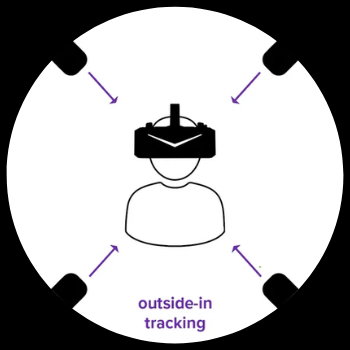
Lighthouse tracking is an outside-in system. One or more fixed base stations mounted in the room emit structured infrared laser sweeps. Sensors on the headset, controllers, and trackers read these signals and calculate their absolute position and orientation in space.

This approach has long been considered the gold standard for precision.

Because tracking references come from fixed, external points, Lighthouse delivers exceptional spatial accuracy and long-term stability. Drift is effectively nonexistent. Environmental lighting, reflections, or moving objects have minimal impact. The system scales effortlessly, allowing reliable tracking of multiple devices at once, headsets, controllers, and full-body trackers operating together in a single, coherent coordinate space.

That level of performance comes with trade-offs. Base stations must be installed, aligned, and powered. They add cost, reduce portability, and make the setup less suitable for quick relocation or temporary environments. Lighthouse is not designed for “pick up and play”; it is designed for maximum fidelity in a fixed space.

In short, Lighthouse favors absolute precision and ecosystem depth over convenience.

SLAM Inside-Out Tracking: Intelligence Built into the Headset

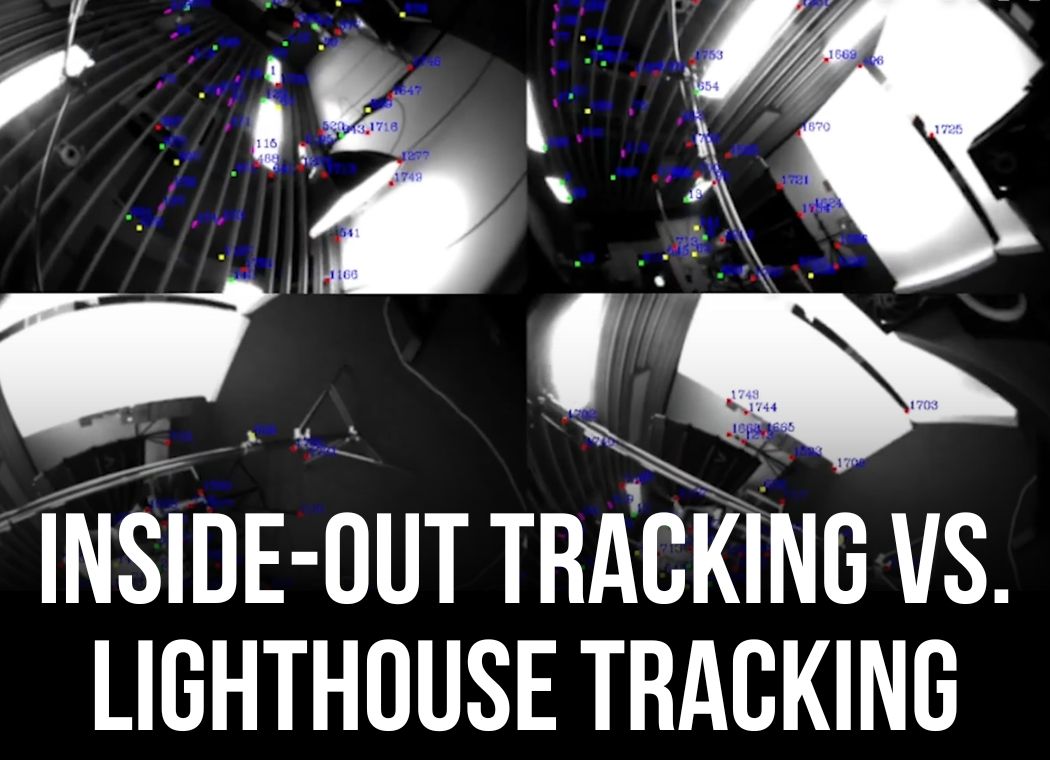
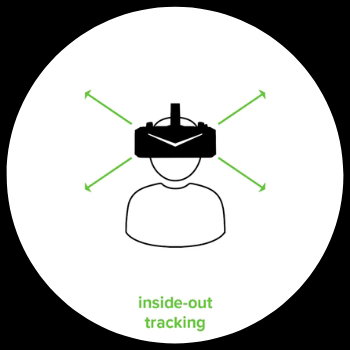
SLAM (Simultaneous Localization and Mapping) tracking works from the opposite direction. It is an inside-out system that relies on cameras and inertial sensors built directly into the headset. By observing the environment and fusing visual data with motion sensors, the headset continuously builds a map of the space and tracks its position within it.

The result is immediacy.

There are no external devices to install. No calibration routines. No room preparation beyond reasonable lighting and visible environmental features. Put on the headset, define your boundary, and you are ready to play.

Modern SLAM systems have reached a level of maturity where their relative accuracy is more than sufficient for the vast majority of VR use cases, including simulation racing and flight. For seated experiences, where head movement is smooth and controlled, inside-out tracking delivers stable, predictable performance with minimal overhead.

However, SLAM is inherently more dependent on the environment. Extremely low light, large uniform surfaces, strong reflections, or rapidly changing visual scenes can reduce tracking confidence. While algorithms continue to improve, SLAM prioritizes adaptability and accessibility rather than absolute spatial authority.

Inside-out tracking favors speed, portability, and usability.

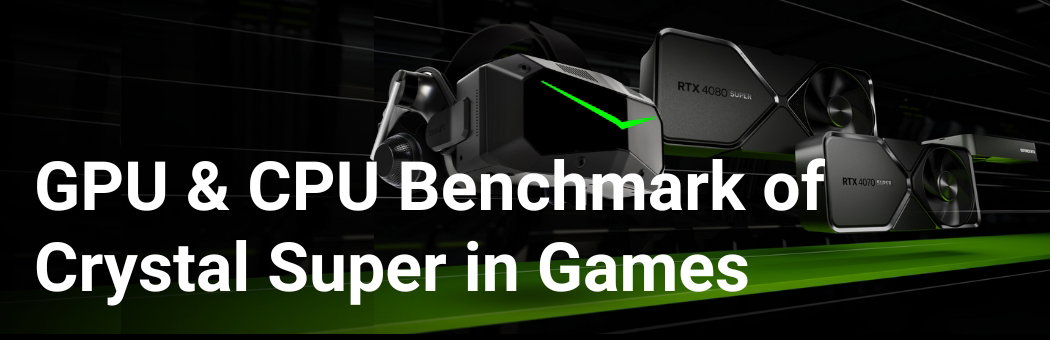
Explore the strengths and limitations of both tracking approaches and see how each one impacts real-world gameplay performance in the full article.


Pimax Supports a Hybrid Tracking Strategy

Pimax supports both Lighthouse and inside-out tracking to meet the diverse needs of serious PCVR users. Lighthouse compatibility preserves existing investments and delivers maximum precision for full-body and room-scale setups, while native SLAM tracking offers a streamlined, practical solution for simulation racing and flight. As inside-out becomes the industry standard, Pimax continues refining its own tracking stack without abandoning advanced users, bridging performance, flexibility, and future readiness in one hybrid strategy.

If you primarily play in a seated setup, you can fully benefit from the convenience and flexibility of inside-out tracking.

If you’ve already built a VR setup with base stations and controllers, you can easily switch to higher-precision, wider-range outside-in tracking by simply replacing the faceplate with the Lighthouse Faceplate.

Get a FREE Lighthouse Faceplate with the following steps: 
  1. Buy a Pimax Crystal Light or Crystal Super before 2026/02/28. Use code LH2026 at checkout.
  2. You will receive a personal pairing code via your email. It is usually the last 4 digits of your order number.
  3. Share your pairing code with anyone who is interested in upgrading their VR.
  4. If someone completed an eligible order using your personal pairing code before 2026/06/30, both of you can receive a FREE Lighthouse Faceplate adaptable to your ordered headset.
Review the full terms and conditions here for complete details.


Additional Discount on All MP Headsets

The subscribers' exclusive discount codes can now be applied to all Crystal Light & Crystal Super modules includes:

Click the above link to claim your discount.
[Code: JN3DQX3ZJ]


More to Read

YouTube
Facebook
X
Instagram
Copyright © 2026 Pimax, All rights reserved.
You were subscribed to the newsletter from Pimax

Our mailing address is:
Pimax
Room 1902, Easey Comm Building
FLAT/RM 401
Hong Kong SAR
Hong Kong

Add us to your address book


Want to change how you receive these emails?
You can update your preferences or unsubscribe from this list.

Email Marketing Powered by Mailchimp
Are you sure?

Lists help you organize the brands that you care about. Your lists are private to you.