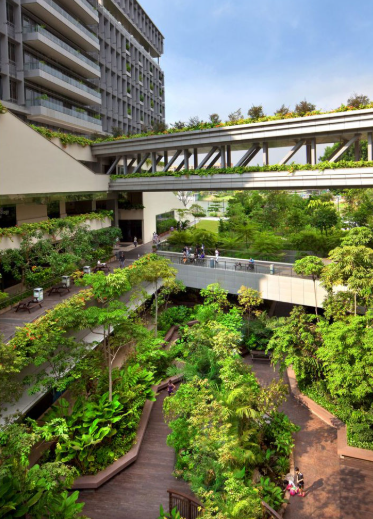
It’s called Khoo Teck Puat Hospital, but many people describe it as “a hospital in a garden, and a garden in a hospital.”
Nature wasn't an afterthought, it was actually built into the design. Green roofs, water features, open courtyards, and planting everywhere you look creates a space that feels alive in a way most hospitals don’t.
And it's not just for people.
The grounds have become a thriving ecosystem of birds, butterflies, dragonflies, fish, and hundreds of plant species. Over time, wildlife simply moved on in.
The gardens aren't just there for smiles, every tree, pond, and green wall has a purpose. The plants shade the building from Singapore's intense sun, keeping it naturally cooler so the hospital relies less on air conditioning.
The open courtyards and gardens help pull cooler air through the building, while rainwater is collected to irrigate the landscape instead of relying entirely on treated water.
The result?
The hospital uses about 30% less energy than a typical hospital in Singapore, saving over $1 million a year in energy costs!!! wild!
At the same time, it's become home to butterflies, dragonflies, birds, fish, and hundreds of plant species.
They didn't have to choose between what's good for people, what's good for wildlife, and what's good for the bottom line. By designing with nature instead of around it, they got all three. Genius if you ask me.
Obviously, you couldn't build this exact hospital everywhere. Climate, geography, and even the size of the space all play a role. But the bigger lesson isn't about copying the design but about asking how we can work with nature instead of constantly trying to replace it.
We tend to design for efficiency and convenience but often forget the emotional and environmental experience of being somewhere like a hospital.
And yet, Khoo Teck Puat Hospital shows what happens when nature is treated as part of healing, not separate from it.
It also made me think about the world we’re building outside hospital walls. Convenience that slowly replaces connection.
That’s why we started etee. Not because we think a single product changes everything but because small choices, multiplied by millions of people, quietly shape the kind of world we live in.