US · stacksocial.com

2,000 years of architecture lore just collapsed

Plus, where to watch the earth glow.


This email was sent

Is this your brand on Milled? Claim it.

Plus, where to watch the earth glow.
͏ ‌   ͏ ‌   ͏ ‌   ͏ ‌   ͏ ‌   ͏ ‌   ͏ ‌   ͏ ‌   ͏ ‌   ͏ ‌   ͏ ‌   ͏ ‌   ͏ ‌   ͏ ‌   ͏ ‌   ͏ ‌   ͏ ‌   ͏ ‌   ͏ ‌   ͏ ‌   ͏ ‌   ͏ ‌   ͏ ‌   ͏ ‌   ͏ ‌   ͏ ‌   ͏ ‌   ͏ ‌   ͏ ‌   ͏ ‌   ͏ ‌   ͏ ‌   ͏ ‌   ͏ ‌   ͏ ‌   ͏ ‌   ͏ ‌   ͏ ‌   ͏ ‌   ͏ ‌   ͏ ‌   ͏ ‌   ͏ ‌   ͏ ‌  
The Futurist
Together With
Welcome to The Futurist

Advertise   |  Talk to Us   |  Shop   |  Unsubscribe

Help us spread the word:
Send the sign-up link to your friends.

/yikes
Zuckoff app can now use your phone to check for nearby Meta smart glasses | Digital Trends

“A new app is giving people a way to find out when Meta smart glasses may be nearby, tapping into growing concerns about the privacy implications of wearable cameras. Called Zuckoff, the app was created by Polish software developer Pawel Szydlowski after he became concerned by videos showing people being recorded without realizing it. … Zuckoff is designed to detect nearby smart glasses and estimate how close they are. Its developer says the app identifies the Bluetooth signals broadcast by compatible glasses and uses information from those signals to determine whether a known pair of smart glasses is nearby. Some of the Bluetooth services can reportedly contain identifiers associated with Meta or Ray-Ban devices.”

Digital Trends »
/dicey
One in three Americans has already lost money to this | Get it now

McAfee found that 68% of people scanned a QR code recently, and 18% landed somewhere they shouldn’t have. Add in the 14 scam texts, emails, and DMs the average American fields daily, and it’s clear antivirus alone isn’t enough protection anymore. McAfee+ now covers identity monitoring, a VPN, personal data removal, and a scam detector that flags suspicious messages before you click anything, malicious link or not. New customers get McAfee+ Premium for $49.99 the first year (originally $149.99). [Ad]

Get it now »
/whoa
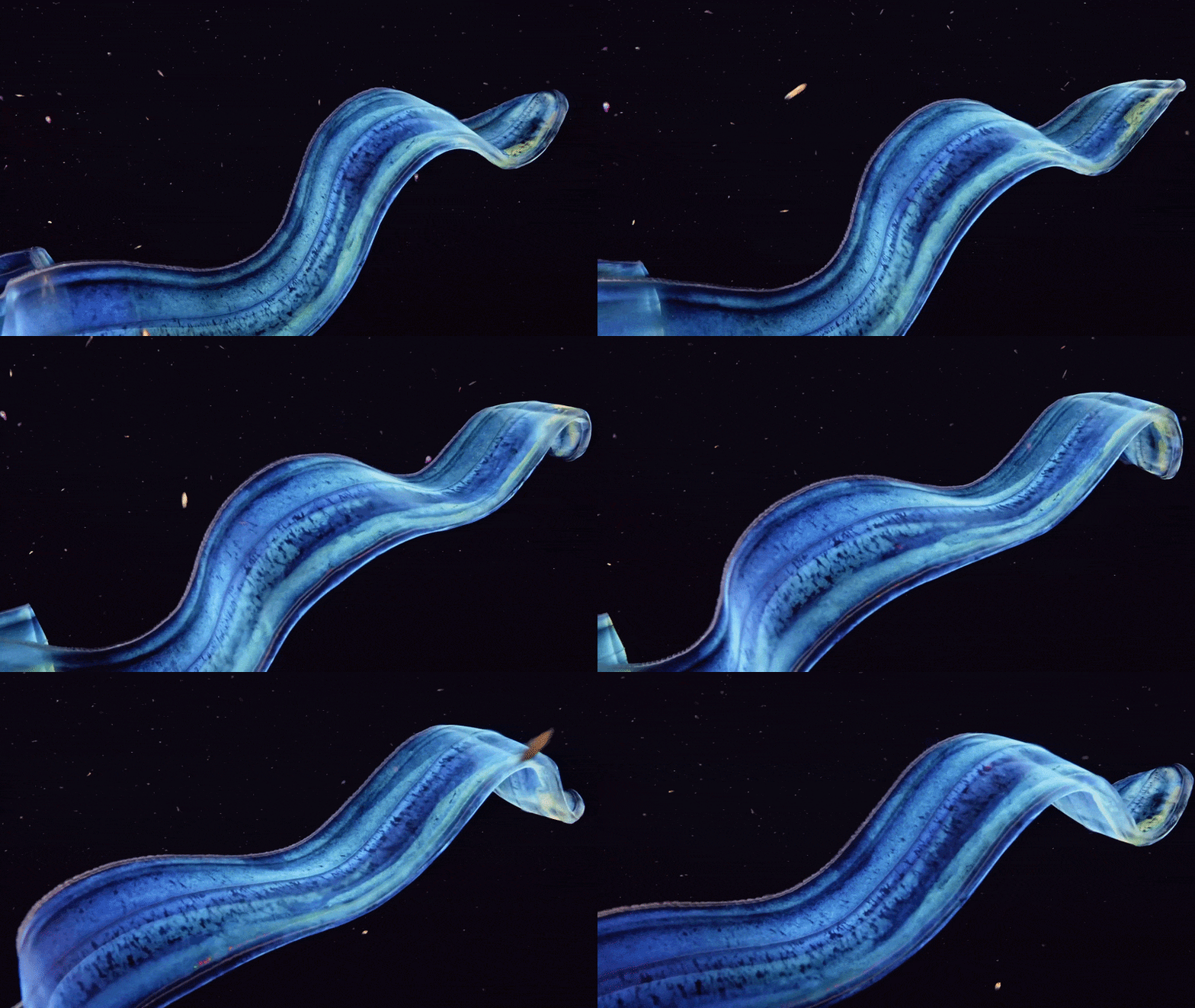
Ctenophores aren't just beautiful. They're biological wonders. | Quanta Magazine

“Around 700 million years ago, a group of organisms resembling little more than glowing, gelatinous blobs split off from the rest of the animals, forming possibly the earliest branching animal lineage. Nearly 200 species of ctenophores, commonly known as comb jellies (but unrelated to jellyfish), live today in environments ranging from the cold depths of the sea to warm coastal surface waters. Their magic isn’t just in their persistence or iridescence; it’s in their DNA. Over the past decade, ctenophores have helped answer long-standing questions about fundamental biology, from how early nervous systems evolved to the origins of the mesmerizing phenomenon of bioluminescence.”

Quanta Magazine »
/explore
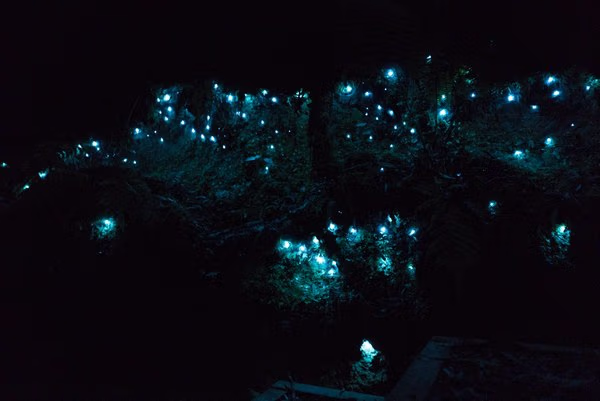
15 places to experience bioluminescence around the world | Atlas Obscura

“The humble glow worm is, in fact, a catchall term for numerous glowing creatures, from gnat larvae to fireflies to algae, that can be found all over the world. These tiny critters illuminate the night through bioluminescence, a process in which light is emitted by internal chemical reactions. Bioluminescence has evolved independently in over 90 different species, first emerging some 540 million years ago, and today, it’s still possible to observe the phenomenon firsthand… if you know where to look.”

Atlas Obscura »
/innovation
The IDE that raised you just grew up, and now it's only $30 | Own your IDE

You’ve been here before: staring at the spinning build indicator like it owes you an apology, copy-pasting Stack Overflow answers into a prayer. Visual Studio has been your weird, complicated work relationship for years. But VS Pro 2026 is different — smarter tooling, faster debugging, and a UI that doesn’t feel like it was designed to test your patience. It’s a one-time purchase for $30, yours to keep, and it might actually make you forget that debugging used to feel like a punishment. [Ad]

Own your IDE »
/trippy
Mathematician debunks the Parthenon's famous optical illusions | Popular Science

“The Parthenon is undeniably one of history’s most renowned architectural feats, but one detail of its structural genius is a total hoax. For over 2,000 years, scholars and admirers have alleged that the ancient Greek building’s nearly imperceptible curves were specifically crafted to compensate for optical illusions that would otherwise ruin the structure’s clean lines. But recent analysis says otherwise. After a detailed investigation and complex computational modeling, University of Oxford mathematician Alain Goriely says the illusions are just that — illusions.”

Popular Science »
/bites
/earth
@karolnienartowicz on Instagram

Interested in having one of your social posts featured in The Futurist?

Get in touch »
Are you sure?

Lists help you organize the brands that you care about. Your lists are private to you.