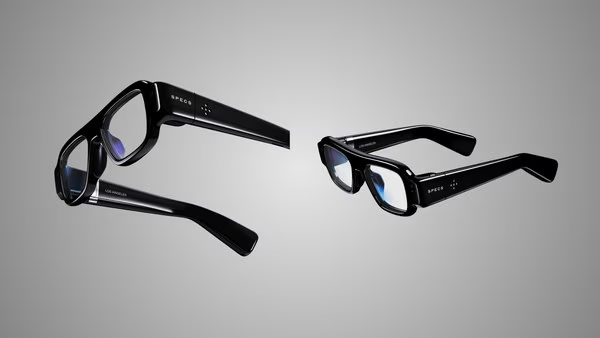
“Speedrunners are, scientifically and objectively, far better than actual runners. Just running faster than someone else requires, what, better drugs? But speedrunning demands a vast combination of dexterity, skill, knowledge and almost no drugs at all. Maybe just weed. These undersung athletes are now just 0.1 seconds away from completing a perfect run of Super Mario Bros., as detailed in a new video from former SMB world record holder Kosmic. (Thanks Polygon.) A newer name has begun taking over the scene…” | | Somewhere inside a pair of ordinary-looking glasses, Snap has hidden a computer that only turns on for you. A private display floats in your field of vision, invisible to everyone around you, laid directly over whatever you’re actually looking at. Translation, navigation, a second monitor, a game board — all rendered into the room itself instead of a screen you have to look down at. There’s no headset. No visible tech. Just the glasses, and then, apparently, everything else. Snap is calling it the next era of computing, which sounds like a stretch until you see what it’s actually doing. [Ad] | | “When I first downloaded the McDonald’s app years ago, I signed up for its loyalty program hoping to get better deals. Why not get some cheap french fries? While I understood that this would entail some type of data tracking, I didn’t grasp how the information would be used to algorithmically predict my next purchase. As a California resident, I have the legal right to access the data a company stores about me. So, I decided to request that information from McDonald’s to better understand what one of the major fast-food companies is collecting about its customers. A few days after I visited the McDonald’s Privacy Rights Center site and requested access, I received a 515-page file in my inbox with the iconic golden arches stamped across the top. When customers sign up for loyalty programs, like the one offered through the McDonald’s app, they might not fully realize the extent to which their data is being aggregated and used in predictive models.” | | “Every few decades, someone announces that science has reached its end. In 1903, the revered physicist Albert Michelson wrote that the ‘facts of physical science have all been discovered.’ In the 1980s, Stephen Hawking predicted that theoretical physics might be finished by the end of the century. With the explosive arrival of artificial intelligence, the feeling is in the air again — this time accompanied by a Nobel Prize. In 2024, Demis Hassabis and John Jumper of Google DeepMind were awarded part of the Nobel in chemistry for their neural network AlphaFold, which predicts the three-dimensional structures of proteins by learning from thousands of experimentally measured shapes. … It seemed, once again, that a path through the rest of science was laid out before us. To be sure, AI will bring extraordinary changes to science, but it has become increasingly clear that AlphaFold, and things like it, may not be the best template for that metamorphosis.” | | Earlier this year, Google finished rolling out changes that effectively neutered browser-based ad blockers — including, yes, the one you’ve been using for years. AdGuard sidesteps all of that by operating at the system level, blocking ads and trackers before they ever reach your browser. One license covers 9 devices for life, includes parental controls, and runs on Windows, Mac, iOS, and Android. It costs $11. Your cable bill costs more than that per week. [Ad] | | “Spend any time with a dog, and it’s clear many have a remarkable ability to understand how we’re feeling. But while there are endless anecdotes of empathetic dogs coming to comfort us when we’re sad and barking happily when we’re feeling good, actual hard scientific evidence of the extent to which dogs really understand human emotion is surprisingly thin on the ground. This is because ultimately, we can never know what it’s like to be a dog — and sadly, we can’t just ask them. In the famous words of British veterinarian and author James Alfred Wight (better known by his pen name James Herriot): if only they could talk. Nevertheless, scientists are slowly developing a more sophisticated understanding of the ways that dogs relate to us…” | |
Interested in having one of your social posts featured in The Futurist? | |
| |