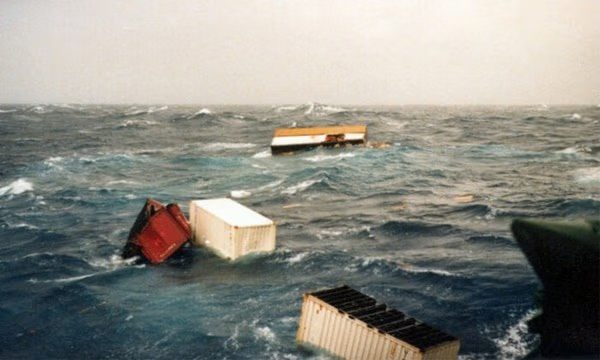
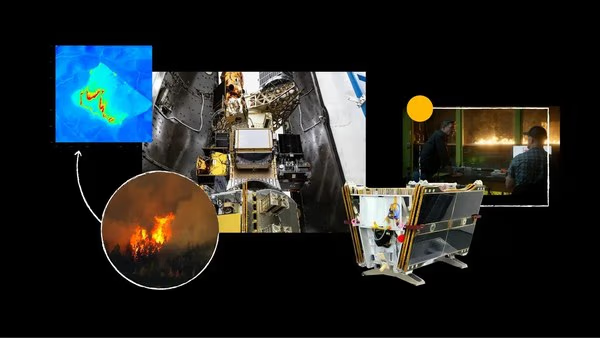
“To the casual observer, the look and feel of shipping containers suggests a world of smooth, lossless transportation, almost immaterial in its implementation of a logistical ideal. However, the system is far from lossless. In fact, during storms and shipwrecks, shipping containers regularly go overboard. Nobody knows exactly how many of these vast, 20- or 40-foot-long steel capsules — stacked in the thousands in the cargo holds of each ship, carrying the stuff of the global economy — are lost each year. Shipping lines and insurance companies keep these figures under wraps. But estimates suggest that of the hundreds of millions in circulation annually, several thousand containers vanish — sometimes forever. And what becomes of the containers that disappear?” | | Snap’s new AR glasses project a full computer onto the world in front of you — a 51-degree field of view running through a see-through waveguide, so you’re looking at a floating 115-inch screen and the room it’s floating in at the same time. Live translation appears mid-conversation. Directions hover over the actual street. A chessboard materializes on your actual table. It sounds like concept art. It’s shipping to real humans this fall, and the early details are worth a closer look. [Ad] | | “Automation is ubiquitous, from the autopilot in airplanes to the cycles of the washing machine in your home. And with the modern advent of artificial intelligence, computers and machines are taking on ever more tasks. That doesn’t necessarily mean human jobs go away, but they change — from doing the task itself to supervising the machine doing it, says Ron McLeod of Glasgow, Scotland. A retired specialist in the field of ‘human factors,’ McLeod spent his career studying how human brains and automation work together — or fail to — in industrial settings like oil refinery control rooms. … At work, AI, robots and automation offer potential gains, but also limitations … AI tools, they note, might be opaque or just plain wrong, and human workers can’t always override their decisions, leaving employees disengaged and frustrated.” | | “A variety of climate action strategies improve people’s quality of life, including strategies that require people to shift their behavior to use less energy, according to a new analysis. The study challenges the conventional wisdom that fighting climate change imposes a burden on the public — and offers a hopeful message about people’s willingness to engage. In the past, most of the debate about policies to reduce greenhouse gas emissions has centered on cost versus amount of carbon saved. The new study adds quality of life as a third, previously overlooked dimension to the picture.” | | Every major AI lab shipped something impressive this year, and instead of picking a favorite, this platform just plugs into all of them at once. Where a single premium chatbot subscription runs $30 a month, this is one $30 payment for lifetime access to the combined brainpower of OpenAI, Midjourney, Anthropic, Meta, and Google’s best models. Chat, write, edit images, dig through PDFs, whatever the task, it handles it quietly instead of billing for it monthly. [Ad] | | “As Canada grapples with some of its worst wildfires in recent history, three satellites launched into low orbit earlier this month, built to deliver AI-powered wildfire detection across the globe. The satellites, part of the FireSat initiative by the non-profit Earth Fire Alliance, can detect low-intensity fires before they are detected by other means, providing third parties with information on where the fire is traveling.” | |
Interested in having one of your social posts featured in The Futurist? | |
| |