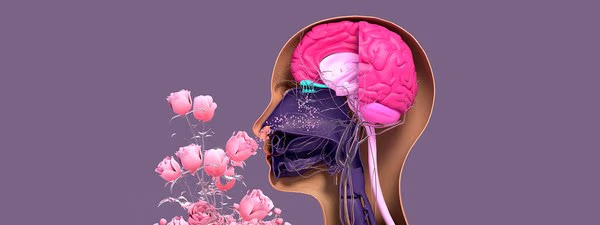
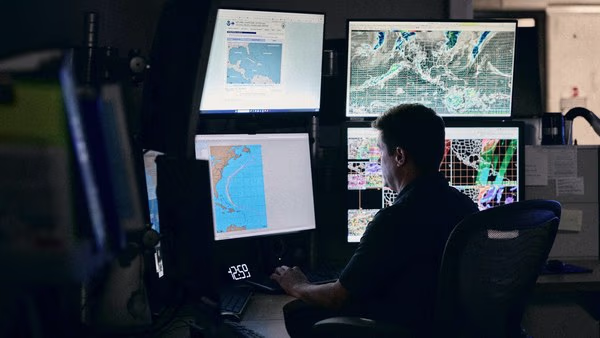
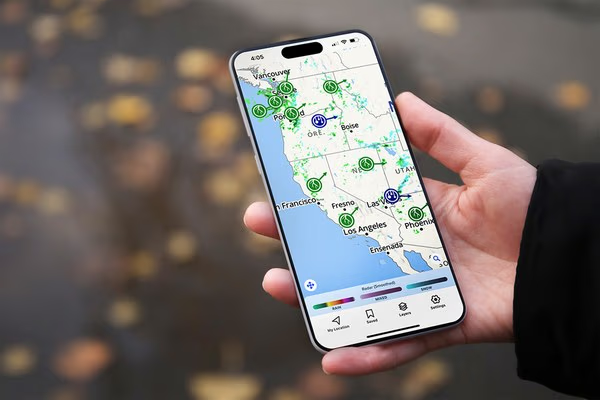
“Those scanning the skies over the East River this summer may spot something unfamiliar — a cargo drone schlepping packages between the Downtown Skyport in lower Manhattan and the Brooklyn Marine Terminal just south of Brooklyn Bridge Park. With its seven-foot wingspan, the white Speedbird drone — which looks like the love child of a Stormtrooper and a spider — can be spotted a mile away. Overseen by a team of three, it’s operated by a big outfit, Skyports Drone Services, a U.K.-based logistics company ‘delivering what matters’ for governments and businesses around the globe. So what exactly is this thing hauling over the river?” | | Here’s a fun thought experiment: How much have you spent on streaming subscriptions in the last three years, and what do you actually have to show for it? Curiosity Stream is the answer to that uncomfortable math. One payment unlocks a lifetime of documentaries on science, space, history, technology, and the universe at large — without renewals, creeping price hikes, or password-sharing drama. Just unrestricted access to content that makes your brain work in a good way. [Ad] | | “About 14 years ago, Chrissi Kelly lost her sense of smell. She had traveled to the Czech Republic to visit family and caught some virus. Months later … she was diagnosed with anosmia (smell loss) … the loss was catastrophic. ‘After about six months of complete loss, I was just climbing the walls, and I did not feel like myself anymore,’ she says. Researchers estimate that up to 22% of the population lives with smell impairments, like hyposmia (partial smell loss) or anosmia (complete smell loss). And many others live with smell disorders like phantosmia, in which a person picks up phantom smells, or parosmia, where typically pleasant scents like coffee or shampoo begin to register as highly unpleasant (think feces or vomit). Yet the conditions have been poorly understood, underdiagnosed, and often minimized by clinicians.” | | “Last October, days before Hurricane Melissa slammed into Jamaica, it wasn’t obvious how quickly the storm would intensify or the path it would take. But inside Google, an experimental AI model was spinning through dozens of scenarios, including the possibility that it might be the strongest hurricane on record to hit the island. … When the storm finally hit, the forecast was correct. Wind speeds topped 131 miles per hour, and the damage was catastrophic: Roofs were torn off more than 120,000 buildings, and tens of thousands of others were destroyed, leaving families homeless. Forty-five people were killed. But the early warnings — and the fact that they stayed consistent as the storm approached — meant that people took them seriously, and likely saved additional lives.” P.S. — Share your email when prompted to read this article. | | Google’s AI model predicted Hurricane Melissa would intensify to a Category 5 five days before it hit Jamaica. You don’t need that level of drama to appreciate having better weather intel than your phone’s default app. Weather Hi-Def Radar puts real-time and future-animated radar on an interactive satellite map, with persistent alerts for lightning, floods, tornadoes, winter storms, and more — across every location you care about. The forecasting arms race just leveled up. Might as well get your hands on a consumer version. [Ad] | | “What the cognitive psychologist and linguist Steven Pinker has artfully termed ‘the euphemism treadmill’ is not a tic or a stunt. It is an inevitable and, more to the point, healthy process, necessary in view of the eternal gulf between language and opinion. We think of euphemisms as one-time events, where one prissily coins a way of saying something that detracts from something unpleasant about it. That serves perfectly well as a definition of what euphemism is, but misses the point that euphemism tends to require regular renewal. This is because thought changes more slowly than we can change the words for it, and has a way of catching up with our new coinages. Since that is likely eternal, we must accept that we’ll change our terms just like we change our underwear, as a part of linguistic life in a civilized society.” | |
Interested in having one of your social posts featured in The Futurist? | |
| |