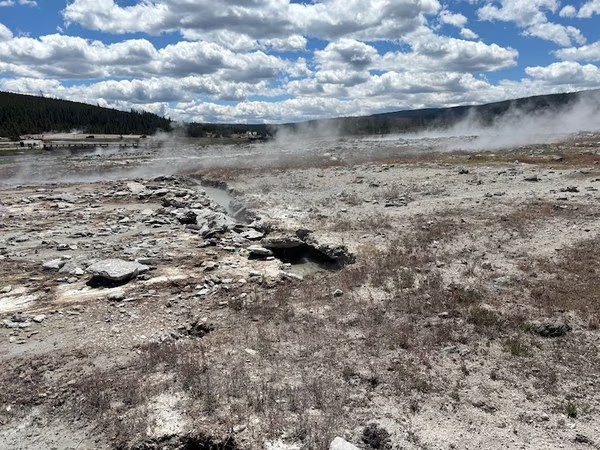
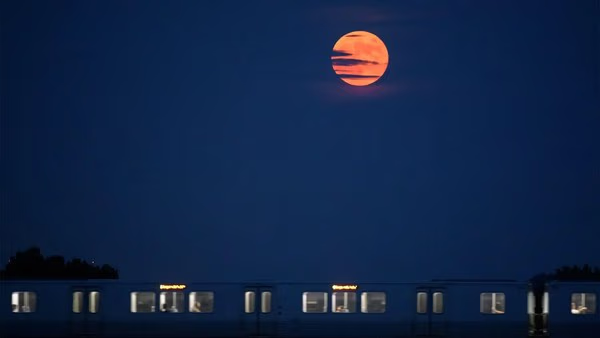
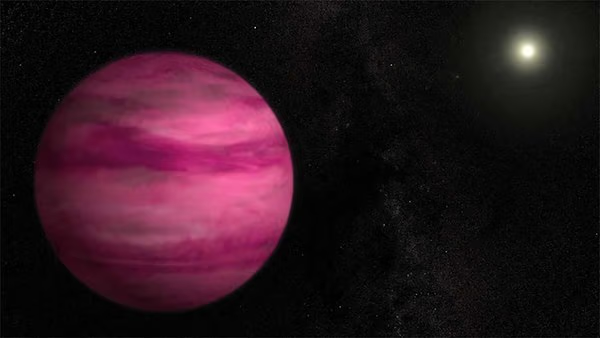
“Another hydrothermal explosion has occurred at Yellowstone National Park, highlighting the unstable nature of the reserve’s extensive volcanic network, the U.S. Geological Survey says. On June 13, a small hydrothermal explosion occurred at Yellowstone’s Biscuit Basin — a popular thermal area located less than 2 miles northwest of Old Faithful, according to the USGS. The explosion occurred at 5:09 a.m. local time and did not cause any injuries, according to the USGS. A new pool formed as a result of activity.” | | Every ~10 minutes, the Bitcoin network pays out a full block reward to whoever finds it first. Industrial miners throw warehouses of hardware at the problem. BlockChance throws lottery tickets — and a lot of them. At 1,000 KH/s, it submits roughly 18x more daily entries than typical ticket miners, quietly running on your desk for less power than a nightlight. The odds are long (about 1 in 6.5 million on any given day), but they’re real, they’re yours, and they compound every single day the device is plugged in. So, why not try? [Ad] | | “It almost sounds like a movie title: The Strawberry Moon. June’s Strawberry Moon is just a week away. It’s the third and final micro moon of 2026, and you can see it on June 29. A micro moon occurs when a full Moon or a new Moon happens at the same time the Moon is at apogee, its farthest point in orbit from Earth. The Strawberry Moon reaches peak illumination at 7:56 p.m. ET on June 29, which is still during daylight hours for everyone in North America. That means the best time to see the full moon is that same evening once the sun has set. The moon is set to rise out of the southeastern sky just after sunset and streak across the southern horizon until it sets in the southwest just before sunrise.” | | “An enormous world orbiting a sun-like star just 57 light-years away in space may have a pink hue and a sky filled with clouds of salt. Astronomers used NASA’s James Webb Space Telescope to study a distant object called GJ 504 b, and for the first time, detailed in a new study, they captured its light in enough detail to study its atmosphere directly rather than relying on rough brightness calculations. ‘Distant object’ is about as precise of a label as it gets for this thing. Despite the Pink Planet nickname, astronomers aren’t even sure what it is. Some studies have suggested it might be a giant exoplanet, while others argue it could be a brown dwarf, a sort of failed star too small to generate its own nuclear power. For now, astronomers are comfortable calling it a ‘planetary-mass companion.’” | | Imagine a thunderdome where GPT-4o, Claude, Gemini, DeepSeek, Llama, and 15+ other models all answer your question at the same time — that’s ChatPlayground AI. One prompt, instant side-by-side outputs, and you get to play judge. Upload PDFs, chat with images, generate visuals, engineer better prompts, and stop pretending your go-to model is always right. It’s one lifetime purchase and the most chaotic-good AI setup you’ll own. [Ad] | | “Scientists have sequenced the genomes of some of the last surviving Neanderthals of northwestern Europe, and it has turned up several surprises. Neanderthals lived across much of Europe and from southwestern to central Asia until they fell into extinction approximately 40,000 years ago. Across this vast geographic expanse, different populations emerged, each with its own story buried in its genetics. In a new study, researchers focused on those who forged out a living in northwestern Europe. To sketch their story, an international team led by researchers from the Max Planck Institute for Evolutionary Anthropology in Germany sequenced DNA from 27 Neanderthal remains found across seven locations in modern-day Belgium and France.” | |
Interested in having one of your social posts featured in The Futurist? | |
| |