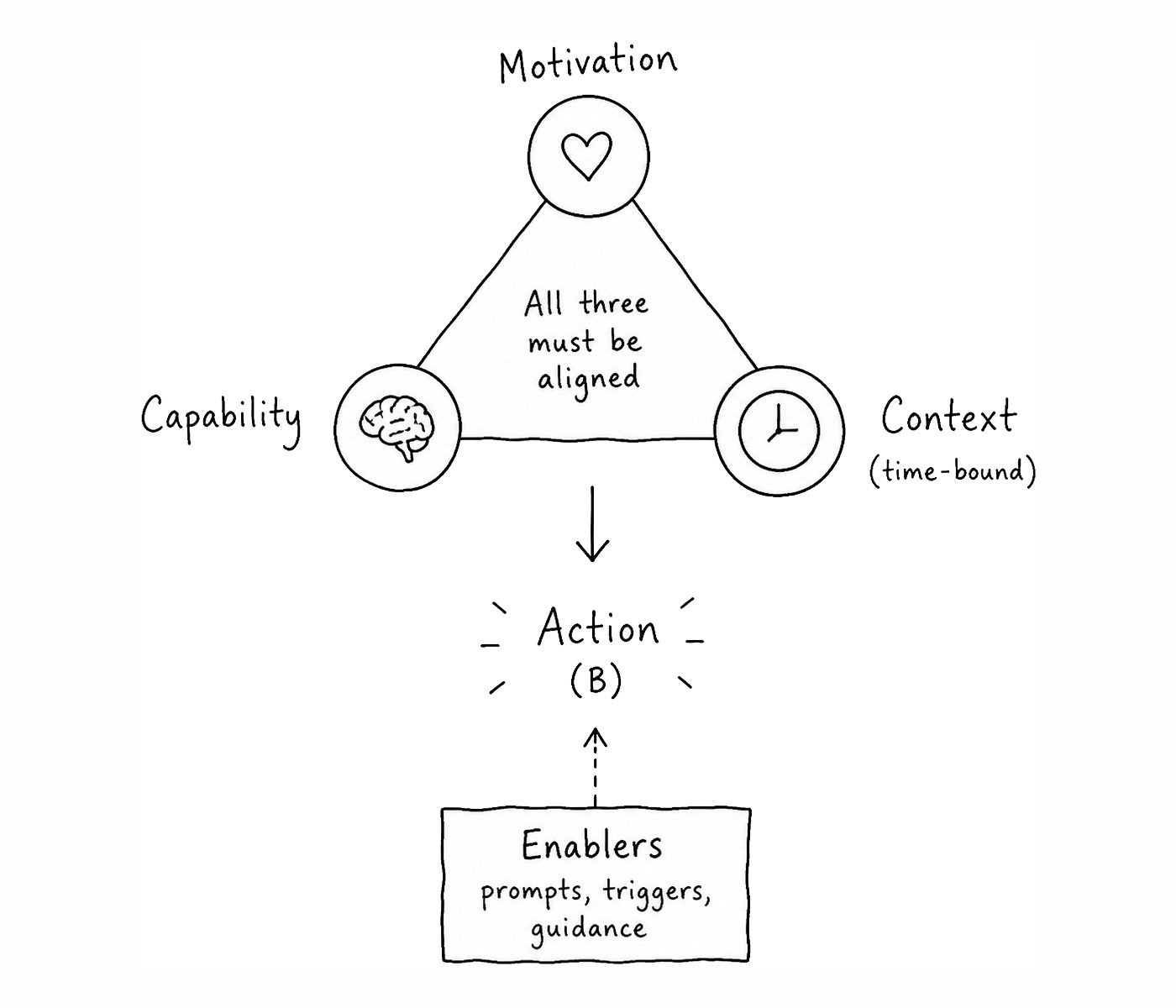
The first two are familiar. The third is where things get interesting.
Context is not just environment or opportunity in a broad sense. It is whether the user can realistically act right now. Do they have enough time? Enough attention? Enough confidence? Enough trust? Enough energy to continue?
This matters because onboarding happens inside windows of opportunity. Those windows open and close constantly.
A user may fully intend to complete a task but still abandon it because the moment changed. They got interrupted. They lost confidence. The task suddenly felt too large. The flow asked for too much at once.
Historically, products could not really respond to this. They only reacted after the user dropped off.
That is where GenAI becomes interesting
Context is what GenAI feeds on!
Not because every product suddenly needs a chatbot, but because onboarding systems can now begin interpreting behavioral context while the user is still inside the experience.
A long pause on an income verification step might trigger an offer to import tax data automatically. Repeated backtracking might trigger human assistance. Someone trying to cancel because of low usage might receive a pause option instead of a discount.
So please! Don't add more prompts! Seek to make a better fit with what you're presenting the user with and their context.
Instead of forcing every user through the same path, onboarding can begin adapting to what the current moment actually allows.
I'm working on a longer article exploring this idea. I hope to finish it this week. Until then, you can read more about my adapted behavioral modal (that fits nicely with AI): https://learningloop.io/blog/a-behavioral-model-of-user-onboarding
This is how to use the new capabilities of GenAI to shift onboarding (and any flow, really) from static flows to adaptive systems.