This issue: How clothing companies are partnering with buzzy authors to hawk their merchandise, a report from Equator magazine’s issue-one launch party, and two recent releases worth the price of an expensive lunch.
|
|
|
|
|
Senior newsletter editor, New York |
|
|
|
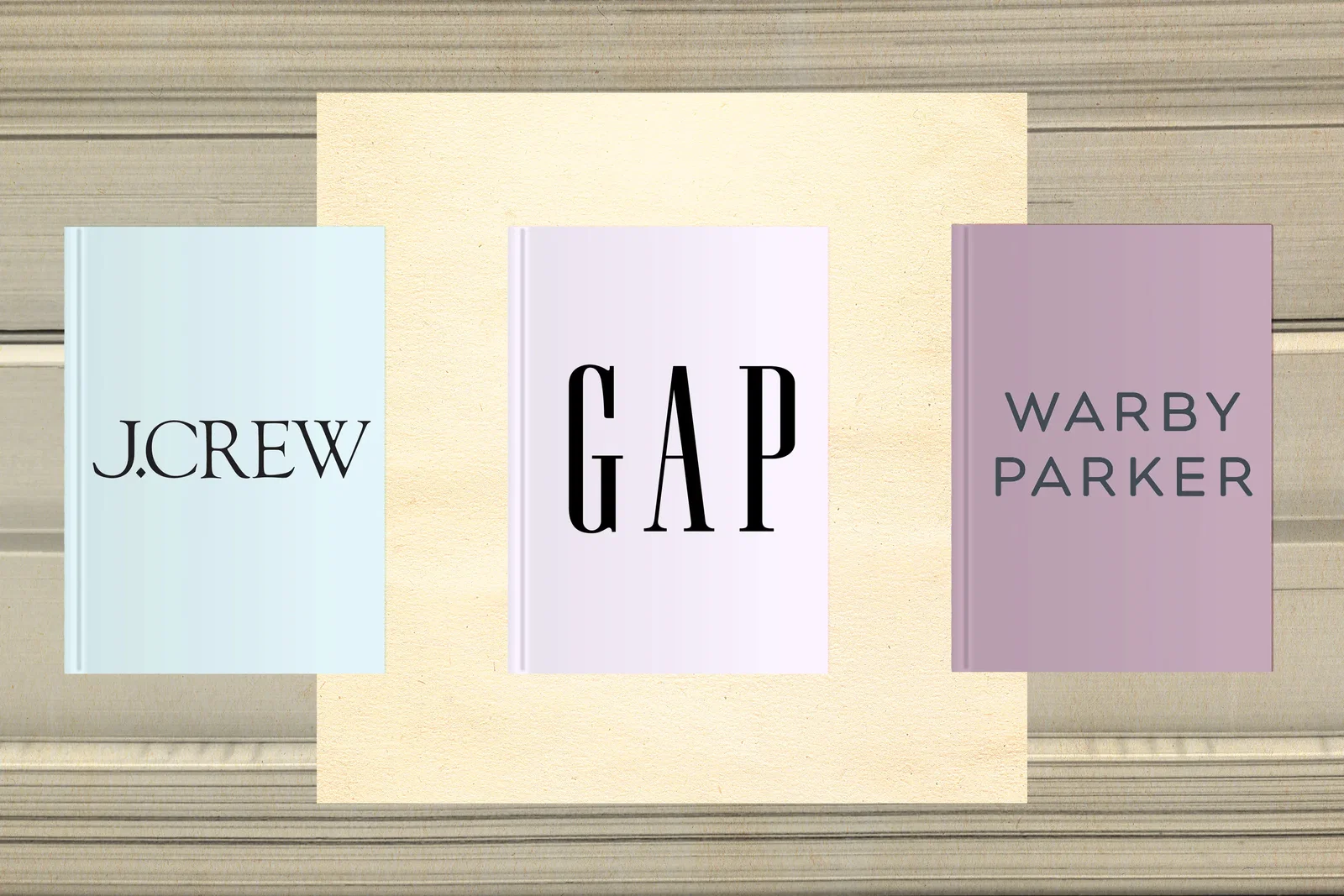
Model Author Reading and writing have never been so fashionable — or so clothing brands tell us.
|
Photo-Illustration: New York Magazine |
|
|
|
You may have seen the recent Gap ad in which Madeline Cash, styled by the brand, moseys around London with a bouquet of what look like daffodils and explains in voice-over that her “fear of finality and late capitalism” inspired her breakout debut novel, Lost Lambs. In another shot, we see the 30-year-old author in a Gap sweatshirt balancing copies of her book (U.K. edition) on her head. The charming low-saturation video was just one of several recent instances of fashion brands both high and low choosing to spotlight writers in their advertising.
There’s a well-established history of designers featuring authors, from Céline tapping Joan Didion for a glossy 2015 shoot to Ottessa Moshfegh walking in Maryam Nassir Zadeh’s New York Fashion Week show. Last year, Zadie Smith spoke about her craft in a 30-second black-and-white video for Bottega Veneta. Miu Miu has now hosted several editions of its salon-esque “Literary Club.” Happiness and Love author Zoe Dubno walked for Proenza Schouler earlier this year and was featured in the Stockholm-based designer Gant’s spring-summer campaign. What feels new is that clothing brands — and not just the ones you might encounter at Fashion Week — are increasingly looking to partner with emerging talent.
Even as fewer Americans read for pleasure and U.S. test scores indicate that student reading comprehension is trending downward, brands like Gap and Gant are framing the literary life as aspirational, almost a luxury in itself — yet still approachable enough to appeal to your average consumer. A representative for Gant told Book Gossip that it chose Dubno because of her authenticity, “clear voice and perspective,” and individuality. Gap CMO Fabiola Torres expressed a similar sentiment about Cash: “People are drawn to individuals who feel authentic. What excites me about younger writers like Madeline is that they’re often shaping culture in real time.”
As vague as the motivations may sound, it’s hard to imagine a downside to giving writers a bigger platform, even if the ultimate goal is to sell cotton blends or aviator frames. “I think the more brands that are engaging in the literary community, the better,” said Warby Parker co-CEO Neil Blumenthal, though he cautioned brands eager to cash in on the trend that consumers today will easily spot a gimmick. In the past year, the New York eyewear company has hosted events pairing writers like Rob Franklin and Lena Dunham with interlocutors like Ziwe and Gloria Steinem, and this summer, it built a campaign around debut novelists specifically, including Cash, Nelio Biedermann, and Roshan Sethi, a 38-year-old TV writer who also happens to be a practicing physician. “I was actually on call that day, but I was able to get out just in time to go down for the fitting,” said Sethi, who agreed to do the two-to-three-hour shoot despite his shyness in front of a camera. “I knew it would be a good idea for the book.”
Whether or not posing in an ad leads directly to book sales, there’s often a mutual benefit for the writer, who, unless endowed with family money or married to a hedge-fund manager, is usually piecing together various gigs for income. Dubno shared that with Gant, she made in four hours “more than what you get for adjuncting one creative writing class.” She added that “raising the status of reading fiction in any way seems good.” (Cash declined a request for comment.)
Other writers are less eager to let companies try to cash in on their image. “I find that kind of thing only beneficial for the brand,” an author living in New York told me on the condition of anonymity. She had recently declined an offer from a Canadian retailer to film a video talking about her work and identity, citing how difficult it is to be taken seriously on literary merit alone. “It’s not actually good for me to use my likeness or leverage my identity to sell clothes because I’m not in the business of selling clothes. I want to write books. I don’t really care about selling clothes for a company,” she said.
“The reading thing has gotten a little out of control as far as the signaling goes,” said creative consultant Chris Black, though he argued that “whatever we can do to highlight books and authors, we should, even though some of it might feel a little dumb.” Last year, he recruited his friend the author and New Yorker staffer Patrick Radden Keefe to be in a J.Crew ad while Black was working with the clothing company. “It’s more fun to shoot people who do something you respect versus just look good,” Black said, and those people are more approachable to male consumers than the “male-model shirt-off six-pack thing.”
I asked Keefe what he would say to a writer conflicted about doing a campaign like his. “When little opportunities come along to remind people that working in legacy media still is, in my view anyway, the world’s coolest vocation, I’m going to jump at the chance. You don’t want some occasional side hustle to obscure the main thing, which is the writing,” he said. “And I would not recommend becoming the face of a meme coin or a drone company or anything to do with AI. But J.Crew feels pretty harmless in the scheme of things.”
However harmless, how much of this kind of thing authors should do is a fine line. “If you’ve read Patrick and see him on Instagram for J.Crew, you’re happy to see him doing that,” said Black, “whereas if you see him do that 30 times, it’s like, When’s this guy fucking writing?”
When I asked Black why he thought designers are increasingly drawn to emerging writers, he suggested it had to do with pricing. “Some of these big names, you see a brand come to you — especially if it’s not your first rodeo — you’re like, I can ask for whatever I want.” Those big names might be taking home $50,000 to $100,000 depending on who they are and who they posed for. But the consensus is that writers are generally cheaper to hire than professional models. Keefe told me that for the three-or-so-hour J.Crew shoot, he’d made “a few thousand bucks.” Later, he learned from a friend who has modeled for the brand that he may have been underpaid. “Perhaps I should have driven a harder bargain,” he said.
Keefe said the ad “did not appear to make a lick of difference” for his book sales, though I wasn’t sure how he could determine that in any definitive way given that London Falling has been on the New York Times best-seller list for nine weeks and counting. When I raised that question, he said “good point” and cheekily sent me a link to the old Nike commercial in which Spike Lee (playing his She’s Gotta Have It character, Mars Blackmon) insists that the source of Michael Jordan’s legendary game has “gotta be the shoes.”
|
|
|
|
Subscribe now to get unlimited access to everything New York, including subscriber-only newsletters, exclusive perks, the New York app, and more. |
|
|
|
A Post-American Print Magazine |
Photo: Sahra Jajarmikhayat |
|
|
|
This past Sunday, on an overcast evening, several dozen people gathered in Chinatown’s Imperial Ballroom Dance Studio to celebrate the first print issue of Equator, a new magazine that launched digitally in October 2025 with an ambitious mission: to imagine a “post-American” media that spotlights the global voices and stories the Anglophone west typically ignores. At the party, piles of the 88-page large-format magazine, with its striking cover image by Sohrab Hura, lay on tables by the windows.
Spirits were still high in the mirror-lined studio following the Knicks’ historic NBA victory the night before. Attendees had a sleepy but blissful air about them, the sweet hangover of collective revelry. Amid the silky slip dresses and button-ups, a stray Knicks or soccer tee jumped out. Guests mingled under the slow rotation of a disco ball while the beats of Burna Boy and Aya Nakamura songs filled the room. Among the crowd were writers Aria Aber, Hari Kunzru, Sahar Delijani, and Hussein Omar; critic Christian Lorentzen; and On the Rag’s Sammy Loren as well as staffers from The New York Review of Books, The Paris Review, Dissent magazine, and The Drift. The artist Shirin Neshat appeared early in the night, sitting on the far end of the dance floor and speaking animatedly with a small group in Farsi. One man was streaming the Côte d’Ivoire–Ecuador match happening in Philadelphia on his phone.
Equator was born out of growing disillusionment and frustration with traditional western media and hastened by the situation unfolding in Gaza following October 7. Beginning in early 2023, its collective of ten editors spent months meeting every week while continuing to work their day jobs at places like the Guardian and New Statesman. “A lot of these titles are very old and in desperate need of a software update,” said editor Gavin Jacobson, who had flown in from London that afternoon and now works on Equator full time. The major goal for the magazine is to become an “incubator for a new generation of writers, thinkers, artists — people who haven’t written elsewhere but have sat on these incredible stories and ideas and don’t really know where to go with them,” he said. Now, it is getting hundreds of pitches a week.
Of the magazine’s ten editors, Jacobson, Bidoun editor-in-chief Negar Azimi, Ratik Asokan, Jonathan Shanin, and Krithika Varagur, who is also an editor at The Drift, were present. “It’s great to have landed in New York and have so many people who love and admire and who have contributed to the magazine in one place,” said Varagur. “Part of the reason the editorial model is a collective one is because we don’t think anything important gets done alone.” The issue includes an essay by Benjamin Moser about how the intersection of American exceptionalism and liberal Judaism led to the genocide, which was selected by M. Gessen for The Best American Essays 2026. There is also an essay by Palestinian writer Isabella Hammad about ruins and mourning, and David Velasco wrote about his firing from Artforum after publishing an open letter calling for a cease-fire in Gaza. Equator plans to produce three print issues a year.
Azimi kicked off the readings by articulating Equator’s origin story and raison d’être. “Before Equator was a magazine, it was a group of friends and colleagues, all of us implicated in one way or another in the Establishment media, all of us frustrated by the boilerplate journalism, the essentialism, the ignorance of other societies and cultures,” she said. Since launch, the reception, she shared, has been remarkable: “It turns out that many people agree with us that the end of the west is not the end of the world.”
Zain Khalid read from his short story about a father and daughter performing hajj during a deadly crowd crush. Varagur then read a section from a story by Soyonbo Borjgin: “Alcohol, it cannot be stressed enough, is central to journalism in Inner Mongolia.” Shanin concluded the speeches by asking for attendees’ support: “I don’t necessarily mean financially — but I also do mean financially.” Lorentzen laughed deeply in the corner.
Azimi, who is also the magazine’s art director, cited the African literary journal Black Orpheus as visual inspiration for Equator’s print incarnation. “People often told us that print is dead, but I feel that there’s a boomeranging movement back to print; we all have so much digital fatigue,” she said. “It feels good to give physical form to what we’re trying to do, which is a magazine and also a movement.” Azimi said she was excited about the two short stories in the issue: “They’re irreverent and crooked and the opposite of sacred. They’re prickly pieces of fiction.”
Anthony DiMieri, one of the filmmakers behind Zohran Mamdani’s campaign videos, liked that the editors were building a global community. “New York City — we’re in a glowing, magical land. But the rest of the world is suffering at large. So much of the suffering only persists because we ignore it. Equator prioritizes that story.” DiMieri has also been producing video content for the magazine, including interviews with actors Wallace Shawn and Riz Ahmed.
Earlier that evening, at the far end of the dance floor, an older couple sat side by side, each flipping through a copy of the magazine. “Every article I’m seeing I want to read,” said Susan Kath. She and her husband, Steve Schindler, both friends of Azimi’s, were chuffed about the Knicks’ win. “Plus we’ve been married 39 years today,” said Kath. Schindler added, “We decided to spend our anniversary here.”
|
|
|
|
The New Releases You Should Buy, Skip, or Put on Hold at the Library |
|
|
|
A Sense of Occasion, by Brodie Crellin
At first, this pervy, laconic debut’s themes feel blatant: After a matriarch’s death, we’ll explore family, sexuality, and, ultimately, love. But Granta editor Brodie Crellin emphasizes these layers to drag a finger through them, swirling each into a messy impasto. Our protagonists, 20-something cousins, are a queer, English George and Lennie, if those two explored each other’s bodies: Jude is shrewd; Patch furtive and reactive. (Patch’s family dog is, in fact, named Leonard, and is not exempt from tweezer-appliquéd character development just because he’s a Labrador.) A scene in which a middle-aged foil is taunted for not recognizing a famous painting made me squirm more than the “check it out: incest” tone occasionally in play. Crellin’s technical talents and sentimentality allergy allow the cousins’ dynamic to gather weight and darkness like a storm cloud taking shape all day. By the time you clock the torrent, you’re already soaked. Buy. —Amy Rose Spiegel
Death of the Soccer God, by Dimitry Elias Léger
Léger’s second novel opens with the protagonist, Gilbert Chevalier, facing a firing squad. He’s pissed off the president of Haiti and has been sentenced to death for his crimes. This triggers Gilbert to reflect on his life, which starts out with his childhood in Port au Prince and winds through New York jazz clubs and Brazilian soccer pitches. The writing in the novel is so electric it feels like a shock of cold water — confident and funny in equal measure. Buy. —Tembe Denton-Hurst
|
|
|
|
If you're enjoying Book Gossip, forward it to a friend. Send us tips, gossip, or feedback at [email protected]. |
|
|
|
https://link.nymag.com/oc/60bf85689b7a136e4b473b24rhwfc.1gu/640045dd
|
|
|
|
|