Photo-Illustration: The Cut; Photos Getty Images
|
This story was originally published on October 4, 2024. |
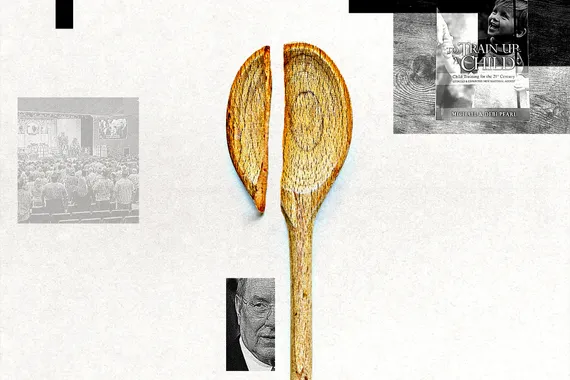
In some hands, a wooden spoon is an innocuous object, a kitchen tool for stirring and scooping. In others, it is an instrument of pain that lingers in the memory far longer than any taste could linger on the tongue. If you strike a child enough times and with enough force with a wooden spoon, it will shatter. |
In October 2021, I posted a tweet asking people who had had abusive Evangelical childhoods to reach out to me for a research project that would form part of my new book, Wild Faith. Within 72 hours, 150 people reached out to me, sharing their stories on email and DM. The respondents’ ages ranged from 22 to 65; many were my age, in their early 30s. They were grateful that someone wanted to talk about what had happened to them. |
I wound up designing a 12-question survey: What was your experience of corporal punishment like? What parenting books or doctrines do you recall your parents using? Do you feel childhood corporal punishment has affected you as an adult? The responses were intense and contained so much candid anguish it felt as though they would etch holes in my computer screen. I have included many in this story, with the names of my respondents changed to protect their identities. |
Within many Evangelical homes, violent abuse of children is cast as a direct act of service to God, and eschewing it a grave, even mortal sin that puts children in peril of losing their eternal souls. In tens of millions of American homes, there presides a structure in which the father dominates over his wife and children with unquestioned brutality, and the wife’s limited sphere of authority over the children is used to inflict further violence. |
While Evangelicals might protest that the intended effect of corporal punishment is virtuous instruction, in the moral universe of Evangelical parenting, the ideal child is not necessarily smart, ambitious, or even kind or loving. Above all, he or she is obedient. |
Nearly every survivor I spoke to emphasized that obedience was strongly emphasized in their homes — central, mandatory, and necessary, extending not just to outward behaviors, such as making a bed or cleaning a table, but even to the facial expressions of the child performing these duties, which must always be cheerful and compliant. As the novelist and former Evangelical Kristen Arnett told me, “Defiance included rolling your eyes, back talk, or even using a sour tone.” |
Rachel, 44, who recalls being beaten with electrical cords, belts, yardsticks, willow switches, Ping-Pong paddles, and fishing rods, told me that obedience extended far beyond external behavior. “Not only should you obey but obey willingly with no rebellion in your heart and with a cheerful attitude,” she said. “I got spanked for not cleaning my room fast enough once, and when I went back to cleaning after my spanking, I had a depressed — or ‘rebellious’ — attitude, so my dad made me sing a cheerful hymn while I cleaned, and if I didn’t sound happy enough, I would be spanked again.”
|
Wooden spoons recurred in countless interviews. Many of the people who wrote to me about their childhoods had had spoon after spoon broken on their thighs and backs. At 23, Abigail refuses to have one in her house. “I don’t even keep them in my kitchen for cooking purposes,” she said. “They’re not allowed in my house at all.” |
“My mom wasn’t averse to carrying around a wooden spoon to hit us with,” Rebecca, 46, told me. “She broke that wooden spoon on me more than once.” For 32-year-old Sarah, a wooden-spoon beating was routinely used until she showed sufficient “repentance.” To this day, she says, “Being struck causes me to feel sick to my stomach, even if it’s something as small as being brushed by a paper airplane.” |
Spoons were the least of it. “In our house the whip hung on a nail in the pantry and was used often. We’d be told to go to our rooms, strip completely naked, and bring the whip to our parents in the living room,” said Anna. “They stuck to the 40-lash rule given in the Bible, but that was for each whipping. We might receive several at the same time, so 80 or 120 lashes were not unheard of. My first memory at 3 years of age was receiving one of these whippings after having my clothes and underwear taken off. We would get it from head to toe, front and back. Neither me nor my siblings have a relationship with our parents today. Where they really belong is jail and then straight to hell.”
|
The belief that obedience to God requires doing violence to children continues to shape American public policy toward children, including in public schools. In March 2023, the Oklahoma legislature was presented with a bill that would have outlawed the physical punishment of disabled students, including slapping, spanking, and paddling. One Republican legislator, Jim Olsen, presented a fierce mien on the statehouse floor as he advocated against the statute. “God’s word is higher than all the so-called experts,” he said. “Several Scriptures could be read here. Let me read just one, Proverbs 29: ‘The rod and reproof give wisdom, but a child left to himself bringeth his mother to shame.’ So that would seem to endorse the use of corporal punishment.” The bill to protect disabled children failed, 45–43.
|
Corporal punishment is legal in schools in 17 states, and approximately 160,000 children are subjected to it every year. In many of these states, parents must sign consent forms signaling their willingness to have their children spanked by strangers with hands or wooden paddles — absent the child’s input about their own body. |
The regularity and implacability of physical punishment are two features that abuse survivors remember keenly. “I was young, probably around age 4, and I remember this experience very clearly yet remember almost nothing else from that age,” Mary, age 30, wrote to me. “We had been out in public. I’m pretty sure that the initial infraction was I started crying when my dad went to zip up my coat. … By the time we got home the punishment being dealt was 100 hits without any pants or underwear. My dad didn’t skip a single one. I just remember hearing my own screaming and wondering if it would ever end.”
|
Leah, 43, told me that ADHD had prevented her from always accurately understanding the orders she was given; as a result, she had been beaten three to seven times a day for years. |
In 1970, a child psychologist named James Dobson published a book, Dare to Discipline, that would galvanize a movement toward “biblical parenting.” He positioned it as a necessary curative for the permissive, sinful culture that had swept through the United States in the 1960s. Like much of the Christian right that came to transform American politics over the last half-century, the “biblical parenting” movement was a reactionary backlash to the rapid social change brought on by the youth-led feminism, civil rights, and anti-war movements. Dobson’s vision was undergirded by repulsion at this perceived social chaos, and at its core was his solution: the enforced submission of children to absolute authority.
|
“The parent’s relationship with his child should be modeled after God’s relationship with man,” Dobson wrote. “This same love leads the benevolent father to guide, correct, and even bring some pain to the child when it is necessary for his eventual good.” He recommended squeezing the trapezius muscle at the back of the neck to control children of all ages. Several people I interviewed said that as a result, any touch on the shoulder still makes them flinch. But Dobson’s book says that God created pain “as a valuable vehicle for instruction.”
|
“In the last half-century, conservative Evangelicals were coalescing as this partisan political movement and coalescing around a particular cultural orientation, and child rearing is right at the center of that,” Kristin Kobes Du Mez, a historian and the author of Jesus and John Wayne: How White Evangelicals Corrupted a Faith and Fractured a Nation, told me. “Out-of-control children were unraveling the social fabric of the country. So it was absolutely critical for parents to get their kids in line. It started in the home: you discipline your kids, and then your kids will grow up to be functioning members of this social order, which was always understood in a hierarchical sense.” Dobson’s The Strong-Willed Child (1978; reissued 2004) is primarily a guidebook in how to create pliant, submissive children through judicious blows.
|
“I remember reading my mom’s letters or diary about how she wasn’t sure what to do about my ‘strong will’ and she just couldn’t break it,” said Bathsheba, 37. “Looking back, I have no idea what I did that was so strong willed. I remember her telling me a story about her telling me not to touch a plant when I was crawling and that I grinned a big ‘knowing’ grin and went and touched it anyway. I would tense myself up to endure hours of spankings. I felt that showing pain would mean they won.”
|
“Almost every spanking I’ve ever received was a result of me asking ‘Why?’” said Chloe, 34, of her parents. “I think they really tried to break me of ‘defying authority’ because they felt it was necessary for me to be a good Christian and a productive member of society and a good wife.” |
By the end of the 1980s, the Dobson view of child rearing had permeated American culture to the point that when confronted with a choice to abolish cruelty against children as a society, Americans and their government responded with a resounding rejection. In November 1989, the U.N. General Assembly ratified an international treaty known as the United Nations Convention on the Rights of the Child (UNCRC). It was an effort that had been 30 years in the making, expanding upon 1959’s Declaration of the Rights of the Child, whose ten principles take up a scanty two pages. A child is granted the right to a name; to a nationality; to an environment in which he or she is loved, protected against neglect and cruelty, and guaranteed an education. The 1989 convention extended the ten articles to 54, largely extrapolations from the earlier, terser text: A child shall not be subject to torture; the jailing of a child should be a matter of last resort; children have the right to adequate medical care and to a free and compulsory primary education.
|
As of this writing, every U.N. member state has ratified the UNCRC except one: the United States. (Somalia and South Sudan, the previous lone holdouts alongside the United States, ratified the treaty in 2015.) |
Of course, this does not mean that children enjoy freedom — from cruelty and neglect, from filicide and abuse, from educational deprivation and hunger — everywhere else in the world. Wherever there are children, there are those who are cruel to them. But the CRC is an aspirational document, a set of standards that every other U.N. member state has agreed are worthy of adopting. The CRC would require a two-thirds vote of the Senate to be ratified. It hasn’t come close. |
|
|
|
More Parenting Stories From The Cut |
|
|
|
It’s hard to explain to a teenager that self-consciousness is healthy.
|
|
|
|
|
Being there for my children and my aging parents, all the time and at once, has turned life into a series of emergencies.
|
|
|
|
|
https://link.nymag.com/oc/60bf85689b7a136e4b473b24rca6v.3d2x/ec9e27fd
|
Vox Media, LLC
1701 Rhode Island Ave NW, Washington, DC 20036
Copyright © 2026, All rights reserved |
https://link.nymag.com/oc/60bf85689b7a136e4b473b24rca6v.3d2x/ec9e27fd
|
|
|
|
|