By Emily Gould, a novelist and critic, is a features writer for New York Magazine |
|
|
|
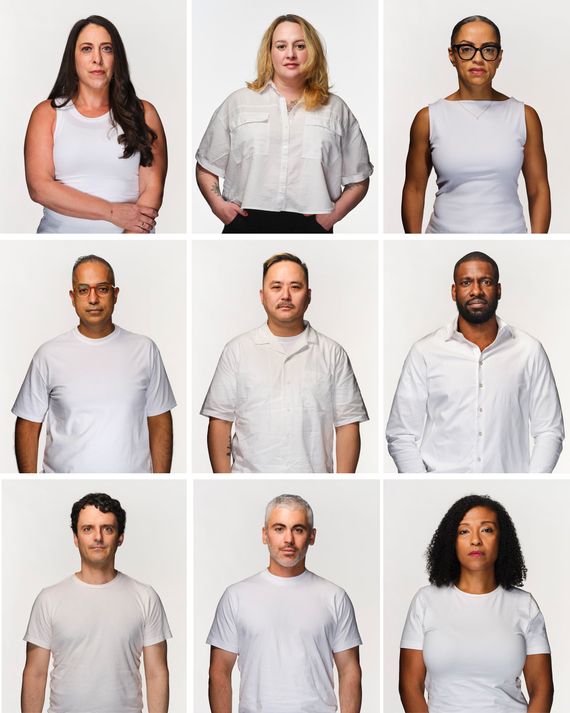
Forty-four 44-year-olds, including the author (top row, center). Photo: Hannah Whitaker |
Doing karaoke is a great way to feel your exact age, something I only recently remembered. It was two days after Halloween, and my 44th birthday party at Lion’s Roar Karaoke House in Williamsburg was already in full swing. Younger attendees sang along with gusto to hits that were popular when they were in their 20s in the 2010s. During that decade, I was too occupied with reproduction and its consequences to pay much attention to the inexorable rise of Ariana Grande. Toward the end of the party, I performed “What’s Up,” by 4 Non Blondes, a song I’ve been karaokeing ever since its opening lines — “Twenty-five years and my life is still / trying to get up that great big hill of hope / for a destination” — were literally true. “Forty-four years and my life is still,” I sang that night. I spent the week after the party feeling hung-over, though I’m sober. When I looked at the photos of me at the mic, it was hard not to compare them to a slideshow my mother had sent me a few weeks earlier on my actual birthday. I’m pretty sure her collection had been automatically generated by Apple’s facial-recognition algorithm, but it still felt like an attack. In all of the pictures, some of which were taken with my mom’s first iPhone 14 years ago, I was so cute, so bright-eyed, so thin, so young.
|
Of course, I am still relatively young, at least compared to how old I hope to be in the future. And I’m often told that I don’t look my age, which is probably because of the way I dress (casual-disheveled) and how many tattoos I have, two of which are Gen-Z-coded stick-and-pokes rather than millennial-coded full color. But it’s also because the full impact of middle age hasn’t slapped me across the face yet. I might be deluding myself, but I feel like I still credibly blend in among my younger co-workers. The illusion isn’t punctured unless we start reminiscing about high school. Once, in a meeting, I mentioned that my school had put stricter security measures in place “after Columbine” and fleetingly saw the “Sure, Grandma, let’s get you to bed” meme flash across my colleagues’ faces. Mostly, over the past few years, I have felt like an old young person.
|
The feeling seems pretty common in my generation. We are in some senses younger than every middle-aged cohort before us. It’s been much more difficult for older millennials and cusp X-ers to attain the career status our parents had at our ages. Many live without a financial safety net, keeping us young in the “furniture from the street” way. We’re less likely to own homes or have emergency savings. When layoffs come around, both the high-powered boomers above us and the less-pricey Gen-Z kids on their way up are more likely to hang on to their jobs — at least until AI replaces the kids, then us.
|
It’s also possible, though expensive, for us to appear far younger than our parents did at our ages via Botox, fillers, and those red-light LED masks that make you look like a scary robot. We’ve all seen that photo of 70-year-old Kris Jenner looking 25; with enough money, we know we can opt out of many physical signs of our decrepitude. We might dress younger than our power-suited mothers did. Grown-ups are no longer identifiable via business-casual uniforms and staid haircuts; the pandemic has erased many offices’ taboo against wearing soft pants. If we want, we’re deluged with all the information in the world about what young people are wearing, listening to, reading, saying, and doing the moment we open our apps. We can swim in the same waters as them, and we often do without even thinking about it: TV shows based on YA novels or set in high schools are just as popular with 40-somethings as they are with viewers in the age bracket of the characters onscreen.
|
Add to all this: The world doesn’t really treat us like old people anymore. When we were kids, 40 was famously “over the hill.” To me, 40 felt more like another journalistic deadline I was blowing; there were lots of things I’d hoped to have achieved by that point in my life, but I would just have to ask the universe for an extension. I didn’t think about my body falling apart or my mortality as much as I mourned the loss of my identity as a precocious person. I’d spent my 20s being the youngest person in the meeting, an interloper in the world of established Gen-X-ers, racing to publish my first book before I turned 30. Then I spent my 30s recovering from and atoning for everything I’d said and done in service of my ambition, and reproducing. Soon after my 40th birthday, I got a full-time job for the first time in eight years and was suddenly a decade older than some of my bosses. No one accorded me the respect owed to an elder stateswoman; I was competing for the same opportunities as the 26-year-olds who shared my job description but not my extracurricular responsibilities, who were then 4 and 7 years old.
|
Regardless of how emotionally young or old I felt, I was heading for an aging milestone. While people were no longer rolling over the hill at 40, the new received wisdom said I’d soon be arriving at something more extreme: the cliff. The term entered the lexicon last year with Miranda July’s novel All Fours — which featured a diagram of the abrupt nosedive women’s hormones take sometime in our fourth decade — and the concept was expanded and reinforced by the publication that August of a widely discussed “nonlinear aging” study from Stanford. That research seemed to confirm something we already sort of knew: There are certain years in life when aging hits us hard and moves us forward at hyperspeed. Forty-four, according to the study, is the first of those years. Sixty is the next, and there may yet be more cliffs to be discovered. The Stanford scientists found these transition points by examining the markers of cellular aging in roughly 100 people between the ages of 25 and 75. Over the course of the study’s 12-year duration, they discovered these markers became increasingly dysregulated in bursts around certain ages. At first, they were skeptical that 44 was a true aberration, thinking that perimenopausal symptoms must be skewing their results. But when they broke the data out by sex, they found that men were experiencing the same key changes women were: increased risk of cardiovascular disease and reduced ability to metabolize fat, alcohol, and caffeine.
|
I first read the study about six months before my 44th birthday. Mostly, it made me feel guilty and scared. At 43, I wasn’t exactly being proactive about my physical health. Some of the factors were out of my control — or at least they felt that way. I was on a cocktail of medications for bipolar disorder that all had sedative effects; no matter how much coffee I drank, I couldn’t seem to muster the energy to do something as ambitious as “going to the gym.” Besides, I had no time: I spent every waking hour either taking care of my kids or working, the exception being a brief period between 9:30 and 11 p.m. that I spent watching TV with my husband in a semi-prone position on the couch. Caffeine was my god. Nicotine, I’m ashamed to admit, was also my god in the form of Juul pods. Cutting out refined sugar seemed like the first step toward a Goop-ian nightmare with orthorexia at its inevitable end point. GLP-1’s were for rich people. My lifestyle wasn’t exactly a point of pride, but I didn’t see how I could be expected to do much better. Between constant deadlines and family stressors, my central nervous system was in a perpetual state of near collapse. My periods had been weird for several years. And underneath it all was low-level dread that this was just the beginning of my irreversible decline. Whether I fell off the cliff or not, I’d still be lucky to reach 88. I was in the second half.
|
|
|
More on Aging From The Cut |
|
|
As we enter our 40s, we’re being forced to confront something awful — not our mortality. Our finances.
|
|
|
|
The face-lift is better than ever, and everybody wants one. Deep inside the uncanny world of the surgically ageless. |
|
|
|
https://link.nymag.com/oc/60bf85689b7a136e4b473b24pkzex.dbe/272a740f
|
Vox Media, LLC
1701 Rhode Island Ave NW, Washington, DC 20036
Copyright © 2025, All rights reserved |
https://link.nymag.com/oc/60bf85689b7a136e4b473b24pkzex.dbe/272a740f
|
|
|
|