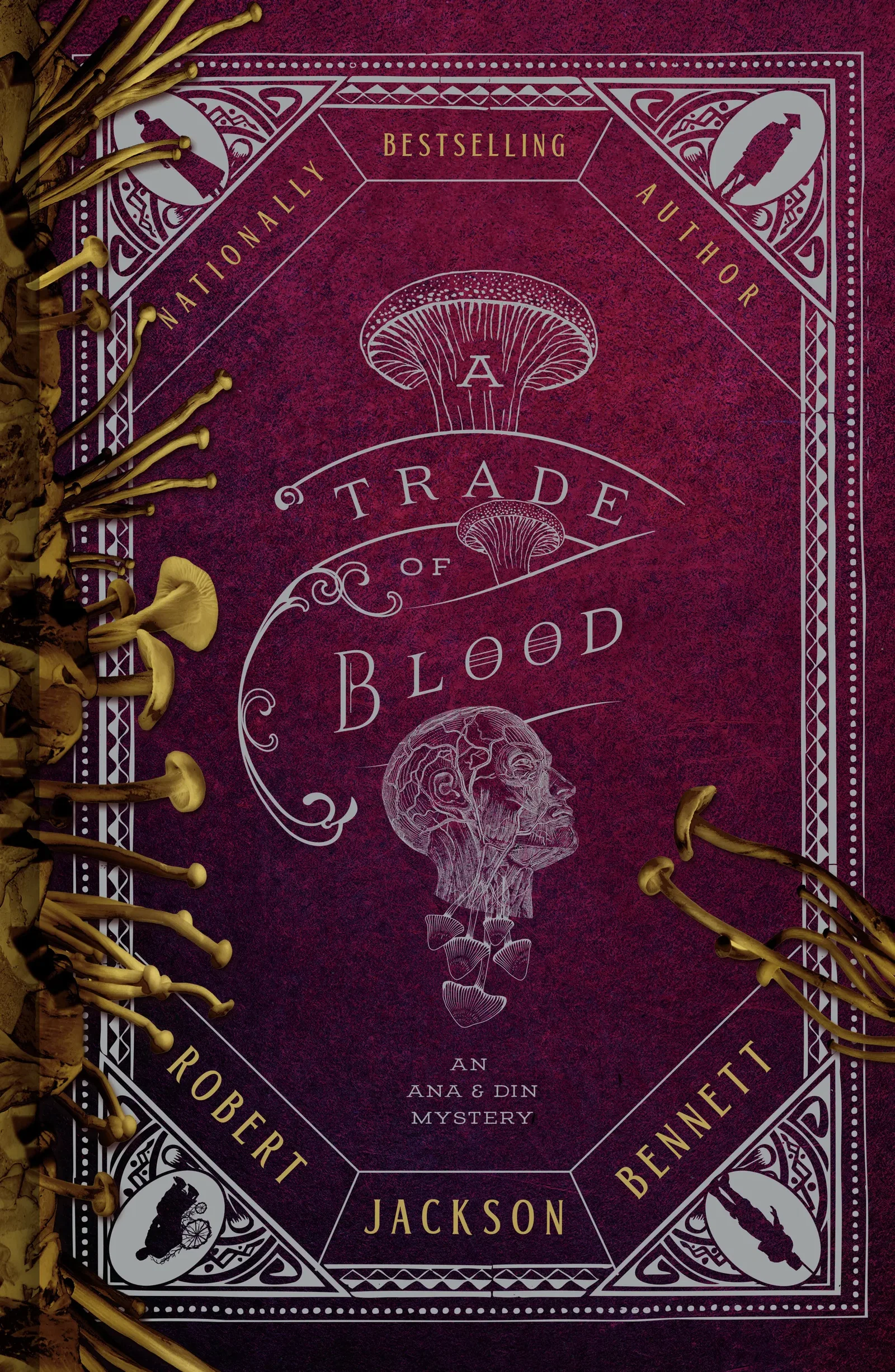
A Trade of Blood, out today, is the most pure fun I’ve had reading a book in a very long time. I’ve been evangelizing about Robert Jackson Bennett’s Ana and Din mysteries ever since my colleague Kathryn VanArendonk put me onto them a few years ago. I believe her pitch was something along the lines of “autistic crone Sherlock and bionic himbo Holmes,” which was enough to sell me on the protagonists of the series that started two books ago with the Hugo Award–winning The Tainted Cup. Who doesn’t want to read a murder mystery set in a complex yet plausible alternate world? I talked to Bennett about the world he’s built, the potential for onscreen adaptation, and, of course, Din’s love life. — Emily Gould
One of the things that I love about this series is that the world-building is so exquisite. The reader feels immediately immersed in a mix of the recognizable and the outlandish. There are also some things that I feel like you've invented that are totally new. How did you come up with this stuff?
A lot of it is just trying to reconceptualize things we take for granted every day as something that's a little bit weird. What if society remained preindustrial but was advanced enough that they could treat certain organisms almost as technology? If you were a preindustrial society that got good enough at shaping flesh and human bodies, then naturally you would trend toward trying to cultivate human brains and human personalities to fulfill specific functions — like Din, who is basically a database.
When I finished this book, I felt sad that I couldn’t immediately read 20 more books in this series. Are you planning to write them?
Yes, I’m working on a draft of book four now! One of the fun things about a murder mystery as opposed to an epic fantasy series is that each installment is so consumable. There are threads that hang around the background that continue from book to book. The goal always was to have Ana and Din go to all the different parts of the empire and learn about how the empire works. There are lots of points of conflict there, too, where things grow stymied, where things want to change but can't, and that's where people start to kill each other.
One plot device that bums me out is that you built in an expiration date for Din, because of his biological augmentations. In A Trade of Blood, we see him becoming worried about how he’s destined to eventually go crazy and die an early death. Why did you do that?
One of the things that we take for granted is that, in the preindustrial world, the average life expectancy was around 40. Right now, Din is 25, and he knows he's probably going to start to really lose it around 50. But one thing about the empire is that they're going to find ways to make this simpler for their people, to make sure that they can live longer and live healthier. They always want to take care of their people, but not for a benevolent reason.
What's going on with the TV and film adaptations?
I can say that it’s been optioned, and I don't know a whole lot besides that. I think there was hope of trying to chase the next Game of Thrones three or four years ago, but that's pretty much over, and no one knows what success looks like anymore. I wasn't opposed to the idea of making it a cartoon.
My fan-fiction imagination is very engaged by Din's romantic life. I love that he’s queer, of course, and that he gets to have a romance or two in every book.
That was a choice I made in book two, because I had already put in book one that he was very pretty. There are people who are appealingly pretty, and there are people who are alarmingly pretty — like, “You should be in a perfume commercial because that's the only place someone to like you exists” — and I thought it'd be funny if Din was that sort of person and knew it, and didn't like it. Also, Din is someone who finds it easy to fall in love. He’s very moved by people, although because of his life history and his background, it's very hard for him to show that or indulge in it. That was always sort of an appeal for me, to have him be the sort of person who seems to indulge in a lot of doomed relationships and knows that they're doomed, but that makes them more meaningful for him because he feels in a very big way that he himself is doomed.