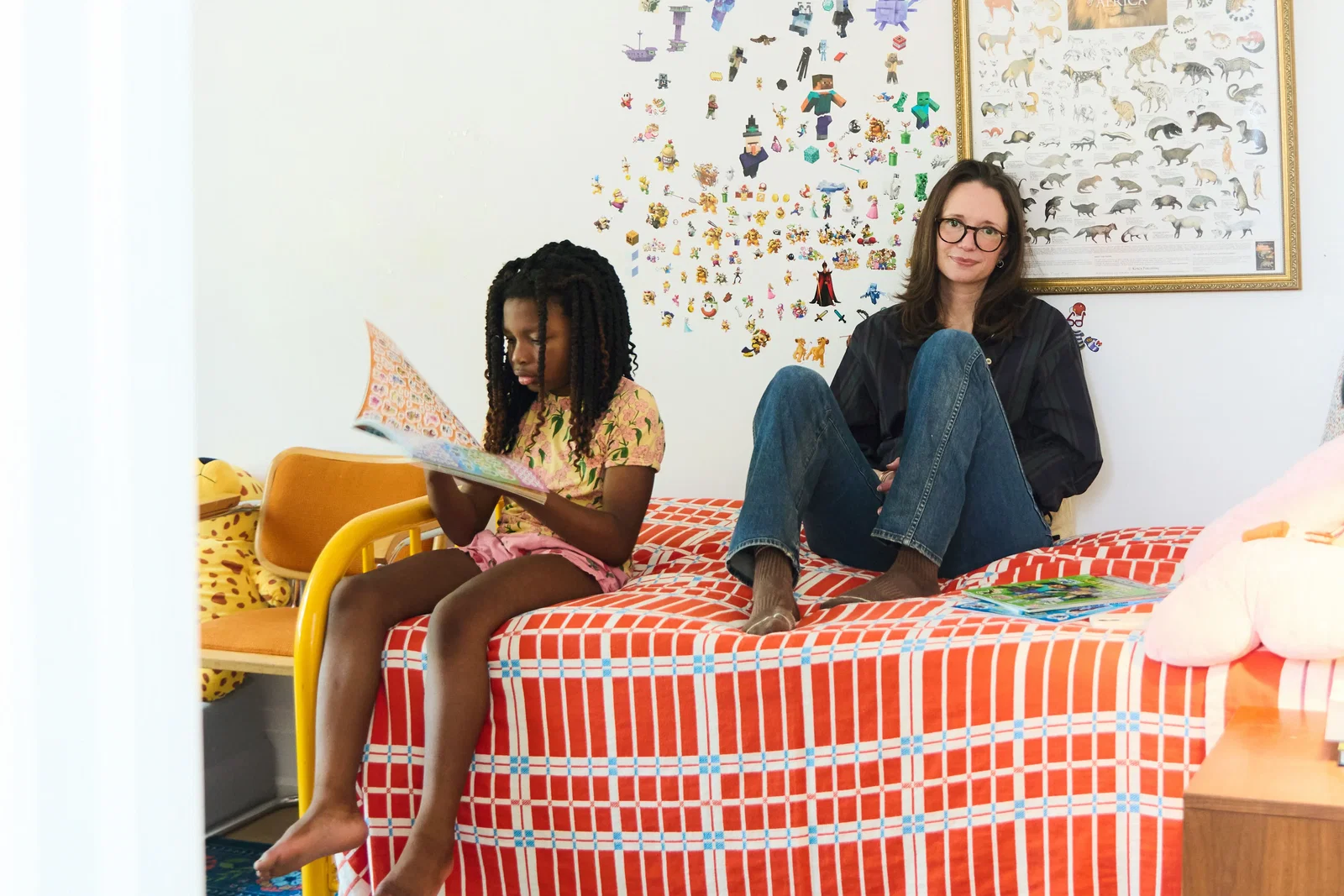
Photo: Vanessa Heins for New York Magazine
|
|
|
|
One Friday morning in September 2025, my 8-year-old daughter, Rose, woke up with a sore throat. Since her toddler years, we have asked her to hold her hands apart to show us how bad something hurts. That day, she separated her palms four inches: medium. I held the thermometer to her forehead (99 degrees) and then got her cozy on the sofa with The Nightmare Before Christmas and a box of tissues. Over the weekend, she cheerfully stayed there, rotating through old Disney Channel shows, Labyrinth, and her favorite spooky cartoon, The Haunted House. By Sunday evening, she was asking if we could visit the splash pad in our Toronto neighborhood, and when she returned to school on Tuesday, my husband, David, her 1-year-old brother, Calvin, and I all seemed to have come down with the same illness. It felt like a minor cold.
|
But over the next few days, Rose started to change. First, it was her limbs. As she was falling asleep one night, her arms and legs suddenly and uncontrollably shot out in front of her, like she was imitating a zombie. If she tried to relax, her abdominal muscles would contract, forcing her to sit upright. This happened dozens of times over the course of an hour, so David took her to the emergency room while I stayed home with our sleeping baby. After Rose’s preliminary blood work came back normal, the doctors attributed the movements to an unusual viral symptom. But not long after, there was a new problem: Rose told us she felt like she was “vibrating inside.” We brought her to a pediatric emergency clinic but were given the same explanation. I called her pediatrician, who said that while he had never heard of a virus having this effect, he was unconcerned and asked me to call again if her symptoms changed. He said she was well enough to go back to school.
|
But as David drove Rose to drop-off three days later, she started to wail. In the rearview mirror, David could see her eyes transform, becoming both unseeing and manic. Arriving at school, she could barely speak. After he opened the door to the back seat so she could get out, she repeatedly tried to choke David and arched her back and kicked her legs. |
David forced her back into her car seat and drove home. I asked her what she was feeling, and she could only repeat that she wanted to hurt us. She tore off her clothes and started to screech and wail. |
I called our pediatrician and asked what we should do. He said that if we went back to the hospital, we would just be sent home again. He explained that sometimes a virus can cause surprising symptoms and gave the example of elderly people developing psychosis with urinary-tract infections. He offered to call in some Ativan to help her calm down while we waited for this to pass. To be safe, he initiated a referral to a psychiatrist. |
As I left for the pharmacy, taking Calvin with me, I could hear Rose in our finished basement with David, kicking the walls and screeching. I said “hello” to a neighbor and felt like I had a secret, as if my life were suddenly different from theirs. After I returned with the medication, David and I struggled to place it under her tongue without her biting our fingers. After we succeeded, I set a timer on my phone to see how long it would take to kick in; once she was calmer, we could come up with a plan. But she didn’t improve. We gave her a second dose, then a third, and still she screamed and kicked.
|
It was almost impossible for me to communicate with David because her wails were too loud to speak over. She also couldn’t eat or use the toilet. Around 4 a.m., she fell asleep and David ran up to our bedroom to talk. But she was awake again by 4:30, and he was back downstairs holding her; on the way down, he hid the kitchen knives. |
We tried to care for her at home through the weekend, but she screamed 16-to-18 hours out of every 24, and Ativan only slightly diminished the strength of her punches. Sometimes she exhausted herself and drank a little chocolate milk or hid under her favorite blanket, but mostly she screamed, arched, kicked, and bit. David was covered in bruises. I kept Calvin with me in the main bedroom, where I could put the most space between us and the noise. At some point in the chaos, I remembered a memoir I had read more than a decade earlier, Brain on Fire, by Susannah Cahalan, which chronicles the author’s battle with psychosis brought on by autoimmune encephalitis. Rose reminded me of Cahalan — and I wondered if she might have the same disease.
|
By Sunday, David couldn’t spend another night awake and we knew Rose needed to be hospitalized. As I knelt on her floor, packing her tiny T-shirts and her favorite Dory Fantasmagory book, I started to weep. The contrast between my daughter now and a week before was nearly impossible to fathom. When I closed my eyes, I could still see her dancing around the house singing made-up songs about Maleficent and Komodo dragons in her signature exaggerated vibrato. |
At the hospital, David learned the pediatric psychiatric unit was full, so, if admitted, Rose would be held on the adult floor and would have a roommate. The psychiatrist said she had an “undefined mental illness” and she needed a referral to a pediatric psychiatrist for a more specific diagnosis. As a social worker familiar with the Diagnostic and Statistical Manual of Mental Disorders, I already knew her symptom progression did not match a recognized mental-health diagnosis. Over the phone, I asked him to check for seizures or a brain infection. He said that Rose’s presentation didn’t match those diagnoses but that he would page a pediatrician for a physical examination. The pediatrician looked in her ears and listened to her heart and then called me. “This is not medical,” she said. “As we have already told you, she needs a psychiatrist.” Rose was discharged with a higher dose of Ativan. When we brought her to an outpatient clinic to see a pediatric psychiatrist a few days later, she tried to jump from our moving car.
|
I don’t know how long this pattern of ER visits and outpatient referrals might have continued had I not texted a group of friends that evening to share Rose’s story. I was just looking for comfort, but one friend—a doctor—texted back an idea: “Have you looked into PANS?” |
PANS, or “pediatric acute-onset neuropsychiatric syndrome,” is a form of brain inflammation caused by infection. Almost any description of its impact on a child comes across as hyperbolic to those who don’t know about it. The physical and emotional pain is so severe that 42 percent of children who develop it by the age of 10 discuss suicide. A survey of 161 patients with PANS found that 14 percent had attempted suicide, including several who were 7 or younger. One 8-year-old started urinating 30 times a day, stopped eating, and became so angry his parents were forced to hide all their scissors and knives. A 17-year-old told me that when she was 10, she woke up with intrusive thoughts. “I didn’t know what suicide was. All I knew is that I wanted to be dead,” she said. A 9-year-old developed uncontrolled blinking and rage and had to be carried out of class. A few PANS parents told me their children have attempted to jump from moving cars, just like Rose did. In fact, the PANS website for physicians mentions jumping from a car as a hallmark of severe disease.
|
The formal introduction of what would become known as PANS came from Susan Swedo, a National Institutes of Health researcher, in 1998. Back then, Swedo called it PANDAS (“pediatric autoimmune neuropsychiatric disorders associated with streptococcal infections”) because the symptoms were tied only to strep throat. Doctors at Stanford and the NIH renamed it PANS in 2014 after they discovered that infections and viruses other than strep — Epstein-Barr, COVID, mycoplasma, Lyme, and influenza among them — can bring about a similar neurological response. (In one recent survey of 103 patients referred to a UCLA PANS clinic, only 3 percent of patients’ illness stemmed from strep and 77 percent traced the condition to another infection.)
|
After my friend’s text, I pulled up a list of the signs of PANS on my phone for the first time. An abrupt onset of OCD symptoms or food restriction; anxiety; emotional lability; irritability; aggression or severe oppositional behaviors; developmental regression; motor abnormalities; sleep disturbance; incontinence. I couldn’t believe it. The entire list matched what we were observing. |
I called our pediatrician to share the breakthrough and was stunned when I was immediately met with skepticism. He told me that parents often blame PANS because they don’t want to come to terms with their kids’ mental illnesses and that he didn’t believe Rose had it. I got off the phone and called a local neurologist for a second opinion. He told me, as a rule, he does not treat PANS because it “isn’t widely recognized.” As I researched more online, I soon realized that for as long as PANS has been defined, there has been a vocal community of physicians actively railing against it. Their campaigning had created “bad buzz” for the diagnosis and led to a gaping chasm between doctors in everyday practice and academic centers like Stanford, Dartmouth, and Mass General that are actively researching and treating the illness.
|
I dug further and, in Reddit forums and Facebook groups, discovered countless families who seemed to have gotten trapped in that void — convinced their child had PANS and unable to find a physician who was willing to treat it or had even heard of it. Some, in their desperation, turned to alternative-medicine grifters pushing bizarre, poorly researched treatments like blood ozone cleansing, peptides, and anti-parasitics. These practitioners discredit the validity of the illness itself just through their association with it. Even well-resourced parents with direct connections to medicine seemed to struggle. One analysis of 11 children with PANS whose parents were doctors found their average time to diagnosis was eight months and, in that time, two of the children attempted suicide and five had suicidal ideation. A doctor I spoke to told me she once treated a patient who had visited Los Angeles emergency rooms 220 times before receiving a diagnosis.
|
I vowed to do anything in my power to save Rose. |
|
|
|
https://link.nymag.com/oc/60bf85689b7a136e4b473b24sb9y4.4fh/f1acb249
|
Vox Media, LLC
1701 Rhode Island Ave NW, Washington, DC 20036
Copyright © 2026, All rights reserved |
https://link.nymag.com/oc/60bf85689b7a136e4b473b24sb9y4.4fh/f1acb249
|
|
|
|
https://link.nymag.com/oc/60bf85689b7a136e4b473b24sb9y4.4fh/f1acb249
|
|
|
|
https://link.nymag.com/oc/60bf85689b7a136e4b473b24sb9y4.4fh/f1acb249
|
|
|
|
|