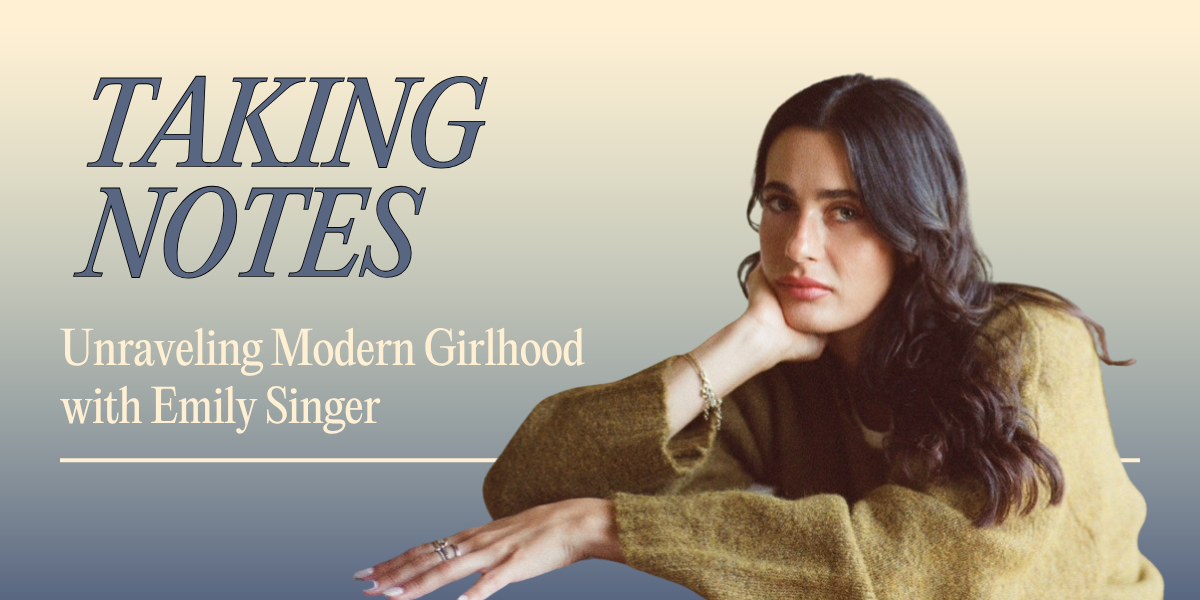
What does it mean to grow up in a world that constantly asks you to perform who you are before you've had the chance to figure it out? That's the question at the heart of Doll Baby, the debut novel from Emily Singer. The story explores a new generation of coming-of-age, quickly making Emily a standout voice through sharp, self-aware perspectives about the messy journey that is girlhood. It’s a story that explores what happens beyond expectations and identity with performances that no longer seem relevant.
We sat down with Emily to talk about modern girlhood, the emotional impact of growing up online, and why sometimes the most meaningful growth doesn’t come from arriving.
Doll Baby explores the line between self-invention and self-erasure. Do you think modern girlhood increasingly asks women to perform a version of themselves rather than discover who they are?
Absolutely. We live in a culture that constantly asks women to be desirable, interesting, successful, emotionally intelligent, and effortless all at the same time. That was something I really wanted to explore in Doll Baby. I think that tension between performance and authenticity is something a lot of women quietly struggle with, especially now that there’s also added pressure to curate themselves for public consumption.
Your novel doesn’t follow a traditional “coming-of-age” arc. What interested you about writing a story centered more on unraveling than arriving?
I really wanted the story to feel honest and authentic. And more often than not, growth comes from unraveling through heartbreak, mistakes, longing, and confusion. Additionally, I wanted to capture memories the way we remember them as humans. Certain moments stay with us not because they were objectively monumental, but because of how they made us feel.
Were there particular cultural references, eras, or archetypes that shaped the world of the novel?
Absolutely. The novel is deeply rooted in the cultural atmosphere of the late 2000s and early 2010s–the world I grew up in. BlackBerry cell phones, AIM. I write that Tumblr was “full of collarbones jutting out and erotica… it was like a shadowy abyss that you could crawl into and evaporate in.” A metaphor for what 2010-2013 felt like inside a teenage girl's brain. There was something both romantic and destructive about the internet then. It felt intimate, anonymous, aspirational, and completely isolating all at once.
Place was really important to me, as well. The Valley [is] unbearably hot and claustrophobic in the summers–beautiful, suffocating, and inescapable. Literature itself also shaped the novel at various times. Jolie is a reader, and her teacher telling her she might have a shot at writing is easy to miss, but it's the moment the whole book is building toward.
How do you think the emotional landscape of adolescence has shifted for young women over the last decade?
When I was a teenager, besides MySpace and Facebook, the internet was pretty anonymous. You had an AIM screen name and a Tumblr username. Maybe YouTube if you were early to it. There was still some breathing room to figure out who you were in private. Adolescent women today don't really have that luxury unless they choose not to be online. Either way, we’re completely overexposed and constantly inundated with other people's lives, bodies, relationships, and aesthetics. It's very hard to hear yourself think with that much noise. On a more positive note, we’re seeing the landscape change from perfect, curated lives and leaning more toward intimacy and authenticity online.
What does “girlhood” mean to you now versus when you first started writing this story?
When I first started writing this book, girlhood felt like something I was still in the middle of, to some extent. By the end, I felt like I’d actually experienced Jolie’s arc myself and could look at everything that had happened to me and to her in a bigger picture. I hope readers feel seen. I hope they’re more kind to themselves and know that it’s all about the journey. I think a lot of women have lived some version of Jolie's story and have never quite seen it reflected to them without judgment.
I wanted to write about that experience with honesty but also with tenderness. I hope readers finish it feeling less alone in whatever version of it they've lived. I think so much of young womanhood is incredibly loud. Full of other people's opinions, other people's needs, the noise of trying to figure out who you are while everyone is watching. I hope readers carry with them the feeling of the last chapter. That there's a version of yourself on the other side of all of it that's worth getting to. A version of yourself that you’ll forgive and love and fight for.