|
͏ ͏ ͏ ͏ ͏ ͏ ͏ ͏ ͏ ͏ ͏ ͏ ͏ ͏ ͏ ͏ ͏ ͏ ͏ ͏ ͏ ͏ ͏ ͏ ͏ ͏ ͏ ͏ ͏ ͏ ͏ ͏ ͏ ͏ ͏ ͏ ͏ ͏ ͏ ͏ ͏ ͏ ͏ ͏ ͏
͏ ͏ ͏ ͏ ͏ ͏ ͏ ͏ ͏ ͏ ͏ ͏ ͏ ͏ ͏ ͏ ͏ ͏ ͏ ͏ ͏ ͏ ͏ ͏ ͏ ͏ ͏ ͏ ͏ ͏ ͏ ͏ ͏
|
|
|
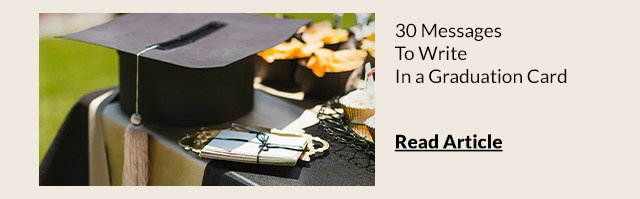
Across the country, millions of students are walking across stages and into new chapters of their lives — from high school to college, from college into careers, and into adulthood. They deserve every accolade and congratulatory message
for all they’ve worked so hard to achieve.
This graduation season feels different, though. Alongside the celebration, there’s an undercurrent of uneasiness about what comes next. You can hear it in conversations between parents, in commencement speeches, and in the chatter at family dinners and graduation parties.
The Class of 2026 is stepping into a world changing at a scale and pace we have never seen before. It’s not just a difficult job market or the stream of unsettling headlines from around the world. It’s the uncertainty around artificial intelligence, which is changing how we
learn, work, and create.
All the uneasiness tends to gather around one question: Are these graduates prepared for what’s coming next?
As a grandfather with seven grandchildren at different stages of their educational journeys, I’ve been wrestling with that question a lot lately. There are moments when I feel uneasy about the world these students are entering. Yet I also see real reasons for optimism.
|
|
The education behind the education
Much of the anxiety around AI and the future of work comes from a fair question: Will the skills students are learning today still matter tomorrow? The answer depends, in part, on how we define education.
Yes, students studied biology, economics, history, formulas, and plenty else. Those subjects matter because they build knowledge. They also give young people practice in solving problems, testing ideas, asking better questions, and continuing to learn on their own.
I believe the people who will thrive in an AI-powered world will be the ones who combine expertise with the ability to think critically and keep learning. They’ll know how to use new tools without surrendering their own judgment, and they’ll understand that the goal is not simply to produce more, but to decide what is worth producing in the first place.
While machines can write, summarize, analyze information, and generate code, their limits show up when the work requires judgment. For graduates who have learned how to think critically and adapt, their humanity and experiences may be their strongest competitive advantage.
|
|
Learning about relationships
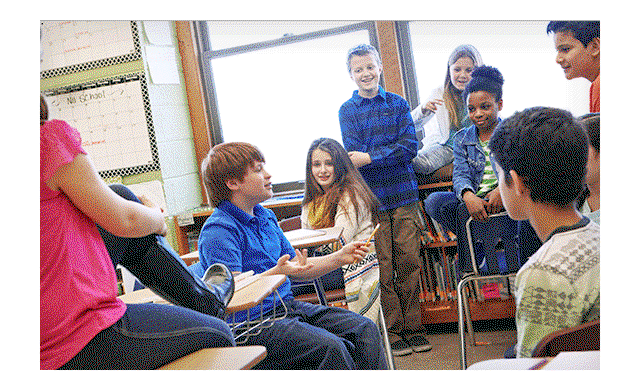
Years of education also teach students something that doesn’t appear on a syllabus: how to build relationships, how to maintain them, and how to grow through them.
That begins early. Children learn how to share, read the room, and understand that other people have needs and feelings too. As they grow older, they learn how to navigate friendships, help one another through hard moments, and work with people they may not have chosen for themselves.
|
|
Those lessons are reinforced by every teacher who pushes a student to rewrite a draft, every coach who has an honest conversation after a loss, and every classmate who becomes a collaborator and then a friend. These relationships are how young people learn accountability, trust, feedback, and responsibility.
And these skills will become even more important if AI reduces the number of traditional entry-level opportunities. Those early roles have long served as training grounds where young people learn from mistakes. If that pathway narrows, graduates will need to rely even more on the relationships and human skills they’ve been building all along to find work, succeed in
more advanced roles, or become entrepreneurs.
|
|
Prepared for the future
I began this week’s letter with some uneasiness, and I still feel some of it.
No one can tell these graduates exactly what their working lives will look like as technology and the job market evolve. Some paths that once looked reliable may become less certain, and new ones will emerge faster than any of us can predict.
Maybe that is why commencements are so important. They don’t promise graduates a clear path, but remind them that they’ve already begun building the habits, relationships, and resilience they will need to find their way.
None of us had the future figured out when we were graduating. What we needed then — and today’s graduates need now — is the capacity to keep becoming: to learn, to adjust, to ask for help, to build trust, and to stay connected to people who will help them grow.
That’s what gives me hope even in this uncertain world.
All the best,
|
|
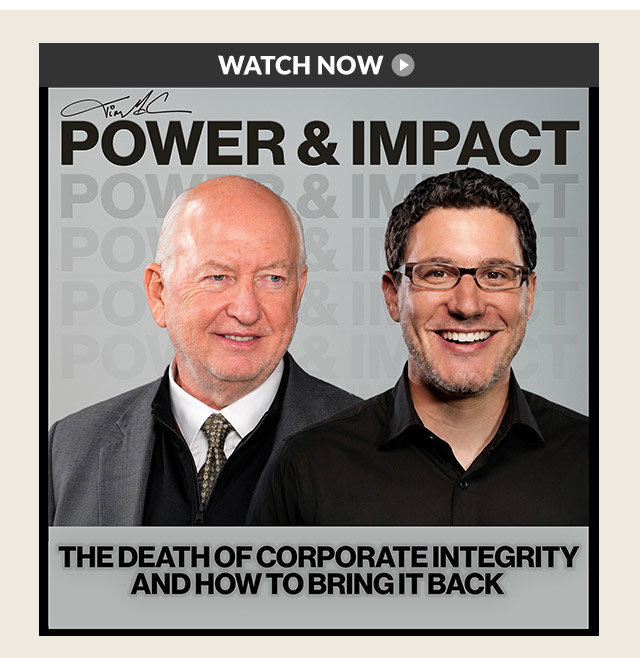
In this week’s episode of Power & Impact, I’m joined by
Eric Ries for a conversation about a question every growing company eventually faces: How do you keep success from becoming the very thing that pulls you away from your purpose?
Eric is best known as the author of The Lean Startup, the book and movement that helped reshape how founders build companies. His new book, Incorruptible
, tackles the next challenge: Once companies are built, how do leaders keep them worthy of the trust people place in them?
Eric argues that companies rarely lose their sense of purpose all at once. They drift through small choices, narrow metrics, short-term pressures, and a gradual shift from serving people to serving spreadsheets. From Costco and Johnson & Johnson to Silicon Valley, he shows how long-term thinking becomes a competitive advantage.
We also talk about AI and the temptation many companies face to treat it primarily as a cost-cutting tool. Eric warns against using AI as a substitute for human judgment, creativity, and understanding. The better path, he argues, is to use it to strengthen human capability.
|
|
50 Years In: A message to graduates
As 1-800-Flowers.com marks its 50th anniversary, I’ve been thinking less about milestones and more about the moments that have helped shape our story. This week, I want to share a message to graduates.
Every now and then, an invitation arrives asking me to speak to a graduating class and offer a little wisdom. I always find that amusing, because my own path was anything but tidy.
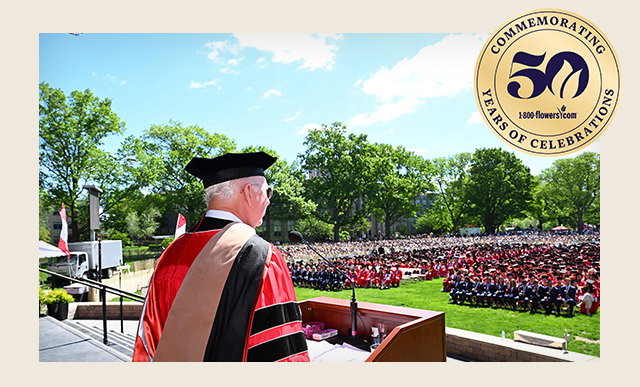
Last year, at St. John’s University in Queens, I told the graduates the truth
: I started college in New Jersey, finished at John Jay, ran St. John’s Home for Boys in Rockaway Beach, tended bar on weekends, and eventually bought a small flower shop with no real knowledge of flowers.
What I did have was curiosity, a willingness to work hard, and a belief that something bigger might be possible. That led to one of the messages I wanted to leave with them: What we believe about ourselves has a way of becoming our reality. If we can imagine ourselves creating something, we give ourselves a better chance of doing it.
I also spoke about the power of relationships, which I believe is one of the key ingredients of a happy life. I urged the graduates to be deliberate about staying connected to classmates, professors, mentors, and friends — and to think about how they would nurture those relationships over time.
A year later, that message feels just as important. Technology is changing quickly, and AI is raising real questions about work and the future. The path forward begins with the same human strengths that have always mattered: curiosity, optimism, resilience, and the relationships that remind us we were never meant to make the journey alone.
|
|
A summer of sharing stories
One of my favorite parts of writing this weekly letter is hearing from you — your stories, your reflections, and the moments that connect us all. As we head into summer, I’d love your help with a few upcoming editions of Celebrations Pulse.
What are your summer plans? Are you heading off on a big adventure? Planning a quiet staycation? Or maybe something wonderfully unexpected? Whatever your summer looks like, I’d love to hear about it. I’ll be selecting a few stories to feature in a letter to celebrate the season’s start.
Let’s celebrate Amazing Dads! With Father’s Day coming up, I’m gathering stories about dads who’ve made a lasting impact. Whether it’s your own dad, a father figure, or someone in your community who deserves recognition, I’d love to hear what makes them amazing.
|
|
|
Related articles that caught my eye
|
|
|
|
|
|
|
Written by our Founder and Chairman, our Celebrations Pulse letters aim to engage with our community. From sharing stories to welcoming your ideas, we want to help you to express, connect, and celebrate the important people in your life.
|
|
|
|
|