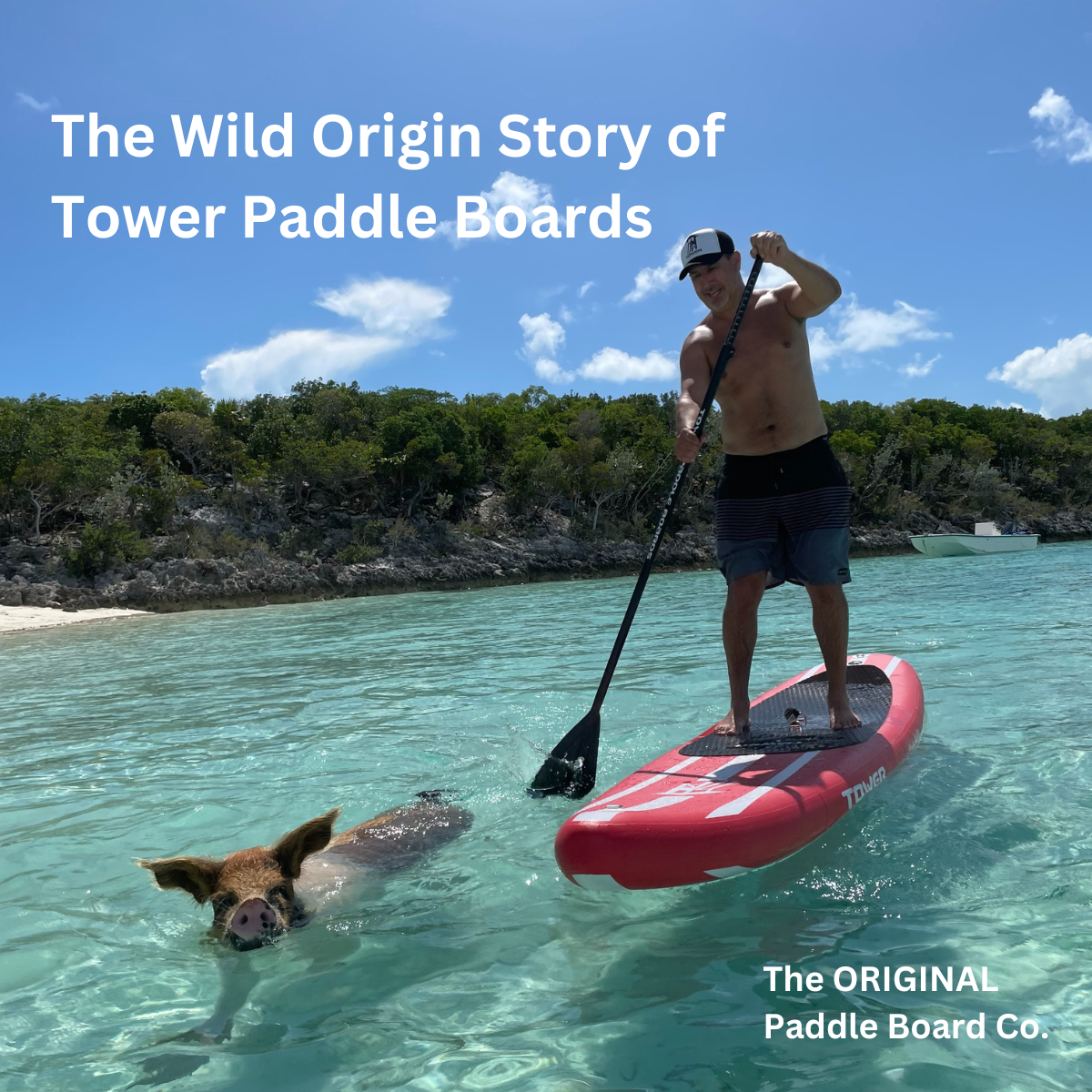
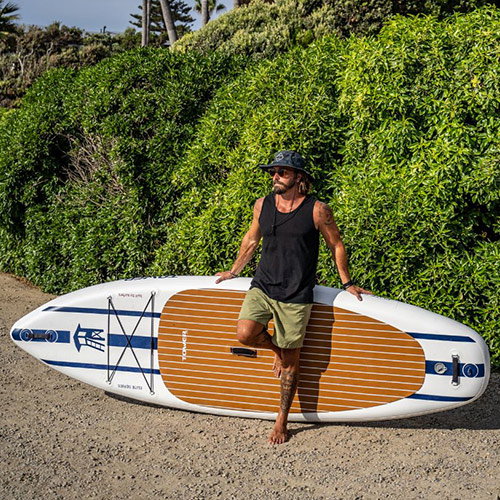
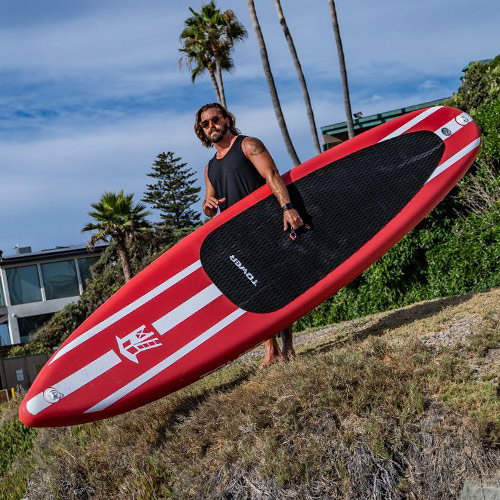
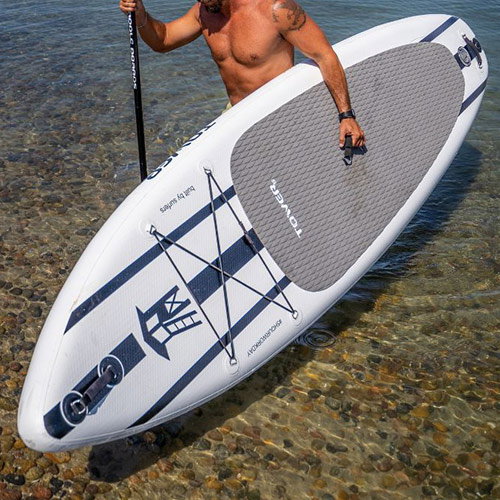
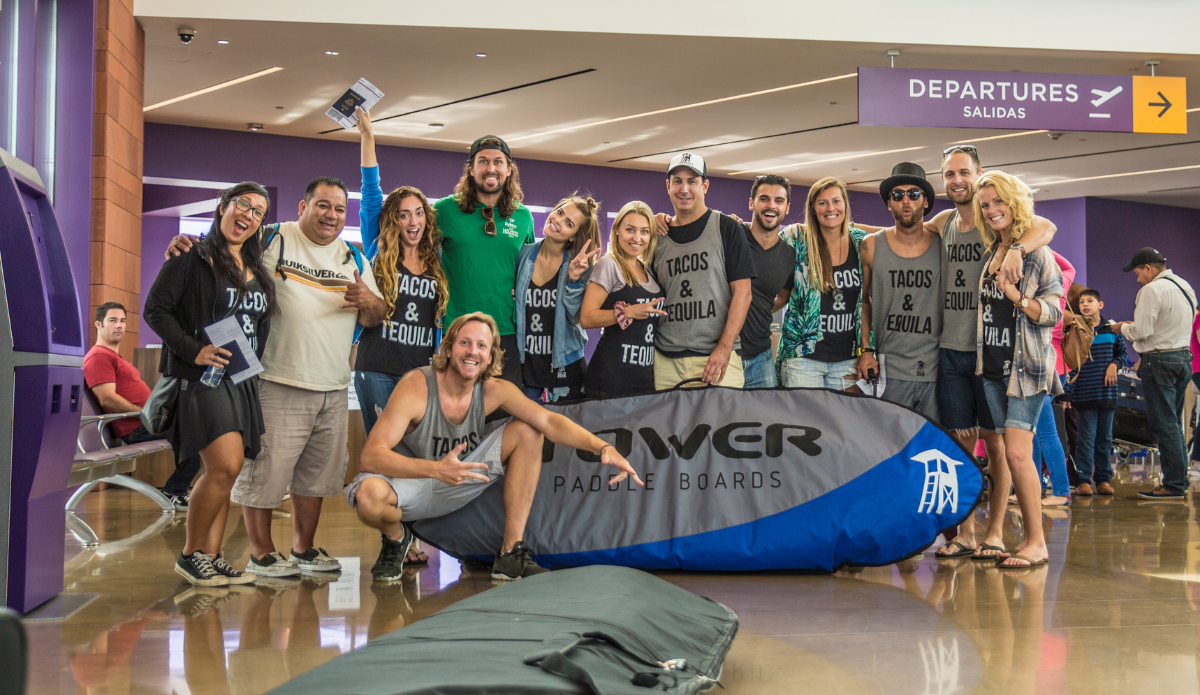
My name is Stephan Aarstol. That's me above at Pig Beach in the Exumas, Bahamas. Here is the origin story of Tower Paddle Boards, which I founded in 2010. This is not your normal marketing fluff from the founder. This is the real entrepreneurial story, how we did it, in detail.
It's been quite a wild ride.
The Birth of Tower
In the spring of 2010, a college buddy visited me in San Diego. We had backpacked and budget hostel traveled around the world together years before. Early one morning we went paddle surfing in La Jolla Shores just up the coast from where I lived. It was my first time, and it was amazing. I got stung by a sting ray. Not so amazing. That made two firsts. Months later, I’d see this as a sign.
I went to buy a paddle board the next week. It was $1200 to $1600 for a decent board. For what was basically an oversized surfboard, the prices were shocking. At the time, I ran a company selling poker chips direct to consumers online. I’d been in online start-ups since 1999 and had a fair amount of expertise in online marketing. While once promising, the poker chip business was declining. After my tax return in 2009 showed an annual income of $16,000, I was scrambling to find another business opportunity while simultaneously job hunting. No one wanted to hire me. It was the Great Recession.
Years before, I had done a visioning exercise where I penned out my ideal lifestyle. I remembered I had written out my ideal job - be the CEO of a surf company. I’d always been a big fan of the beach lifestyle. I lived at the beach. While thinking about why paddle boards were so expensive, it clicked. Maybe I could sell paddle boards at better prices if I sold them the same way I had been selling poker chips for the past seven years… direct to consumers. Then it dawned on me that a paddle boarding company is actually pretty close to a surf company. It was the perfect fit. I’d found my new opportunity.
|
|
The ORIGINAL Paddle Board Co.
Tower is the original inflatable stand-up paddle board brand. We've been doing this a long time. That's why we can confidently offer our satisfaction guarantee:
|
|
Tower Innovations X 2
I went all in on paddle boards. I needed cash for inventory so I sold off the inventory of my best selling poker chip line (killing 40% of that business overnight) and freed up $30,000 to start Tower Paddle Boards. The plan was to sell half price paddle boards by selling them direct to consumer only and leveraging SEO (“Search engine optimization”) to be found without advertising. It worked, almost immediately. The first container of paddle boards sold out before they even landed on US soil.
My first innovation was in distribution. I didn’t change the product at all, but by selling direct to consumer only, I cut out all the middlemen. This allowed me to price a comparable quality paddle boards at roughly half the price of the competition.
My second innovation was in marketing. The industry, largely suiting retailers, advertised in magazines, sponsored athletes, spent lavishly on tradeshows and events, and some were even adverting heavily online. My prices were so unbelievable that we didn’t need to. I freely leveraged SEO and didn’t spend a dime on advertising. Word got around.
|
|
Disrupting the SUP Industry
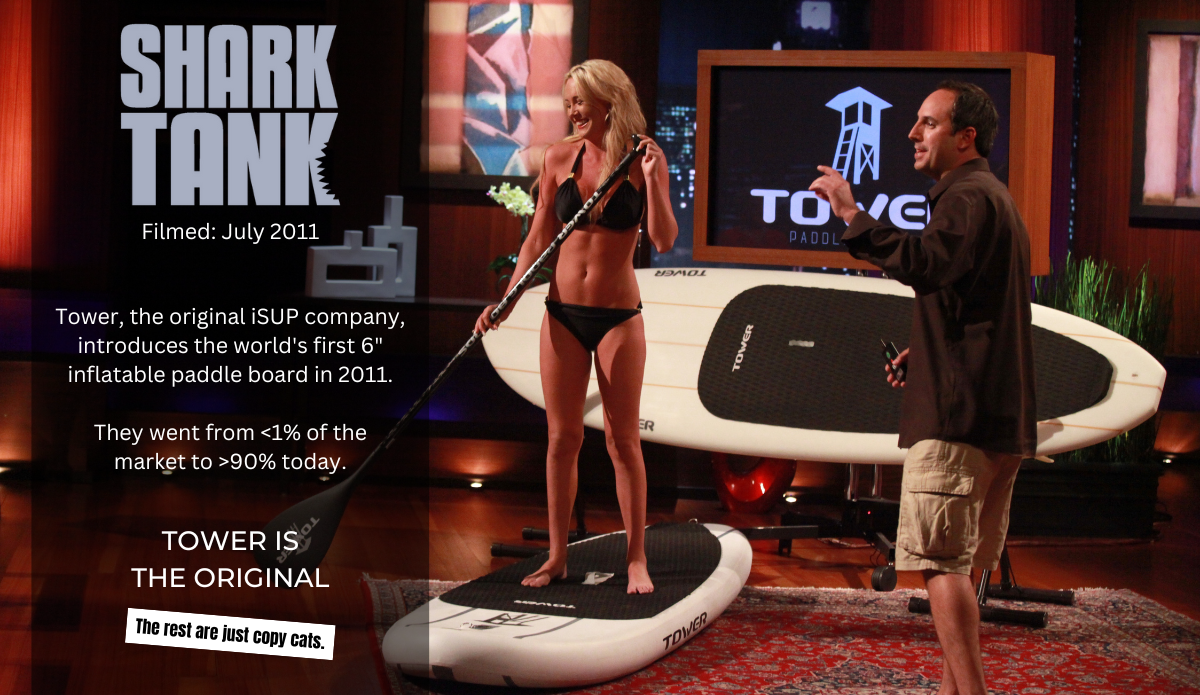
In 2011, a producer from a TV show called Shark Tank (that I’d never heard of at the time) called us out of the blue and asked us to come pitch the investors on their show. I say “us” because I had just hired my first employee 3 weeks earlier. Shark Tank found us with a Google search (because we were good at SEO). They were intrigued by our direct to consumer model and great prices, and assumed we were a top brand in the industry.
We had $35,000 in lifetime sales at the time of the call. Five weeks later, we introduced the world’s first 6” thick inflatable paddle board during our pitch to the sharks. Our sales had grown to $100,000 in those five weeks. My pitch started pretty awful and most the sharks dropped out right away, but I made a bit of a comeback in the Q&A round. Mark Cuban invested $150,000 and we used his investment to do our first production run of inflatable paddle boards.
The problem with the SUP industry at the time was paddle boards were 12’ long and 3’ wide. They were massive. They had to be shipped via expensive freight, and they frequently got damaged in transit. It was, quite frankly, a horrible direct to consumer business.
More critically, these massive paddle boards didn’t work for anyone living in an apartment as the only place to store them was the living room, a garage, or a massive deck. I knew this because I lived in an apartment and my paddle board lived conspicuously in the living room. This was annoying and severely limited the market.
Inflatable paddle boards (“iSUPs”) and inflatable surfboards had been on the market for about 5 years at the time, but they were only a novelty. iSUPs were all 4” thick and rode like a banana thru the water, slow and springy. They were awful. Inflatable surfboards were even thinner. They were made this way because all the people making them came from the surf industry where surfboards are 2-3” thick and paddle boards were maybe 4” thick. That’s how it had always been done.
I was intrigued by the inflatable SUPs. Like my poker chips, iSUPs were relatively compact when deflated (36” x 12”), so they were a much better fit for my direct to consumer business model. You could ship them in a UPS box & they were basically indestructible. More critically, they could fit in a closet, or a car trunk, or be checked as baggage on a plane. So we set out to fix iSUPs in a bid to fix our business. We experimented with 6” thick iSUPs and 8” thick ones. It worked. By doubling the thickness, the rigidity of inflatable paddle boards increased by 800%. It was an exponential effect. Even the 6” thick ones were 325% more rigid than 4” thick ones.
The rigidity solved the performance issue iSUPs had. They were virtually as good as hard boards. More critically, they were better because you couldn’t damage them as easily and they could be stored anywhere and transported easily.
At the time of our 2011 introduction of the 6” thick iSUP on Shark Tank, inflatable paddle boards represented less than 1% of the overall paddle board market. Within 5 years, the market would be transformed, and inflatable SUPs would represent over 70% of all paddle boards sold. Today, that number is over 90%.
|
|
Tower to the Moon
Tower took off like a rocket ship starting in 2011. In a period of 4 years, we would grow annual sales from $265,000 in 2011 to $7.5M in 2015, a growth of over 2700%. We achieved this without spending a dime on advertising. All the savings of cutting the middlemen out was passed on to consumers.
Here’s a timeline of notable events in the rise of Tower:
2012 - Our 2011 pitch airs on ABC's Shark Tank in March and we get a $150,000 investment from Mark Cuban.
2016 - We’re named one of the top five SUP brands in the world, Amazon founder Jeff Bezos name-drops us in his annual letter to stockholders, and the Harvard Business Review publishes a case study on our business.
2017 - The prestigious Robb Report names our 6” thick Chris Craft iSUP (selling for $699 at the time) the #1 best SUP worldwide over $2,400 and $3,400 competitor SUPs. We were also named to Internet Retailer’s “Hot 100” list of the World’s Most Innovative Retailers.
The success of our direct to consumer business model and our innovative 6” thick iSUPs was a very public one. Once we did $375,000 of paddle board sales in a day through an Amazon daily deal, and a short while later there would be an article in a major eCommerce magazine about how we did it. Word spread quickly.
A lot of other paddle board brands took notice. Others noticed and ventured to start new paddle board brands. It took them all a few years to clue into the power of our direct to consumer model. It took them a few more years to clue into how our 6” thick inflatable SUPs entirely disrupted the paddle board industry. They eventually clued in. As always happens, other brands all eventually caught on and copied our innovations. Nothing was really patentable, after all. But make no mistake; Tower was the ORIGINAL paddle board company when it comes to the modern inflatable paddle board. Nobody, no brand, and no copycats, can deny that.
Today, you can either buy a Tower inflatable paddle board, an original, or you can buy a copycat. It’s as simple as that.
|
|
Elite Series
from $649
800% More Rigid
3-Year Warranty
Max Weight Bearing
|
Premium Series
from $449
325% More Rigid
2-Year Warranty
Industry Leading
|
Starter Series
from $349
250% More Rigid
1-Year Warranty
For Beginners
|
|
|
The Five Hour Workday
In the summer of 2015, while we were shaking up the paddle board market, we set our sights on doing something more impactful in the world. The year prior, we were on pace to do $5M in revenues with a staff of 5. Our growth ascent was empowered by a very sharp and highly productive team of individuals with no experience and mostly just out of college.
We were a surf company that no one really took seriously, and frankly a lot of the audience was shocked when they counted down to naming us as the #1 fastest growing private company in San Diego at the award ceremony. No one really got what we were doing to grow so fast. As a beach lifestyle company, we were a work hard, play hard team, of course. But we felt there was more to it than that. We felt the world had kind of changed. We had realized a lot of our success by automating much of our operations. We wanted to test the limits of what we’d uncovered.
We decided to do a workplace experiment – one to potentially disrupt what had not changed much since the Industrial Revolution nearly 100 years prior. We wanted to experiment with changing the 8-hour workday.
I informed everyone we were going to switch to a five hour workday from 8am to 1pm straight through, no lunch, five days a week. It was going to be a summer experiment for 3 months and we’d roll back to normal hours in the fall. At 1pm we’d be done for the day. I also informed everyone that they would be expected to be as productive, or more productive, than they were currently (on our 9-5 workday). If they couldn’t figure out how to do that, they’d be fired. It was a renegotiation of sorts. I’d give them their lives back in the form of walking out of work at 1pm every day, but they’d have to be give me a highly efficient and productive work effort. There were no rules other than that.
Our revenues increased 50% that year and our productivity didn’t really fall off at all. The experiment worked quite well. It worked so well that in the fall we decided to keep it going and we did it full time for the next 2 years straight.
Word got out about our little experiment, and people really seemed to resonate with it. There was this sense that everyone had that the long days in the office were largely a farce wasting both their and their employer’s time. But no one was saying anything about it.
I had written a few articles on what we were doing and they really spread like wildfire. As a result, I decided to write a book on our experiment. It was titled “ The Five Hour Workday”. The book published in the fall of 2016 and the concept of our five hour workday almost immediately went viral. I did well over 100 interviews. A wide swath of major media channels covered it. It garnered press in over 20 countries. At the time, we conservatively estimated word spread to over 10 million people worldwide. One Huffington Post interview garnered over 4 million views alone.
Over time, other companies followed our lead and did their own workplace experiments. A shorter workday movement of sorts started to rise. It wasn’t all at once, but it percolated for years. Three years later, in 2019, the Wall Street Journal and the New York Times both wrote articles on the Five Hour Workday concept. When the pandemic of 2020 hit and people began working from home, another round of media resurfaced the concept and follow on conversations about the nature of how, where, and how long we work. It’s still an evolving landscape, which we played a small role in.
|
|
The Road Ahead
Today we've diversified online into electric beach cruisers, skateboards, surfboards, and more. Offline, we've built out a waterfront event venue on the beach in San Diego that we call the Tower Beach Club. We office out of the back of the beach club, and host all kinds of special events, intimate concerts, and weddings.
That's the story of Tower. Thanks for reading and as always we appreciate you sending your friends and family our way!
|
|
The ORIGINAL Paddle Board Co.
Tower is the original inflatable stand-up paddle board brand. We've been doing this a long time. That's why we can confidently offer our satisfaction guarantee:
|
|
|
|
|