Vitamin C shouldn’t be the thing you only reach for when you’re getting sick. That would be selling it extraordinarily short.
Vitamin C is required for collagen synthesis. And collagen isn’t just for healthy-looking skin. It’s structural. It’s in your tendons, your cartilage, and even your blood vessel walls.
Every rep you do in the gym is building collagen. Every recovery window depends on it.
And that’s just scratching the surface. Vitamin C also:
- Supports neurotransmitter synthesis (serotonin, carnitine production, etc.)
- Is a potent antioxidant that protects mitochondria from oxidative stress
- Dramatically enhances non-heme iron absorption
- Is required for healthy cortisol production and adrenal function
And yet, despite being one of the most commonly taken supplements, 42% of Americans have low vitamin C levels.
It’s in almost everyone’s supplement drawer, so how can that be?
The truth is, most large doses of vitamin C end up as expensive urine.
This is because your gut has a hard absorption ceiling for standard ascorbic acid, the form of vitamin C found in 95% of supplements (check yours… it's probably what you're taking).
But past a certain threshold, absorption plummets, and the excess is simply excreted in urine.
This is why mega-dosing vitamin C in ascorbic acid form is largely a waste of money, and for many people, it causes digestive issues, too.
The second problem is what I call the cofactor problem.
In nature, vitamin C never shows up alone.
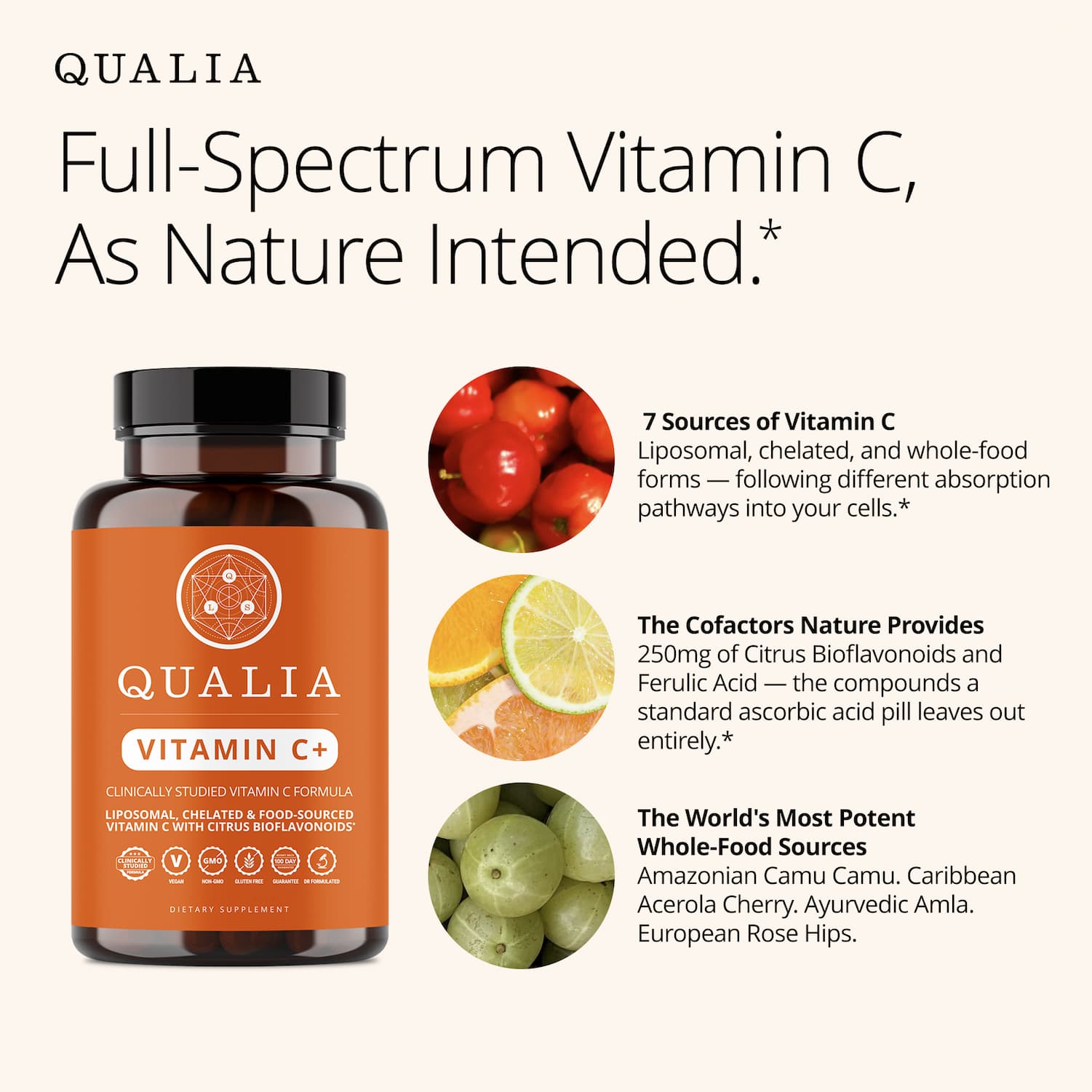
Every real food source (citrus, camu camu, acerola cherry, and rose hip) delivers vitamin C embedded in a matrix of bioflavonoids and plant compounds that tell your body how to absorb, retain, and use it.
Isolated ascorbic acid strips all of that away, so you lose a significant portion of the biological context that makes vitamin C effective.
The team at Qualia, whom I've come to trust as some of the most rigorous formulators in the supplement industry, just rebuilt vitamin C supplementation from scratch to solve both of these problems.